Technique 15 of 31
The Leadership Triangle
Assess people’s unwavering willingness to follow you, even to the ends of the earth.
- Followership
- Leadership Effectiveness
- Influence
In short
The Leadership Triangle shows why people follow you and how far they would go. Rate yourself from 1 to 10 on personality, vision and circumstance, plot the three ratings as a triangle, and read its size and shape to see how strongly you hold your followers and which dimension to develop.
For: Leaders, especially during Agile transformations
The Problem
Leadership is often defined in many ways, but at its core, it’s about earning trust, engaging people, and inspiring them toward a vision.1 In Agile transformations, leaders must navigate change while answering two key questions: “Why do people follow me?” and “How far would they go with me?” Without clarity, trust weakens, engagement drops, and resistance grows.2
The Experiment
Working closely with leadership teams, I developed the Leadership Triangle—a structured way to assess and strengthen influence. By helping leaders identify what attracts followers, sustains commitment, and defines their leadership limits, this framework enables them to foster genuine, lasting followership.3
What Factors Inspire Followership?
The Leadership Triangle explores three primary factors that influence why individuals choose to follow their leaders.4
Personality
The first factor centers around the leader’s personality—the essence of “who they are.” This encompasses their knowledge, skills, talents, strengths, charisma, and other distinctive qualities.5
Vision
The second factor revolves around the leader’s vision—the compelling destination they aspire to reach. It entails the direction they aim to steer their followers, the goals they set forth, and the overarching purpose that resonates with their team.6
Circumstance
The third factor is circumstance, which emerges when team members recognize limited organizational alternatives or find themselves influenced by interdependencies and accountability.7 In such cases, individuals may align with leadership based on structural necessities, even if their motivation stems from organizational dynamics rather than intrinsic inspiration.8

What Does the Leadership Triangle Signify?
The Leadership Triangle serves as a visual representation of your power. Here’s how to utilize it effectively:
Step 1: Evaluate each dimension.
Assess your standing on the three key dimensions—personality, vision, and circumstance. Rate yourself on a scale of 1 to 10, indicating your level of strength in each area:
| Dimension | Rating |
|---|---|
| 1. Personality: People follow me because of what I am. Consider factors such as your knowledge, experience, talent, charisma, and character. | 4 |
| 2. Vision: People follow me because of the vision I have. Reflect on the direction you’re heading and the goals you have set. | 7 |
| 3. Circumstance: People follow me by necessity. Evaluate the extent to which individuals depend on your position or available options. | 3 |
Step 2: Create your Leadership Triangle.
Using the ratings from Step 1, construct your own Leadership Triangle. Here’s an example, where the ratings for the three dimensions are as follows: personality—4, vision—7, circumstance—3.
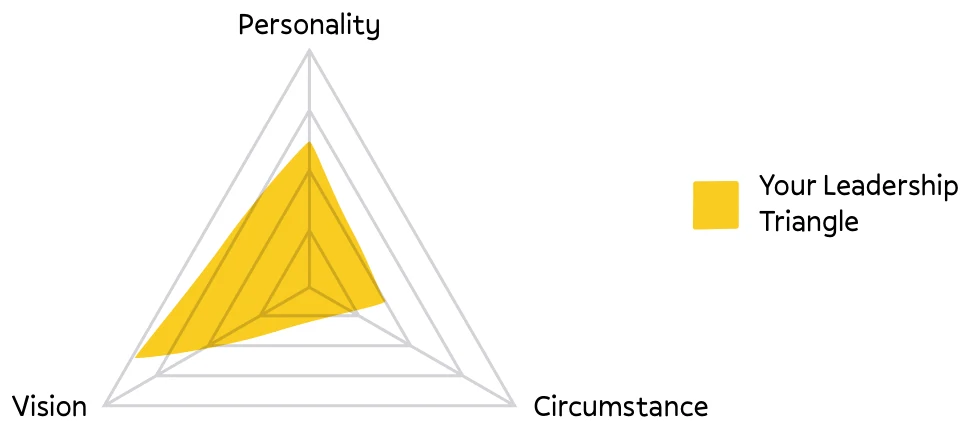
How Far Would They Follow Your Lead?
If we imagine you as a leader being a magnet and your followers as steel shavings, the Leadership Triangle becomes a valuable tool for assessing your ability to attract and retain your supporters, even when faced with the presence of new magnets.9 This assessment holds particular significance when it originates from your followers themselves, as it reveals insightful information and highlights potential gaps within the triangles. Consider the following guidelines for interpreting your Leadership Triangle:
The Size of Your Triangle
The size of your Leadership Triangle directly correlates with your ability to retain followers. A larger triangle signifies a stronger hold over your supporters.10 It demands your continuous dedication and daily efforts to expand (or sustain) your influence.
Focus on All Dimensions
Within the Leadership Triangle, no dimension is inherently negative or unfavorable, including circumstance. It is essential to strive for growth in each dimension rather than neglect or disregard any of them.11 For instance, understanding circumstances can establish the credibility of your position within a specific organizational role, strengthening your magnetic appeal as a leader. There is merit in each dimension.
Emphasize and Develop Dimensions
When followers primarily align with personality, irrespective of the vision, they become similar to sheep blindly following their shepherd, potentially venturing toward dangerous outcomes.12 My observations indicate that many individuals fall into this pattern. The same holds true for circumstance, as people may choose leaders driven by fear or the lack of superior alternatives. Each dimension holds significance, and as leaders, we must encourage our followers to be thoughtful and demanding, particularly regarding the vision.13
References
- J. M. Kouzes and B. Z. Posner, The Leadership Challenge: How to Make Extraordinary Things Happen in Organizations, 6th ed. (Wiley, 2017).
- J. P. Kotter, Leading Change (Harvard Business Review Press, 2012).
- B. Kellerman, Followership: How Followers Are Creating Change and Changing Leaders (Harvard Business School Press, 2008).
- E. P. Hollander, “Leadership, Followership, Self, and Others,” The Leadership Quarterly 3, no. 1 (1992): 43–54.
- T. A. Judge, J. E. Bono, R. Ilies, and M. W. Gerhardt, “Personality and Leadership: A Qualitative and Quantitative Review,” Journal of Applied Psychology 87, no. 4 (2002): 765–80.
- W. Bennis and B. Nanus, Leaders: Strategies for Taking Charge, 2nd ed. (HarperBusiness, 2007).
- J. Pfeffer, Power in Organizations (Ballinger Publishing Company, 1981).
- J. R. French and B. Raven, “The Bases of Social Power,” in Studies in Social Power, ed. D. Cartwright (University of Michigan Press, 1959).
- R. E. Kelley, The Power of Followership: How to Create Leaders People Want to Follow and Followers Who Lead Themselves (Doubleday, 1992).
- G. Yukl, Leadership in Organizations, 8th ed. (Pearson, 2012).
- J. P. Howell and D. L. Costley, Understanding Behaviors for Effective Leadership, 2nd ed. (Pearson Prentice Hall, 2006).
- I. Chaleff, The Courageous Follower: Standing Up to and for Our Leaders, 3rd ed. (Berrett-Koehler Publishers, 2009).
- R. A. Heifetz and M. Linsky, Leadership on the Line: Staying Alive Through the Dangers of Leading (Harvard Business School Press, 2002).
From Never Stop Experimenting by Stavros Stavru, PhD, illustrated by Iva Grueva. Published here in full on .
How to cite this technique
Stavru, S. (2025). The Leadership Triangle. In Never Stop Experimenting: 31 Real-World Experiments for Continuous Growth in Work and Life. Morgan James Publishing. https://neverstopexperimenting.com/techniques/leadership-triangle
Related techniques

08 · Leadership & teams
The Team Strategy Matrix
Uncover the best way to manage your team.

09 · Leadership & teams
The Manager’s Dilemma
When given the choice, do you favor individual superstars or a cohesive super team?
10 · Leadership & teams
The Care Meter
Gauge your adequacy in providing care for others.

11 · Leadership & teams
The Fitness Radar
Assess whether the person you care for is in the right place.

12 · Leadership & teams
The Functional Domino
Determine the best-suited role for each person in your organization.
13 · Leadership & teams
The Conflicts Strainer
Identify and prioritize conflicts that truly require attention.
One new experiment, now and then
New techniques, real-world results and behind-the-scenes stories from Stavros. No spam; unsubscribe anytime.