Technique 10 of 31
The Care Meter
Gauge your adequacy in providing care for others.
- Leadership
- People Management
- Support
In short
The Care Meter helps people managers give the right amount of care, neither too little nor too much. Care is organized in a Care Pyramid of Fitness, Direction, Results, Growth and Morale. Set a weekly threshold per person (six hours), track the time you actually spend, and divide to get a care coefficient; close to 1 is healthy.
For: People managers and team leads
The Problem
As an organizational trainer and consultant, I’ve always seen people management as an expression of care. But I kept wondering: What does it truly mean to care? And how do we balance care—offering enough support without fostering dependency or burnout? Too little leads to disengagement; too much can overwhelm both giver and receiver.1
The Experiment
Working alongside people managers, I developed the Care Meter—a structured way to assess and regulate care levels. At its core is the Care Pyramid, which organizes care into five key dimensions—Fitness, Direction, Results, Growth, and Morale—ensuring a balanced approach. By applying this tool, the people managers gained clarity on how to offer meaningful support without unintended consequences.
What Are the Particular Areas in Which People Require Care?
Through my experience working with various teams and organizations, I have identified five significant challenges related to individual personalities and their well-being. Recognizing that certain issues carry more weight and require attention before others can be effectively addressed, I developed the concept of the Care Pyramid.
This pyramid structure highlights the prioritization of care dimensions, ensuring a sustainable and comprehensive approach to individual support.
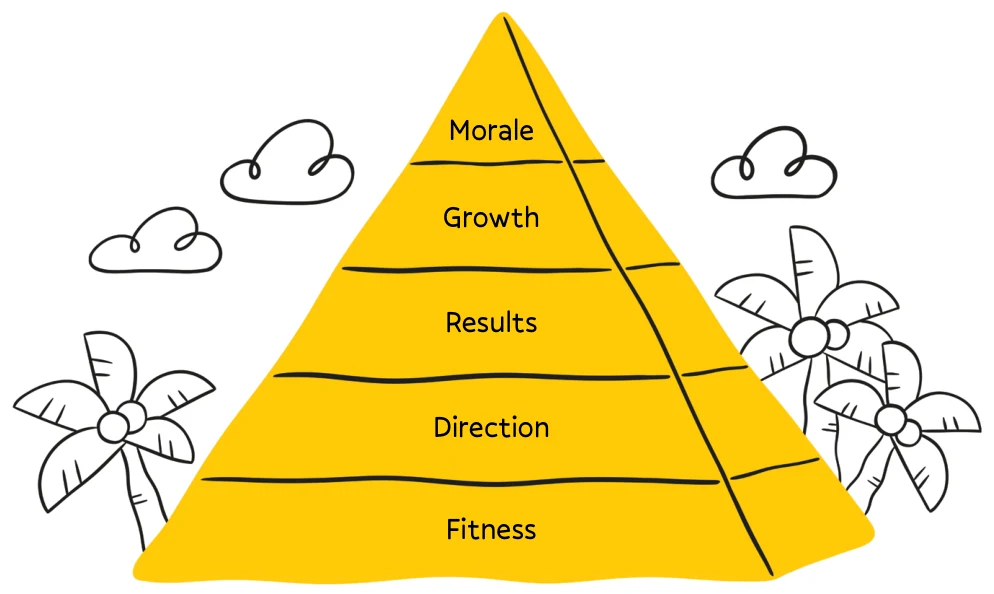
Fitness
At the base of the pyramid lies the most critical dimension: Fitness. This dimension focuses on helping individuals find their rightful place within our team and organization. By achieving a strong alignment of values, beliefs, and overall worldview between the person and their leader, team, and organizational context, we create an environment where they can thrive (Person–Environment Fit).2
Direction
Moving up the pyramid, we reach the dimension of Direction. Caring for others entails consistently providing them with contextual understanding. This includes communicating the big picture, defining vision, discussing strategies, setting goals, and establishing success criteria.3 By offering comprehensive guidance and clarity, we empower individuals to make informed decisions and meaningful contributions.
Results
Results occupy the next level of the pyramid. Here, our responsibility is to support others in maximizing the positive impact of their work while minimizing negative outcomes. This can involve providing specific guidance, offering a supportive presence, and ensuring that individuals feel empowered to achieve tangible results.4
Growth
Ascending further, we reach the dimension of Growth. Caring for others necessitates unlocking their full potential and supporting their continuous development. This can take the form of training, mentorship, constructive feedback, and other means to foster competence and personal growth.5
Morale
At the pinnacle of the pyramid lies Morale—a culmination of motivation, engagement, loyalty, and satisfaction. By actively managing these essential aspects, we create an environment that nurtures individual well-being and fosters a positive and fulfilling experience.6
Understanding the interconnectedness of these dimensions within the Care Pyramid allows us to recognize the significance of each level.
- A high level of morale is of little benefit if competence is lacking.7
- Achieving excellent results without alignment with the right goals or a sense of meaning can lead to dissatisfaction.8
With the Care Pyramid as our guide, we prioritize our efforts, ensuring a holistic and progressive approach from Fitness to Morale.
How Much Care Should I Give to Others?
The concept of the Care Meter revolves around the idea that there exists an ideal amount of time we should dedicate to caring for others, irrespective of factors such as their performance, our affinity toward them, or their current state of well-being.9
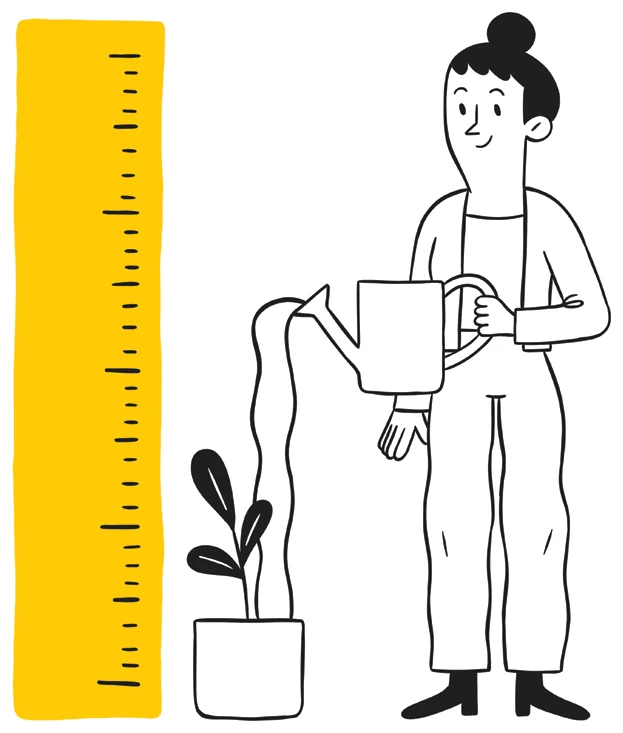
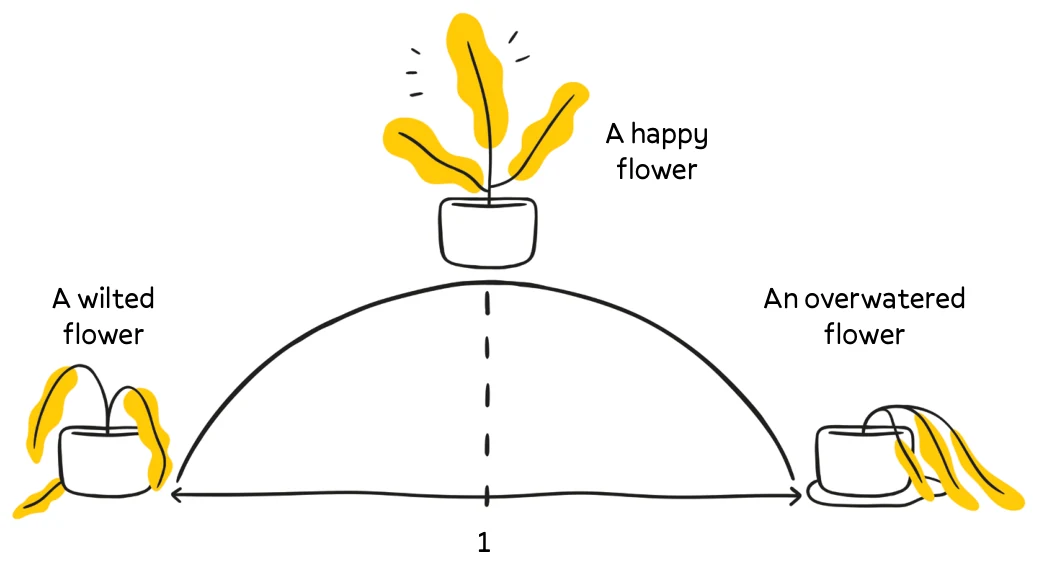
Much like watering a flower, optimal care requires finding a delicate balance.
Just as a flower wilts without water, neglecting care can lead to the deterioration of relationships.10
Conversely, excessive care can overwhelm and hinder growth.
The Care Meter acts as a guiding tool to help us strike that healthy equilibrium.
- Define the threshold for healthy care (in hours per week). Drawing from my experience, I have utilized the insights from the Leadership IQ survey. It suggests that an ideal time for a leader to spend with their subordinate is six hours per week.11 However, I expand the interpretation to encompass not only direct interaction but also the time spent contemplating and reflecting on the well-being of others.
- Multiply the healthy care threshold by the number of individuals you care for. This calculation determines the total time you should allocate for caring. Based on the aforementioned survey and Step 1, we can ascertain that dedicating 40 hours a week would adequately cater to no more than six individuals (assuming this is the sole focus).
- Evaluate the time allocated to each activity in the Care Pyramid. At the end of the week, assess the time devoted to each activity within the Care Pyramid. This assessment ensures a comprehensive evaluation and helps identify any potential areas of neglect.
- Calculate the cumulative time spent caring for others. Aggregate the time spent across all activities in the Care Pyramid.
- Determine your healthy care coefficient for others. Divide the value obtained in Step 4 by the figure from Step 2.
Ideally, a coefficient close to 1 signifies a healthy balance. If the value is less than 1, consider whether additional time should be allocated to caring for others. Conversely, if the coefficient surpasses 1, reflect on whether you might be providing excessive care.
References
- A. B. Bakker and E. Demerouti, “The Job Demands-Resources Model: State of the Art,” Journal of Managerial Psychology 22, no. 3 (2007): 309–28.
- A. L. Kristof-Brown, R. D. Zimmerman, and E. C. Johnson, “Consequences of Individuals’ Fit at Work: A Meta-Analysis of Person–Job, Person–Organization, Person–Group, and Person–Supervisor Fit,” Personnel Psychology 58, no. 2 (2005): 281–42.
- B. M. Bass, “From Transactional to Transformational Leadership: Learning to Share the Vision,” Organizational Dynamics 18, no. 3 (1990): 19–31.
- A. Wrzesniewski and J. E. Dutton, “Crafting a Job: Revisioning Employees as Active Crafters of Their Work,” Academy of Management Review 26, no. 2 (2001): 179–201.
- M. London and J. W. Smither, “Empowered Self-Development and Continuous Learning,” Human Resource Management 38, no. 1 (1999): 3–15.
- J. K. Harter, F. L. Schmidt, and T. L. Hayes, “Business-Unit-Level Relationship Between Employee Satisfaction, Employee Engagement, and Business Outcomes: A Meta-Analysis,” Journal of Applied Psychology 87, no. 2 (2002): 268–79.
- R. E. Boyatzis, “Competencies in the 21st Century,” Journal of Management Development 27, no. 1 (2008): 5–12.
- J. R. Hackman and G. R. Oldham, “Motivation Through the Design of Work: Test of a Theory,” Organizational Behavior and Human Performance 16, no. 2 (1976): 250–79.
- D. Van Dierendonck, “Servant Leadership: A Review and Synthesis,” Journal of Management 37, no. 4 (2011): 1228–61.
- J. E. Dutton and E. D. Heaphy, “The Power of High-Quality Connections,” Positive Organizational Scholarship: Foundations of a New Discipline 3 (2003): 263–78.
- M. Murphy, Optimal Hours with the Boss (Leadership IQ, 2014).
From Never Stop Experimenting by Stavros Stavru, PhD, illustrated by Iva Grueva. Published here in full on .
How to cite this technique
Stavru, S. (2025). The Care Meter. In Never Stop Experimenting: 31 Real-World Experiments for Continuous Growth in Work and Life. Morgan James Publishing. https://neverstopexperimenting.com/techniques/care-meter
Related techniques
08 · Leadership & teams
The Team Strategy Matrix
Uncover the best way to manage your team.
09 · Leadership & teams
The Manager’s Dilemma
When given the choice, do you favor individual superstars or a cohesive super team?

11 · Leadership & teams
The Fitness Radar
Assess whether the person you care for is in the right place.

12 · Leadership & teams
The Functional Domino
Determine the best-suited role for each person in your organization.
13 · Leadership & teams
The Conflicts Strainer
Identify and prioritize conflicts that truly require attention.
14 · Leadership & teams
The Power Circles
Master the art of effectively blending various forms of power.
One new experiment, now and then
New techniques, real-world results and behind-the-scenes stories from Stavros. No spam; unsubscribe anytime.