Technique 14 of 31
The Power Circles
Master the art of effectively blending various forms of power.
- Influence
- Leadership Style
- Team Dynamics
In short
Power Circles map how a person uses power by splitting 100% among aggressive, cooperative and manipulative power, drawn as three concentric rings. Gather ratings from subordinates and peers, average them, then build a Power Map of your team to remind you which power style to use with each person.
For: Leaders and managers of teams
The Problem
We all influence our surroundings, especially through interactions. But effectiveness isn’t just about our preferred approach—it also depends on how others respond.1 When these don’t align, frustration follows. What works in one situation can fail in another, making consistent impact challenging.
The Experiment
Exploring influence dynamics with teams and leaders, I refined the Power Circles—a tool that helps individuals visualize influence preferences and adjust their power style accordingly. Rather than relying on a single approach, this framework allows for adaptability, making influence more precise and effective across different contexts.of power manifestations that ensures the highest level of effectiveness within a given context.
What Are the Three Distinct Forms of Power?
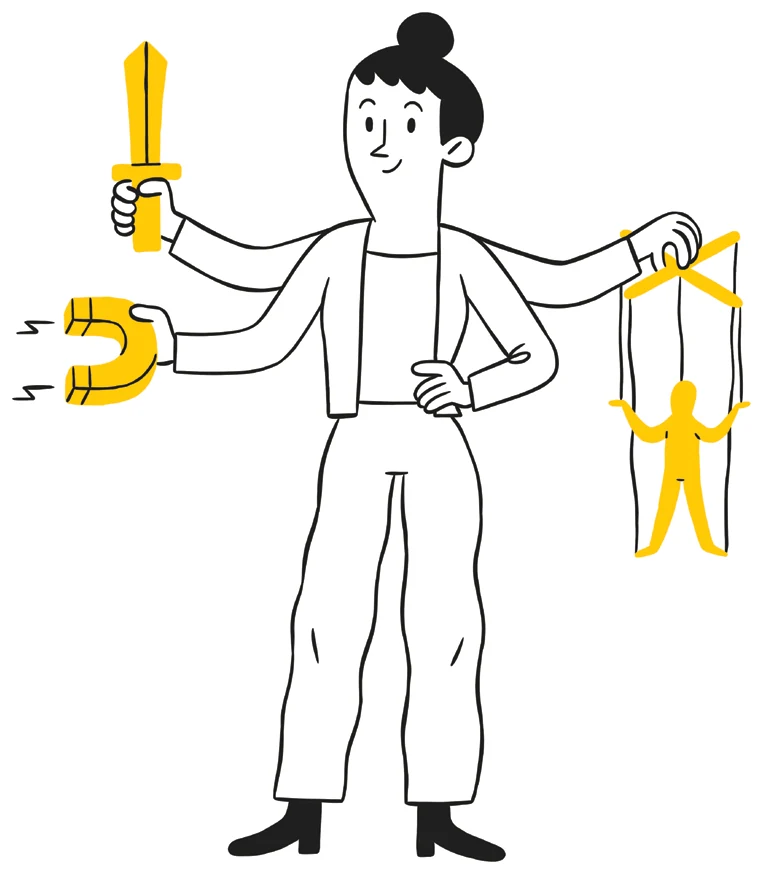
Power can manifest in various forms, such as expertise, position, charisma, and more.2 These facets determine the extent and nature of our influence within an organization. However, Power Circles transcend these specific aspects and primarily focus on how power is demonstrated, often referred to as leadership style.3
Within the Power Circles framework, three distinct manifestations of power are explored:
- Aggressive power, which relies on forceful imposition, often without the voluntary consent of others. It involves asserting one’s position through dominance and coercion.4
- Cooperative power, which emphasizes persuasion and the ability to win others over, gaining their voluntary support and alignment. It fosters collaboration and seeks consensus.5
- Manipulative power, which involves influencing others through deceptive tactics. It may involve subtle manipulation to achieve desired outcomes.6
How Is Power Mapped?
To gauge the distribution of these power manifestations, an important question is posed:
When assessing your interactions with person X and the impact they have on you, how would you allocate 100% among aggressive, cooperative, and manipulative power?
The response to this question is visually represented through the Power Circles. The person’s name is placed at the center, and three concentric circles correspond to the percentages assigned to each manifestation.7 The thickness of the circles represents the respective percentage, while the color distinguishes the type of power manifestation.
This example provides the answer for Ben.
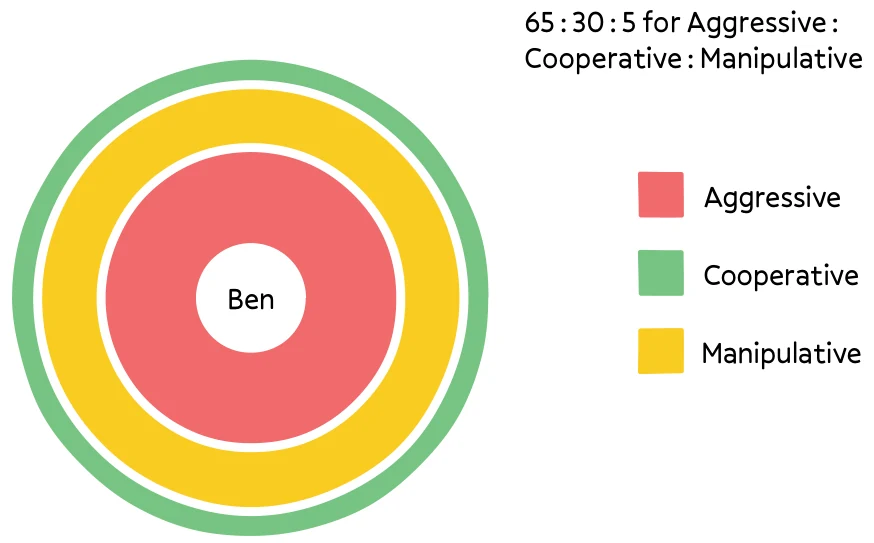
In order to capture a comprehensive perspective, it is recommended, based on my experience, to gather input from as many subordinates and peers as possible. The average Power Circles can then be synthesized, offering a holistic understanding of a person’s power dynamics.8
What Does “Reflective Use of Power” Mean?
The concept of “reflective use of power” in the context of Power Circles emphasizes that effectiveness in leadership often requires us to align our power expression with how those affected would employ power themselves.9 While many of us naturally gravitate toward cooperative approaches, effective governance sometimes demands adapting to styles that may feel uncomfortable to us personally.10 This approach recognizes that different individuals operate within their own deeply ingrained power frameworks—some respond primarily to direct, aggressive approaches, while others connect better with cooperative or even subtle, manipulative tactics.11
Just as we adjust our communication style to build rapport with different personalities, reflective use of power suggests that matching someone’s preferred power style can create the most effective path to mutual understanding and goal achievement.12 This may require us to step outside our comfort zone, particularly when dealing with those who primarily respond to aggressive or manipulative power expressions. While this can create internal tension for leaders who prefer cooperative approaches, the ability to flexibly adapt our power style—even temporarily—often proves crucial for team and organizational effectiveness.13
This understanding challenges the notion that aggression and manipulation are universally inappropriate and is against my own leadership preferences, but my experience has shown that they can be remarkably effective in certain contexts.14 The key lies in recognizing that we’re not abandoning our core values, but rather speaking the “power language” that others best understand, much like using a translator to bridge a communication gap.
How to Use a Power Map?
To aid in managing interactions with different individuals, such as when leading a team, I create a Power Map. This visual representation serves as a reminder of how I should engage with each person based on their preferred style of power.
Here is a sample power map for reference.
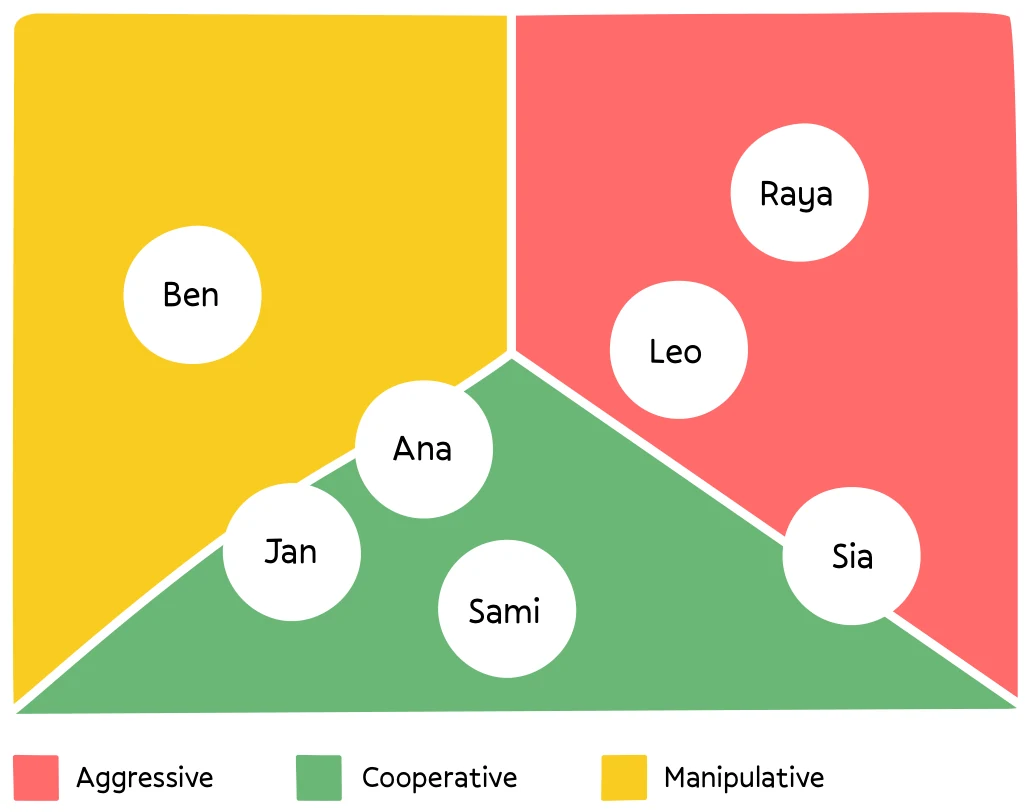
The example Power Map showcases specific approaches for interacting with different individuals. It suggests employing a more manipulative approach with Ben; adopting a cooperative stance with Ana, Jan, and Sami; and demonstrating aggression with Leo, Raya, and Sia.
References
- G. Yukl and C. M. Falbe, “Influence Tactics and Objectives in Upward, Downward, and Lateral Influence Attempts,” Journal of Applied Psychology 75, no. 2 (1990): 132–40.
- J. R. P. French and B. Raven, “The Bases of Social Power,” in Studies in Social Power, ed. D. Cartwright (University of Michigan Press, 1959), 150–67.
- D. Goleman, “Leadership that Gets Results,” Harvard Business Review 78, no. 2 (2000): 78–90.
- D. Kipnis, S. M. Schmidt, and I. Wilkinson, “Intraorganizational Influence Tactics: Explorations in Getting One’s Way,” Journal of Applied Psychology 65, no. 4 (1980): 440–52.
- T. R. Tyler, “The Psychology of Cooperation: Implications for Public Policy,” in Social Psychology and Politics, ed. J. P. Forgas, K. Fiedler, and W. D. Crano (Psychology Press, 2015), 81-99.
- R. Hogan and J. Hogan, Dark Side of Leadership (Hogan Assessment Systems, 1997).
- E. R. Tufte, The Visual Display of Quantitative Information, 2nd ed. (Graphics Press, 2001).
- D. A. Waldman, G. G. Ramirez, R. J. House, and P. Puranam, “Does Leadership Matter? CEO Leadership Attributes and Profitability Under Conditions of Perceived Environmental Uncertainty,” Academy of Management Journal 44, no. 1 (2001): 134-143.
- D. A. Schön, The Reflective Practitioner: How Professionals Think in Action (Basic Books, 1983).
- R. E. Kaplan and R. B. Kaiser, “Developing Versatile Leadership,” MIT Sloan Management Review 44, no. 4 (2003): 19-26.
- D. Keltner, D. H. Gruenfeld, and C. Anderson, “Power, Approach, and Inhibition,” Psychological Review 110, no. 2 (2003): 265–84.
- H. Giles, J. Coupland, and N. Coupland, Contexts of Accommodation: Developments in Applied Sociolinguistics (Cambridge University Press, 1991).
- L. Gratton and T. J. Erickson, “Eight Ways to Build Collaborative Teams,” Harvard Business Review 85, no. 11 (2007): 100-109.
- J. Pfeffer, Power: Why Some People Have It and Others Don’t (HarperBusiness, 2010).
From Never Stop Experimenting by Stavros Stavru, PhD, illustrated by Iva Grueva. Published here in full on .
How to cite this technique
Stavru, S. (2025). The Power Circles. In Never Stop Experimenting: 31 Real-World Experiments for Continuous Growth in Work and Life. Morgan James Publishing. https://neverstopexperimenting.com/techniques/power-circles
Related techniques
08 · Leadership & teams
The Team Strategy Matrix
Uncover the best way to manage your team.
09 · Leadership & teams
The Manager’s Dilemma
When given the choice, do you favor individual superstars or a cohesive super team?
10 · Leadership & teams
The Care Meter
Gauge your adequacy in providing care for others.
11 · Leadership & teams
The Fitness Radar
Assess whether the person you care for is in the right place.
12 · Leadership & teams
The Functional Domino
Determine the best-suited role for each person in your organization.
13 · Leadership & teams
The Conflicts Strainer
Identify and prioritize conflicts that truly require attention.
One new experiment, now and then
New techniques, real-world results and behind-the-scenes stories from Stavros. No spam; unsubscribe anytime.