Technique 8 of 31
The Team Strategy Matrix
Uncover the best way to manage your team.
- Team Dynamics
- Collaboration Approach
- Management Strategy
In short
The Team Strategy Matrix checks whether a team's management strategy fits the team. It places the team on two dimensions, how much members depend on each other for their goals and how different their goals are, and points to one of four strategies: partnership, teamwork, support or competition, each with what the leader should focus on.
For: Team leads and managers
The Problem
Teams are essential for collaboration and success, but they can also become inefficient or frustrating when mismanaged.1 Many challenges stem from a mismatch between a team’s characteristics and the management strategy applied.2 When these don’t align, teams can feel ineffective or even like barriers to success.
The Experiment
Together with teams and leaders, I developed the Team Strategy Matrix—a tool designed to assess whether a team’s needs align with its management strategy.3 By mapping key characteristics to strategic approaches, this framework allows leaders to make informed adjustments, ensuring teams remain engaged, effective, and purpose-driven.
How Is the Team Strategy Matrix Structured?
A common understanding of a team often involves two main elements: (1) a shared goal that unifies team members and (2) continuous interaction among them.3 The Team Strategy Matrix expands upon this definition by focusing on two key dimensions: (1) the degree of dependence among team members in relation to their goals and (2) the degree of difference in the goals pursued by team members.4
Based on where a team falls on these dimensions, different management strategies can be employed:5
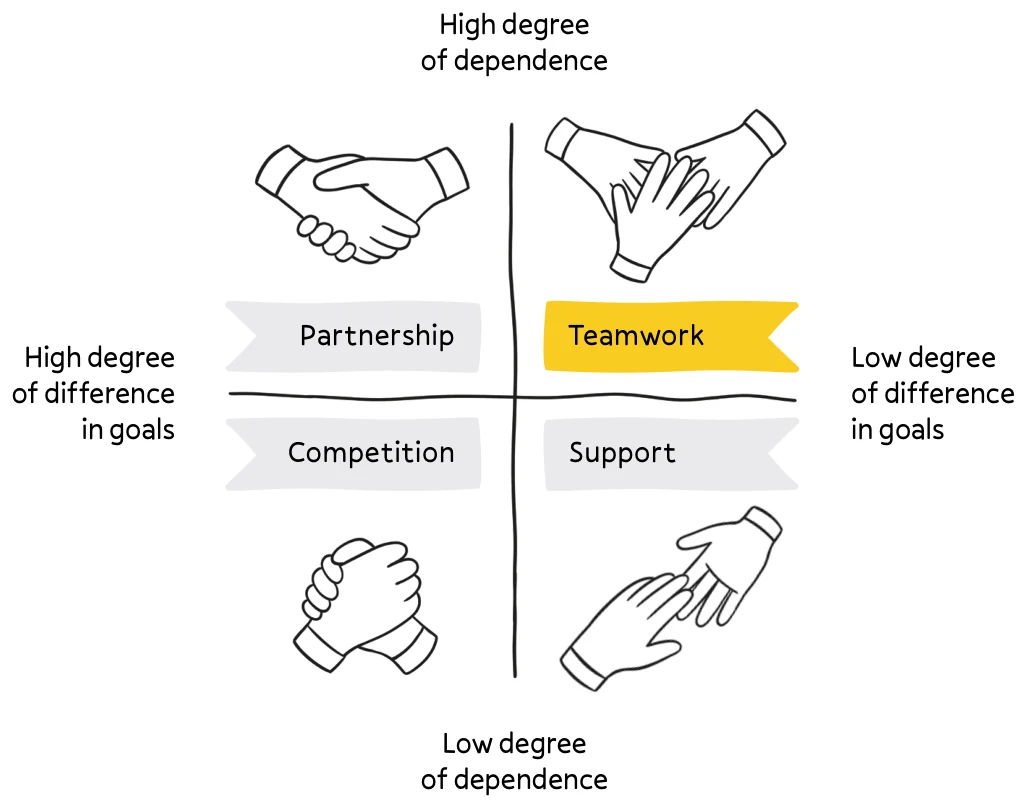
In the matrix, teamwork is highlighted in red. This is not because it is superior or universally preferred, but because it is the default strategy commonly employed in various contexts.6 The red color serves as a reminder to consciously consider alternative strategies and make well-informed decisions, avoiding the pitfalls of trendy traps.
What Are the Various Strategies for Managing Teams?
Partnership

The partnership strategy is suitable when team members have a high degree of dependence but pursue different goals.7
In this context, the team leader should focus on fostering cooperation through structured collaboration processes, building tolerance by promoting mutual understanding, facilitating effective negotiation of competing priorities, and implementing clear conflict resolution mechanisms.8 They must create an environment where conflicting objectives can coexist productively.
An ideal scenario to illustrate this strategy is a technical team where programmers and quality assurance specialists have interdependent but conflicting goals. The programmers’ success is measured by their ability to implement functionality quickly with minimal initial defects, incentivizing rapid delivery and defensive responses to criticism. Meanwhile, quality assurance specialists’ performance is evaluated based on their thoroughness in finding issues and potential problems, encouraging intensive testing and detailed critique. Despite their shared higher-level objective of delivering quality software, these distinct performance metrics create natural tensions that require active management through partnership strategies.
Teamwork

The teamwork strategy is best when team members have a high degree of dependence and share common goals.9
The team leader should focus on building trust through transparent processes and shared accountability, fostering effective communication channels and feedback loops, and ensuring synchronization of efforts through coordinated planning and execution.10 They must create an environment where shared success is clearly defined and collectively pursued.
An ideal scenario to illustrate this strategy is a technical team where programmers and quality assurance specialists work with aligned incentives. Both groups’ success is measured by their collective ability to deliver maximum value to the client—measured through metrics like customer satisfaction, feature adoption rates, and minimal production issues. Programmers focus on developing features that meet customer needs, while QA specialists ensure these features work reliably in real-world scenarios. Their shared performance metrics encourage collaboration, mutual support, and joint problem-solving rather than creating opposing interests.
Support

The support strategy is appropriate when team members have a low degree of dependence but share common goals.11
The team leader should focus on fostering empathy by promoting understanding of shared challenges, encouraging mutual assistance through knowledge sharing and best practice exchange, building a supportive culture where members voluntarily help each other, and facilitating connections between team members despite their independent work.12 They must create an environment where individual autonomy coexists with collective support.
An ideal illustration of this strategy is a global customer service team where representatives work across different time zones, independently handling customer requests. Each agent manages their own queue of tickets or calls, making autonomous decisions about how to resolve issues. While they don’t depend on each other to complete their tasks, they share the common goal of maintaining high customer satisfaction scores for the organization.
Competition

The competition strategy works well when team members have a low degree of dependence and pursue different goals.13
The team leader should focus on nurturing a healthy competitive spirit while preventing destructive rivalry, encouraging knowledge sharing despite competitive dynamics, establishing fair competition rules and metrics, and maintaining a balance between individual achievement and organizational benefit.14 They must create an environment where competition drives excellence without undermining collaboration while ensuring transparency in performance metrics and preventing information hoarding that could harm the organization’s overall success.
An ideal illustration of this strategy is a sales team where representatives operate in different market segments or territories. Each sales rep works independently with their own portfolio of clients and unique sales targets, such as enterprise representatives focusing on large contracts while others target small and mid-sized businesses, or industry specialists pursuing specific sectors while regional reps compete against local competitors. Despite pursuing different individual targets and competing for resources, recognition, and bonuses, successful teams maintain a culture where sharing market intelligence, successful strategies, and solutions to common challenges benefits everyone. This creates a dynamic where individual competition drives performance while knowledge sharing elevates the entire team’s capabilities.
References
- J. R. Hackman, Leading Teams: Setting the Stage for Great Performances (Harvard Business School Press, 2002).
- R. Wageman and F. M. Gordon, “As the Twig Is Bent: How Group Values Shape Emergent Task Interdependence in Groups,” Organization Science 16, no. 6 (2005): 687–700.
- J. R. Katzenbach and D. K. Smith, The Wisdom of Teams: Creating the High-Performance Organization (Harvard Business School Press, 1993).
- J. D. Thompson, Organizations in Action: Social Science Bases of Administrative Theory (McGraw-Hill, 1967).
- K. W. Thomas and R. H. Kilmann, Thomas-Kilmann Conflict Mode Instrument (TKI) (Xicom, 1974).
- A. C. Edmondson, Teaming: How Organizations Learn, Innovate, and Compete in the Knowledge Economy (Jossey-Bass, 2012).
- K. M. Eisenhardt, J. L. Kahwajy, and L. J. Bourgeois III, “How Management Teams Can Have a Good Fight,” Harvard Business Review 75, no. 4 (1997): 77–86.
- R. Fisher and W. Ury, Getting to Yes: Negotiating Agreement Without Giving In (Penguin, 2011).
- C. Duhigg, “What Google Learned From Its Quest to Build the Perfect Team,” New York Times Magazine, February 28, 2016, https://www.nytimes.com/2016/02/28/magazine/what-google-learned-from-its-quest-to-build-the-perfect-team.html.
- P. Lencioni, The Five Dysfunctions of a Team: A Leadership Fable (Jossey-Bass, 2002).
- J. S. House, Work Stress and Social Support (Addison-Wesley, 1981).
- D. Tjosvold, “Cooperative and Competitive Goal Approaches to Conflict: Accomplishments and Challenges,” Applied Psychology 47, no. 3 (1998): 285–313.
- M. Deutsch, “A Theory of Co-operation and Competition,” Human Relations 2, no. 2 (1949): 129–52.
- J. S. Bunderson and K. M. Sutcliffe, “Comparing Alternative Conceptualizations of Functional Diversity in Management Teams: Process and Performance Effects,” Academy of Management Journal 45, no. 5 (2002): 875–93.
From Never Stop Experimenting by Stavros Stavru, PhD, illustrated by Iva Grueva. Published here in full on .
How to cite this technique
Stavru, S. (2025). The Team Strategy Matrix. In Never Stop Experimenting: 31 Real-World Experiments for Continuous Growth in Work and Life. Morgan James Publishing. https://neverstopexperimenting.com/techniques/team-strategy-matrix
Related techniques
09 · Leadership & teams
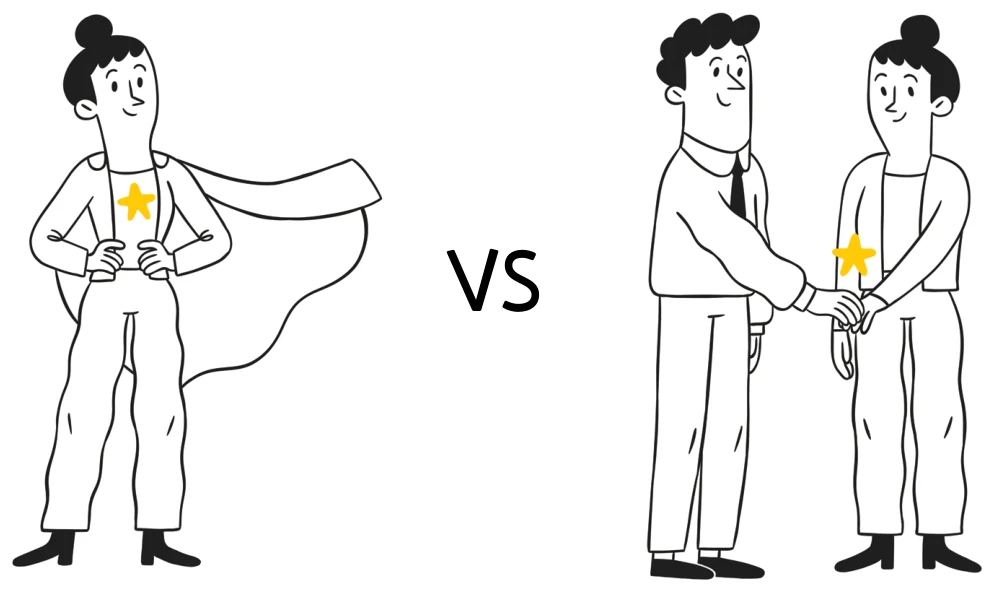
The Manager’s Dilemma
When given the choice, do you favor individual superstars or a cohesive super team?
10 · Leadership & teams
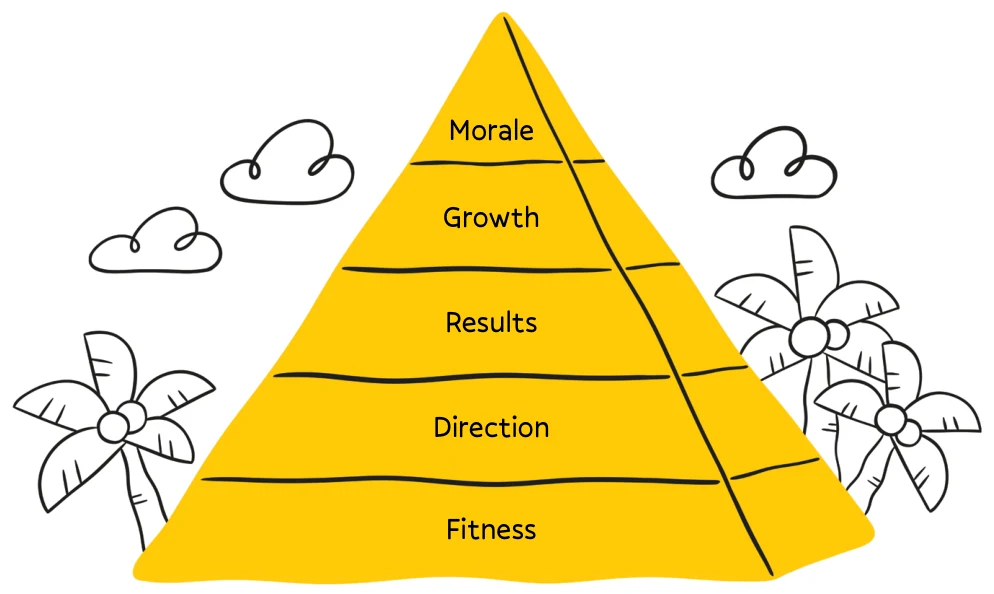
The Care Meter
Gauge your adequacy in providing care for others.

11 · Leadership & teams
The Fitness Radar
Assess whether the person you care for is in the right place.

12 · Leadership & teams
The Functional Domino
Determine the best-suited role for each person in your organization.
13 · Leadership & teams
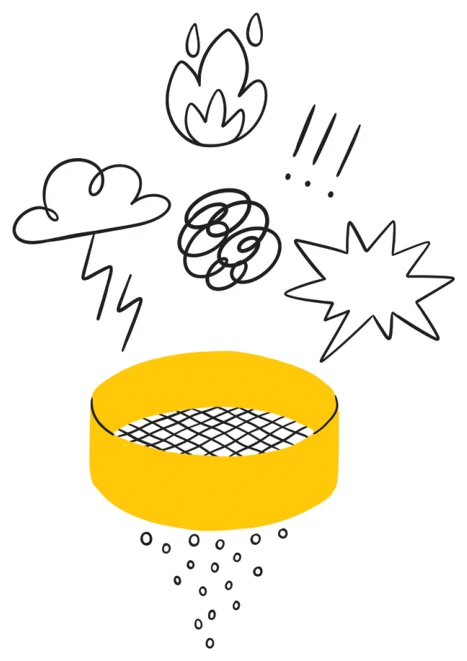
The Conflicts Strainer
Identify and prioritize conflicts that truly require attention.
14 · Leadership & teams
The Power Circles
Master the art of effectively blending various forms of power.
One new experiment, now and then
New techniques, real-world results and behind-the-scenes stories from Stavros. No spam; unsubscribe anytime.