Technique 9 of 31
The Manager’s Dilemma
When given the choice, do you favor individual superstars or a cohesive super team?
- Team Structure
- Individual vs. Collective Performance
In short
The Manager’s Dilemma helps a leader choose between a group of independent superstars and a cohesive super team. Estimate how much value comes from member interactions, then rate ten dimensions, five favoring superstars and five favoring super teams, from 1 to 10. The total, between -50 and +50, points to the better structure.
For: Managers and executives organizing work
The Problem
Agile and modern work culture often treat teams as sacred.1 But through questioning and experimenting, I found that teams aren’t always the best solution. In some cases, they add complexity, slow progress, or even hinder results.2
The Experiment
While collaborating with managers and executives, I explored when teams truly add value and when alternative structures might be more effective. This led to the Manager’s Dilemma—a framework for assessing when to rely on teams versus when individual ownership or flexible collaboration might yield better results.3 By challenging the assumption that “teams are always the answer,” leaders gained a clearer, more strategic approach to organizing work.
Where Does Value Originate?
There are many different definitions of a team,4 ranging from a group of individuals pursuing a shared goal to interdependent collaborators. Yet, in the context of my dilemma, the precise definition becomes less crucial. Instead, what holds greater significance is the level of interaction among team members.5 Hence, I pose the following question to assess teamwork:
How much of the group’s value will be generated through member interactions?

Below 30%: The work leans more toward individual contributions.6 While problem-solving and decision-making may involve team interactions, the majority of value creation stems from individual efforts rather than collaboration. At this point, the critical question emerges: Should we always prioritize collective activities to strengthen teamwork, or should we explore ways to empower individual performance and independence for better results? What if increased interaction doesn’t contribute to value creation—or worse, actually hinders it?7
What Is the Manager’s Dilemma?
Team member interactions are within our control and management. While increasing interaction is often beneficial, it may not always be the best solution. Popular trends, such as the focus on teams and the glorification of teamwork, can unintentionally result in excessive or even counterproductive levels of interaction.8 Instead of enhancing value delivery, these interactions might actually hinder it.
Indeed, cultivating effective super teams demands time, dedicated efforts, exceptional leadership, and strong teamwork skills.9 Conversely, fostering individual work and nurturing superstars relies heavily on our ability to manage and inspire individuals.10
Thus, at the crossroads of leadership, I present my Manager’s Dilemma:
If presented with the choice, which path would you opt for: five exceptional individuals working independently as superstars, or a cohesive super team where five individuals collaborate seamlessly?
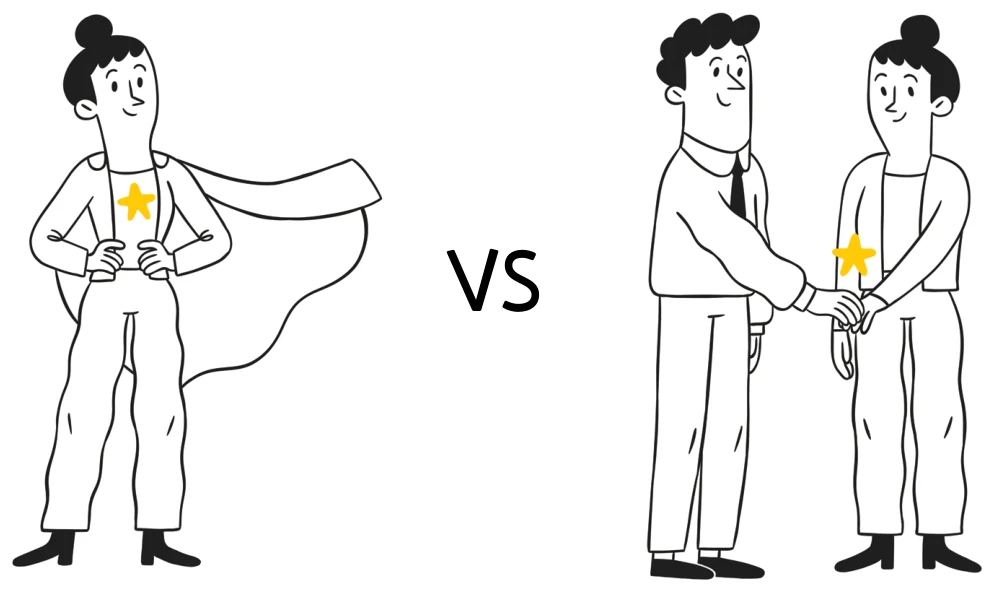
To contextualize this dilemma, consider a scenario: Imagine you are establishing a startup and have access to a team of five full-stack developers, each capable of independently developing fully functional features. While occasional meetings would be necessary to address significant decisions and establish common policies, the majority of their time—let’s say 80%—would be dedicated to individual work.11 Alternatively, you could assemble a cross-functional team comprising five individuals with specific competencies, interdependent on one another. Together, they possess the ability to develop fully functional features, but not alone.12 Which path would you choose, and more importantly, why?
Which Is Superior: Superstars or Super Teams?
Drawing from my own experiences with both superstars and star teams, I have come to appreciate the unique advantages associated with each option:
Superstars
Fostering individual superstars within an organization brings forth the following benefits, primarily derived from individual work:
- Speed. The ability to save time by minimizing interactions with others.13 Moreover, decision-making and problem-solving can be expedited, enhancing overall efficiency.14
- Efficiency. By invoking the Ringelmann Effect (where individual effort decreases as group size increases)15 and Price’s Law (which states that a small percentage of people often contribute the majority of results),16 individual superstars can operate with heightened efficiency, maximizing their output.
- Responsibility. Taking on individual responsibilities and commitments without relying on others ensures a strong sense of ownership. It eliminates the need for others to cover tasks or navigate team dynamics, fostering a greater level of personal accountability.17
- Creativity. My own experience has shown that creators often thrive in solitary work environments. Collaborative group settings can sometimes hinder creativity due to factors like groupthink, conformity, excessive criticism, and conflicting ideas.18
- Predictability. Individual behavior tends to be more predictable than group behavior, which is heavily influenced by complex group dynamics.19 Working independently also cultivates valuable skills such as time management, stress management, self-motivation, and self-discipline.20
Super Teams
I’ve seen firsthand how super teams, powered by effective teamwork, give businesses a competitive edge through:
- Impact. When individuals with diverse perspectives collaborate in a team, the clash of viewpoints can generate powerful outcomes.21
- Power. As social beings, we often find security and strength in being part of a group. Teams can navigate challenges, crises, and tough decisions more effectively by leveraging the collective power of their members.22
- Sustainability. In high-performance teams, individuals are more inclined to prioritize the group’s interests over their personal aspirations. This cultivates loyalty and enhances the organization’s ability to retain talented individuals.23
- Safety. The presence of team members acting as checks and balances minimizes the likelihood of impulsive, poorly considered decisions driven by excessive emotions.24
- Morale. Interactions within a team make work more engaging and enjoyable, creating an atmosphere of mutual support, assistance, and encouragement.25
What Is the Solution to the Manager’s Dilemma?
Through my own professional struggles in tackling this complex dilemma, I’ve developed a simple algorithm to help managers navigate it more effectively.
- Evaluate the importance of each dimension. Assess how significant each of the ten dimensions (speed, efficiency, creativity, etc.) is on a scale of 1 to 10 in the context of your decision.
- Assign scores. Assign a negative score (-1) to the dimensions associated with a group of superstars.
- Calculate the final score. Calculate the sum of all the points obtained in Step 2. The resulting value will fall within the range of -50 to +50.
A negative total score suggests that managing a group of individual superstars may be better suited to your circumstances—and the lower the score, the more preferable that approach becomes. Conversely, a high positive score indicates that building a well-integrated super team might be the better option.
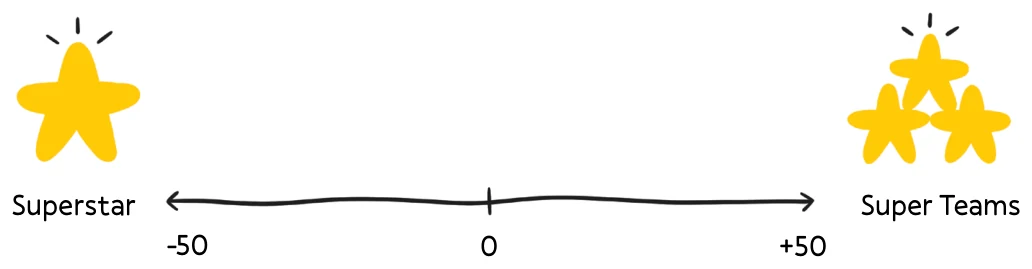
This simple framework provides a structured and quantifiable approach to solving the Manager’s Dilemma, ensuring leaders can make the best decision based on their unique context.
References
- D. K. Rigby, J. Sutherland, and A. Noble, “Agile at Scale,” Harvard Business Review, May–June 2018, https://hbr.org/2018/05/agile-at-scale.
- R. Cross, R. Rebele, and A. Grant, “Collaborative Overload,” Harvard Business Review, January–February 2016, https://hbr.org/2016/01/collaborative-overload.
- J. R. Hackman, Leading Teams: Setting the Stage for Great Performances (Harvard Business School Press, 2002).
- J. R. Katzenbach and D. K. Smith, The Wisdom of Teams: Creating the High-Performance Organization (Harvard Business School Press, 1993).
- A. Pentland, “The New Science of Building Great Teams,” Harvard Business Review, April 2012, https://hbr.org/2012/04/the-new-science-of-building-great-teams.
- H. K. Gardner, Smart Collaboration: How Professionals and Their Firms Succeed by Breaking Down Silos (Harvard Business Review Press, 2017).
- J. R. Hackman and R. Wageman, “A Theory of Team Coaching,” Academy of Management Review 30, no. 2 (2005), https://doi.org/10.5465/amr.2005.16387885.
- R., Cross, and P. Gray, “Where Has the Time Gone? Addressing Collaboration Overload in a Networked Economy,” California Management Review 56, no. 1 (2013): 50–66.
- P. Lencioni, The Five Dysfunctions of a Team: A Leadership Fable (Jossey-Bass, 2002).
- M. Buckingham and A. Goodall, “The Feedback Fallacy,” Harvard Business Review, March–April 2019, https://hbr.org/2019/03/the-feedback-fallacy.
- B. R. Staats and D. M. Upton, “Lean Knowledge Work,” Harvard Business Review, October 2011, https://hbr.org/2011/10/lean-knowledge-work.
- A. C. Edmondson, “Teamwork on the Fly,” Harvard Business Review, April 2012, https://hbr.org/2012/04/teamwork-on-the-fly-2.
- T. DeMarco and T. Lister, Peopleware: Productive Projects and Teams (Addison-Wesley, 2013).
- D. Kahneman, Thinking, Fast and Slow (Farrar, Straus and Giroux, 2011).
- S. J. Karau and K. D. Williams, “Social Loafing: A Meta-Analytic Review and Theoretical Integration,” Journal of Personality and Social Psychology 65, no. 4 (1993): 681–706.
- D. J. de Solla Price, Little Science, Big Science (Columbia University Press, 1963).
- A. M. Grant, “Leading with Meaning: Beneficiary Contact, Prosocial Impact, and the Performance Effects of Transformational Leadership,” Academy of Management Journal 55, no. 2 (2012): 458–76.
- T. M. Amabile, R. Conti, H. Coon, J. Lazenby, and M. Herron, Assessing the Work Environment for Creativity. Academy of Management Journal 39, no. 5 (1996): 1154–84.
- I. L. Janis, Groupthink: Psychological Studies of Policy Decisions and Fiascoes (Houghton Mifflin, 1982).
- A. Duckworth, Grit: The Power of Passion and Perseverance (Scribner, 2016).
- S. E. Page, The Diversity Bonus: How Great Teams Pay Off in the Knowledge Economy (Princeton University Press, 2017).
- A. C. Edmondson, The Fearless Organization: Creating Psychological Safety in the Workplace for Learning, Innovation, and Growth (Wiley, 2018).
- C. Duhigg, “What Google Learned From Its Quest to Build the Perfect Team,” New York Times Magazine, February 28, 2016, https://www.nytimes.com/2016/02/28/magazine/what-google-learned-from-its-quest-to-build-the-perfect-team.html.
- D. Kahneman, D. Lovallo, and O. Sibony, “Before You Make That Big Decision...,” Harvard Business Review, June 2011, https://hbr.org/2011/06/the-big-idea-before-you-make-that-big-decision.
- J. K. Harter, F. L. Schmidt, and T. L. Hayes, “Business-Unit-Level Relationship Between Employee Satisfaction, Employee Engagement, and Business Outcomes: A Meta-Analysis,” Journal of Applied Psychology 87, no. 2 (2002): 268–79.
From Never Stop Experimenting by Stavros Stavru, PhD, illustrated by Iva Grueva. Published here in full on .
How to cite this technique
Stavru, S. (2025). The Manager’s Dilemma. In Never Stop Experimenting: 31 Real-World Experiments for Continuous Growth in Work and Life. Morgan James Publishing. https://neverstopexperimenting.com/techniques/managers-dilemma
Related techniques

08 · Leadership & teams
The Team Strategy Matrix
Uncover the best way to manage your team.
10 · Leadership & teams
The Care Meter
Gauge your adequacy in providing care for others.

11 · Leadership & teams
The Fitness Radar
Assess whether the person you care for is in the right place.

12 · Leadership & teams
The Functional Domino
Determine the best-suited role for each person in your organization.

13 · Leadership & teams
The Conflicts Strainer
Identify and prioritize conflicts that truly require attention.

14 · Leadership & teams
The Power Circles
Master the art of effectively blending various forms of power.
One new experiment, now and then
New techniques, real-world results and behind-the-scenes stories from Stavros. No spam; unsubscribe anytime.