Technique 13 of 31
The Conflicts Strainer
Identify and prioritize conflicts that truly require attention.
- Conflict Resolution
- Team Dynamics
- Prioritization
In short
The Conflicts Strainer filters real conflicts from discussions, debates and conversations. It rates a disagreement on two dimensions, the degree of difference and the degree of dependence, and keeps attention on Type A conflicts, where both are high. These are then defused by reducing differences (Type X strategies) or reducing dependence (Type Y strategies).
For: Team leads and Agile teams
The Problem
Agile teams often mistake routine discussions for real conflicts, wasting time and energy addressing every perceived issue.1 While teamwork and autonomy encourage dialogue, not every disagreement requires resolution.2 Overreacting to minor disagreements drains focus and slows progress without adding value.3
The Experiment
To help teams focus on what truly matters, I worked with them to develop the Conflict Strainer—a practical tool that quickly filters out the noise and highlights only meaningful conflicts. By applying it, teams improved their decision-making, maintained momentum, and reduced unnecessary friction in their day-to-day interactions.
What Is Conflict?
The concept of conflict, as defined within the Conflict Strainer, comprises two key elements. Firstly, it involves the existence of differences, encompassing various aspects such as needs, values, beliefs, personal traits, and working styles.4 Secondly, conflict is influenced by the degree of dependence, which can manifest in collaborative work, task interdependencies, and shared outcomes.5 Based on these dimensions, four types of conflicts emerge, as illustrated in the matrix below:
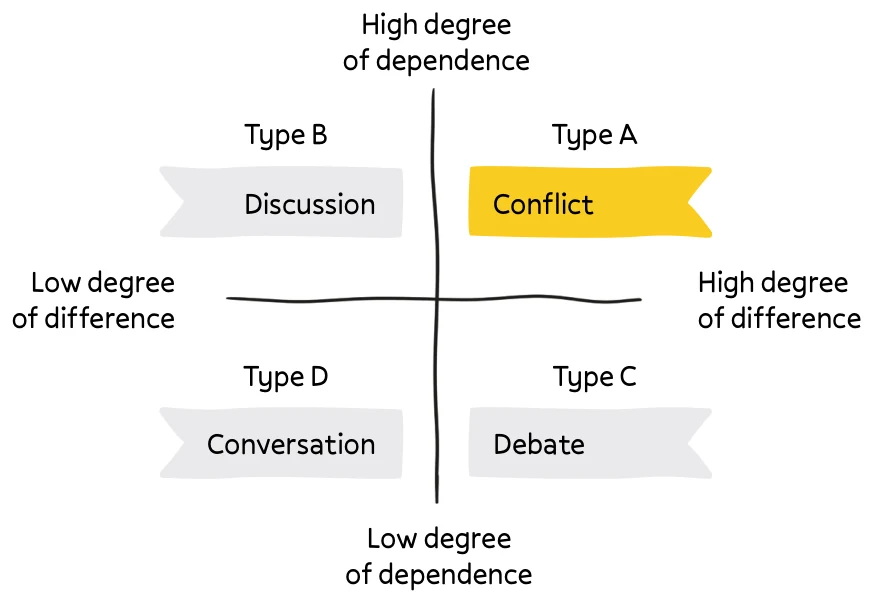
| Low degree of difference | High degree of difference | |
|---|---|---|
| High degree of dependence | Type B: Discussion | Type A: Conflict |
| Low degree of dependence | Type D: Conversation | Type C: Debate |
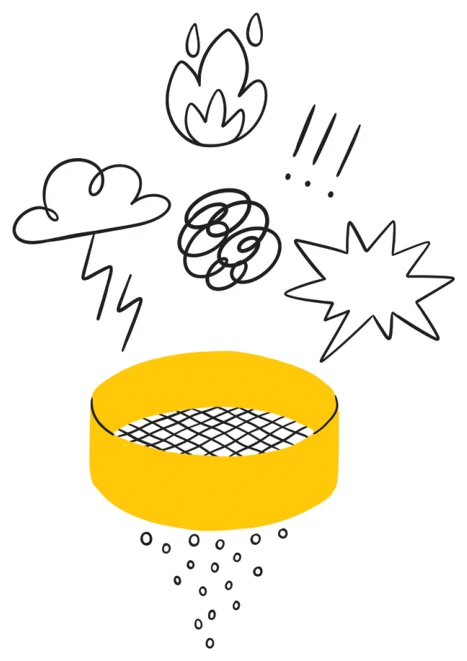
According to the Conflict Strainer, our primary focus should be on conflicts falling under Type A. These situations involve a high degree of interdependence and a high degree of difference.
Finding a solution to Type A conflicts is crucial because it is imperative for us to sustainably move forward.6
When managing team dynamics, it’s crucial to understand when to invest energy in resolving differences and when to let them coexist.7 In discussions (Type B), where dependence is high but differences are low, team members often spend unnecessary time and emotional energy trying to achieve perfect alignment, even though existing similarities are already sufficient for effective collaboration.8 Similarly, in debates (Type C), where differences are high but dependence is low, people frequently engage in lengthy arguments trying to convince others of their viewpoint, despite the fact that their low interdependence means they can function effectively while maintaining different perspectives.9
The key insight? The energy spent on discussions and debates would be better directed at true conflicts (Type A), where both high differences and high dependence require active resolution for the team to function effectively.10
What Coping Strategies Are Available to Us?

Drawing from the insights of the Conflict Strainer, one approach to addressing a Type A conflict is by transforming it into one of the other conflict types.11
This transformation serves to diminish the conflict’s potential and mitigate its negative consequences.
Here are two possible types of coping strategies:
Type X Strategies: Reducing Differences
These strategies focus on transforming a Type A conflict (high differences, high dependence) into a Type B situation (low differences, high dependence) by actively managing the differences between parties. This can be achieved through several approaches: fostering mutual understanding to uncover previously unrecognized commonalities,12 reframing differences as complementary strengths rather than opposing positions,13 or developing shared values and goals that bridge individual differences.14 When complete alignment isn’t possible, these strategies may involve structured compromise through negotiation or mediation15 or fostering tolerance and appreciation for diversity. The key is not necessarily to eliminate all differences but to reduce their impact on the working relationship to a level where high interdependence can function effectively.
Type Y Strategies: Reducing Dependence
These strategies focus on transforming a Type A conflict (high differences, high dependence) into a Type C situation (high differences, low dependence) by strategically reducing interdependence between parties. This can be achieved through structural solutions such as clarifying decision-making authority,16 establishing clear boundaries and protocols,17 creating buffer resources to reduce bottlenecks, or redesigning workflows to minimize forced interactions.18 The goal is not to isolate parties completely but rather to create enough operational independence that their differences no longer create daily friction. This transforms a high-stakes conflict into a more manageable debate scenario, where differing viewpoints can coexist because each party has sufficient autonomy to execute their responsibilities without requiring constant agreement from others.
In the short term, Type Y strategies (reducing dependence) often appear more attractive and deliver immediate results, as structural and procedural changes can be implemented relatively quickly with clear success metrics.19 However, for sustainable long-term solutions, Type X strategies (reducing differences) become essential because they address the root cause of the conflict rather than just its operational symptoms.20 While building understanding, fostering tolerance, and finding ways to work with differences may be more challenging and time-consuming, this investment creates more resilient team dynamics that can better handle future challenges.21 The ideal approach often involves implementing Type Y strategies for immediate relief while simultaneously working on Type X strategies for lasting resolution.
References
- C. K. De Dreu and L. R. Weingart, “Task Versus Relationship Conflict, Team Performance, and Team Member Satisfaction: A Meta-Analysis,” Journal of Applied Psychology 88, no. 4 (2003): 741–49.
- D. Tjosvold, “The Conflict-Positive Organization: It Depends upon Us,” Journal of Organizational Behavior 29, no. 1 (2008): 19–28.
- F. R. De Wit, L. L. Greer, and K. A. Jehn, “The Paradox of Intragroup Conflict: A Meta-Analysis,” Journal of Applied Psychology 97, no. 2 (2012): 360–90.
- M. Deutsch, “Sixty Years of Conflict,” International Journal of Conflict Management 1, no. 3 (1990): 237–63.
- K. A. Jehn, “A Multimethod Examination of the Benefits and Detriments of Intragroup Conflict,” Administrative Science Quarterly 40, no. 2 (1995): 256-282.
- K. M. Eisenhardt, J. L. Kahwajy, and L. J. Bourgeois III, “How Management Teams Can Have a Good Fight,” Harvard Business Review 75 (1997): 77–86.
- M. A. Rahim, “Toward a Theory of Managing Organizational Conflict,” International Journal of Conflict Management 13, no. 3 (2002): 206–235.
- S. Rispens and E. Demerouti, “Conflict at Work, Negative Emotions, and Performance,” Negotiation and Conflict Management Research 9, no. 2 (2016): 103–19.
- D. W. Johnson and R. T. Johnson, “New Developments in Social Interdependence Theory,” Genetic, Social, and General Psychology Monographs 131, no. 4 (2005): 285–358.
- P. J. Carnevale and D. G. Pruitt, “Negotiation and Mediation,” Annual Review of Psychology 43 (1992): 531-582.
- K. A. Jehn and C. Bendersky, “Intragroup Conflict in Organizations: A Contingency Perspective on the Conflict-Outcome Relationship,” Research in Organizational Behavior 25 (2003): 187-242.
- D. W. Johnson and R. T. Johnson, “Energizing Learning: The Instructional Power of Conflict,” Educational Researcher 38, no. 1 (2009): 37–51.
- K. J. Behfar, R. S. Peterson, E. A. Mannix, and W. M. Trochim, “The Critical Role of Conflict Resolution in Teams,” Journal of Applied Psychology 93, no. 1 (2008): 170–88.
- T. L. Simons and R. S. Peterson, “Task Conflict and Relationship Conflict in Top Management Teams: The Pivotal Role of Intragroup Trust,” Journal of Applied Psychology 85, no. 1 (2000): 102-111.
- R. Fisher, W. L. Ury, and B. Patton, Getting to Yes: Negotiating Agreement Without Giving In (Penguin, 2011).
- A. C. Edmondson, “Psychological Safety and Learning Behavior in Work Teams,” Administrative Science Quarterly 44, no. 2 (1999): 350-383.
- K. W. Thomas, “Conflict and Conflict Management: Reflections and Update,” Journal of Organizational Behavior 13, no. 3 (1992): 265–74.
- K. A. Jehn and E. A. Mannix, “The Dynamic Nature of Conflict: A Longitudinal Study of Intragroup Conflict and Group Performance,” Academy of Management Journal 44, no. 2 (2001): 238–51.
- C. K. De Dreu, “Conflict at Work: Basic Principles and Applied Issues,” Applied Psychology 59, no. 4 (2010): 635–68.
- A. G. Tekleab, N. R. Quigley, and P. E. Tesluk, “A Longitudinal Study of Team Conflict, Conflict Management, Cohesion, and Team Effectiveness,” Group & Organization Management 34, no. 2 (2009): 170–205.
- D. Tjosvold, A. S. H. Wong, and N. Y. Feng Chen, “Managing Conflict in Teams,” Journal of Organizational Effectiveness 1, no. 1 (2014): 7–26.
From Never Stop Experimenting by Stavros Stavru, PhD, illustrated by Iva Grueva. Published here in full on .
How to cite this technique
Stavru, S. (2025). The Conflicts Strainer. In Never Stop Experimenting: 31 Real-World Experiments for Continuous Growth in Work and Life. Morgan James Publishing. https://neverstopexperimenting.com/techniques/conflicts-strainer
Related techniques
08 · Leadership & teams
The Team Strategy Matrix
Uncover the best way to manage your team.
09 · Leadership & teams
The Manager’s Dilemma
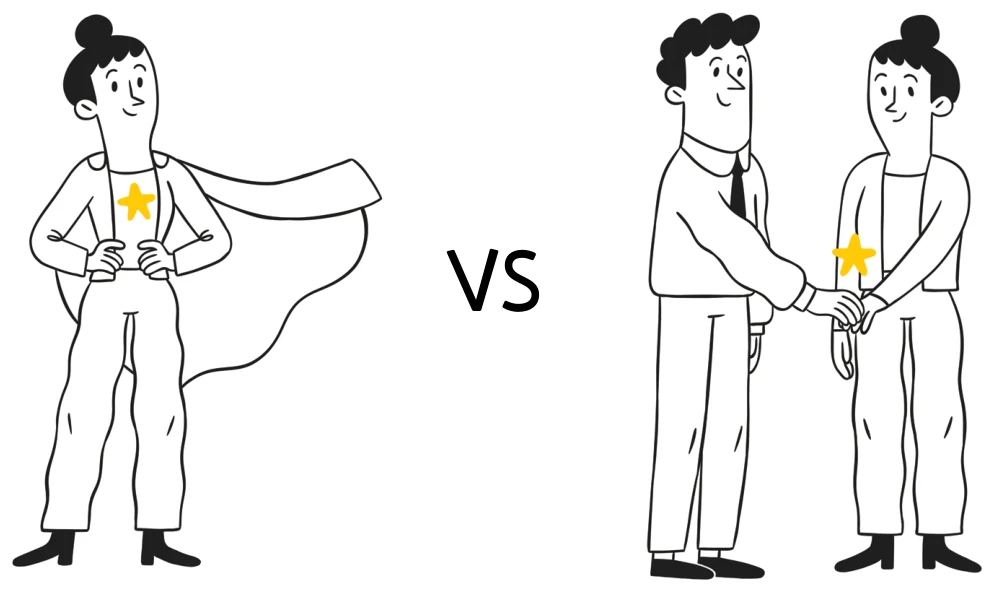
When given the choice, do you favor individual superstars or a cohesive super team?
10 · Leadership & teams
The Care Meter
Gauge your adequacy in providing care for others.

11 · Leadership & teams
The Fitness Radar
Assess whether the person you care for is in the right place.
12 · Leadership & teams
The Functional Domino
Determine the best-suited role for each person in your organization.
14 · Leadership & teams
The Power Circles
Master the art of effectively blending various forms of power.
One new experiment, now and then
New techniques, real-world results and behind-the-scenes stories from Stavros. No spam; unsubscribe anytime.