Technique 12 of 31
The Functional Domino
Determine the best-suited role for each person in your organization.
- Role Definition
- Team Structure
- Skills Allocation
In short
The Functional Domino shows how a person’s time splits across the five functions of the 5P Work Model, People, Processes, Products, Politics and Platforms, each dot worth 10%. Compared with standard dominos for Product Owner, Scrum Master and Developer, it shows which role fits best; it also exposes team imbalances and miscalibration.
For: Transformation leaders and managers assigning roles
The Problem
Agile transformations often stall over role assignments:1 Should a project manager become a Product Owner or Scrum Master? Should a team leader shift roles or stay technical? Misalignment breeds disengagement, resistance, and instability—like a domino effect, one wrong fit can topple the entire transformation.2
The Experiment
Collaborating with transformation leaders, I refined the Functional Domino technique to make role decisions structured and sustainable. Built on the 5P Work Model—People, Processes, Products, Politics, and Platforms—it helps individuals map how they actually spend their time. Comparing this with Agile role patterns reveals the best fit, helping teams prevent misalignment before it disrupts the transformation process.
What Are the Fundamental Functions in One Organization?
Drawing on 20 years of experience in the corporate world, I have identified (at least) five fundamental functions that encompass the diverse activities within an organization. These functions form the basis for describing and understanding every role and position. I refer to them as the 5P Work Model. Let’s explore each function and the types of work they commonly involve:
People3
- Talent acquisition, retention, and dismissal
- Performance management and development
- Employee engagement, motivation, commitment, and satisfaction
- Workplace culture and diversity management
- Health, safety, and well-being
- Training and skills development
- Employee relations and conflict resolution
- Organization design and workforce planning
Guiding Question: “Does this activity directly impact how we manage, develop, or care for our employees and their work environment?”
Processes4
- Process design and optimization
- Workflow management and control
- Quality management systems
- Change and transition management
- Risk management and compliance
- Resource allocation and scheduling
- Knowledge management and documentation
- Performance monitoring and improvement
Guiding Question: “Does this activity define how work gets done, is controlled, or improved in the organization?”
Products5
- Product/service portfolio management
- Customer experience and satisfaction
- Market research and strategy
- Innovation and development
- Quality assurance and delivery
- Sales and marketing management
- Supplier and partnership management
- Product lifecycle management
- Digital transformation
Guiding Question: “Does this activity relate to what we deliver to our customers or how we create value in the market?”
Politics6
- Strategic direction and planning
- Corporate governance and structure
- Financial management and control
- Stakeholder relationship management
- Legal and regulatory compliance
- Brand and reputation management
- Cultural values and ethics
- External relations and partnerships
Guiding Question: “Does this activity impact how we make decisions, exercise power, or manage relationships within and outside the organization?”
Platforms7
- Technology strategy and planning
- Infrastructure and systems management
- Application development and maintenance
- Data governance and security
- Technical standards and practices
- Digital transformation initiatives
- Technology vendor management
- Architecture and integration
Guiding Question: “Does this activity relate to how we use, manage, or develop our technical capabilities and infrastructure?”
What Does the Functional Domino Represent?

The Functional Domino is a visual representation that showcases how a person’s time is distributed across the various organizational functions mentioned earlier. Each point on the domino represents 10% of the total time dedicated by the person.
Let’s explore an example of a Functional Domino:
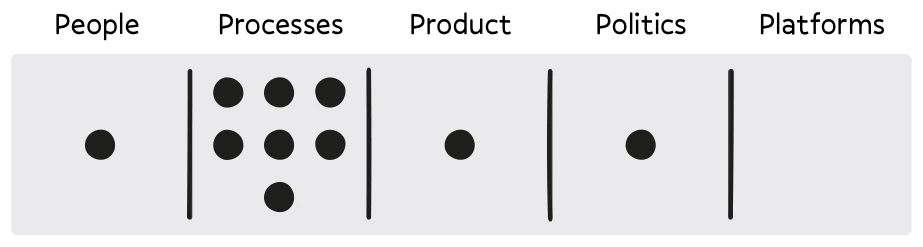
In the provided example, we can observe that the person or role depicted by the Functional Domino allocates 70% of their time to processes, while dedicating 10% to each of the following functions: people, products, and politics. Additionally, no time is allocated to platforms. This visualization can effectively represent the role of a traditional project manager, although its composition may vary significantly across different theoretical frameworks and individual organizations.
Product Owner, Scrum Master, or Developer?
To showcase the effectiveness of the Functional Domino, let me provide an example related to a Scrum transformation. I have developed a simple algorithm to determine which role would be the best fit for individuals in such a transformation.8 Here are the steps:
Step 1: Introduce the 5P Work Model.
Present the 5P Work Model to the individual, allowing them some time to understand its components and implications.
Step 2: Allocate time preferences.
Invite the person to allocate their time based on their personal preferences, assuming they have the freedom to choose.
Step 3: Visualize the Functional Domino.
Once the person determines their time allocation across the functions, visually represent it using the Functional Domino.
Step 4: Benchmark using standard Functional Dominos.
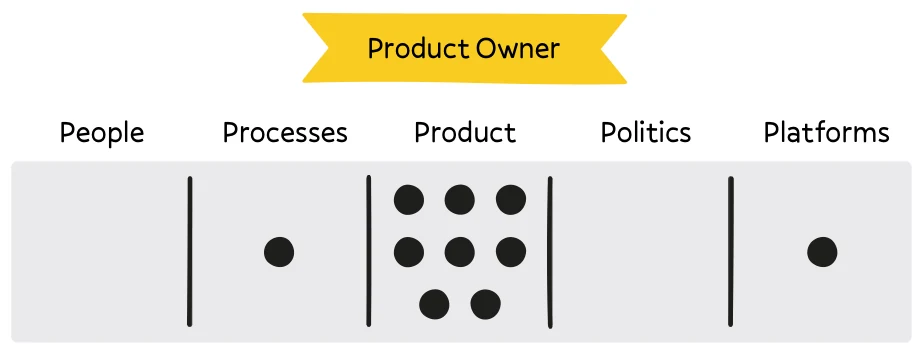
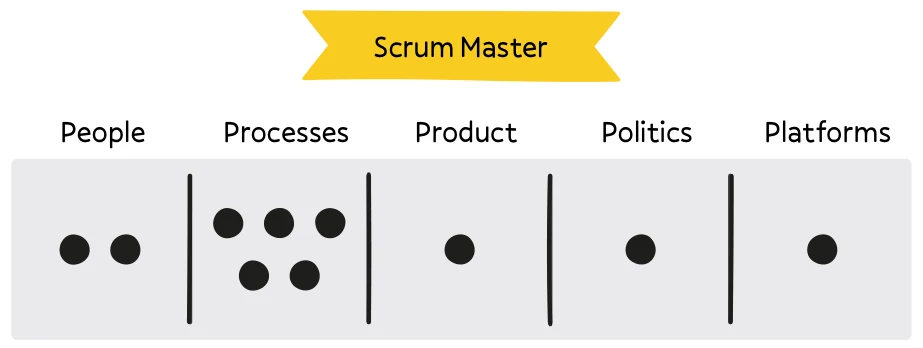
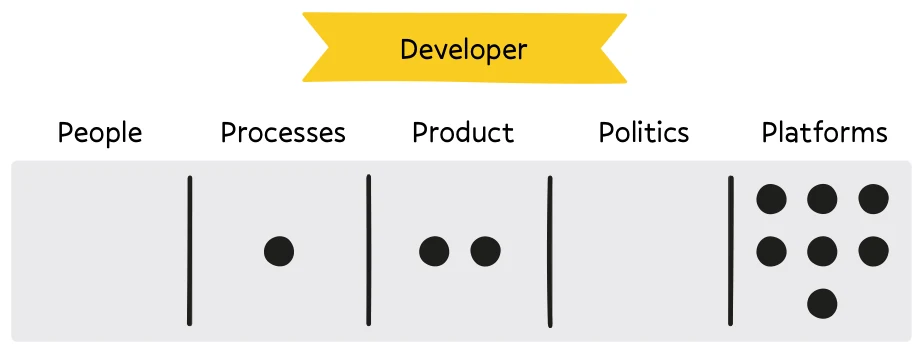
Compare the Functional Domino from Step 3 with the standard Functional Dominos that have been developed based on my extensive data and experience. These standard dominos reflect the typical time allocation patterns for Product Owners, Scrum Masters, and Development Team members9 within the 5P Work Model.
| Role | People | Processes | Product | Politics | Platforms |
|---|---|---|---|---|---|
| Product Owner | 0% | 10% | 80% | 0% | 10% |
| Scrum Master | 20% | 50% | 10% | 10% | 10% |
| Developer | 0% | 10% | 20% | 0% | 70% |
Please note that these standard Functional Dominos are based on my personal experience and should be used with caution, as they may not apply universally.
Step 5: Choose the best fit.
Select the role that aligns most closely with the individual’s Functional Domino. However, it’s important to remember that if none of the Scrum roles closely match their preferences, we shouldn’t limit ourselves to just those roles. There may be other suitable positions or opportunities to explore within the organization.
How Else Can the Functional Domino Be Utilized?
Throughout my experience, I have discovered two additional valuable applications of the Functional Domino:
Visualizing Team Structure in the Context of Work Preferences
By obtaining the Functional Dominos of each team member, you gain a powerful tool for identifying prevailing preferences and identifying any deficits within the team.10 This information is instrumental in constructing well-balanced teams,11 ensuring that each function is represented by individuals who feel comfortable and even passionate about their assigned work. Consider the following example:
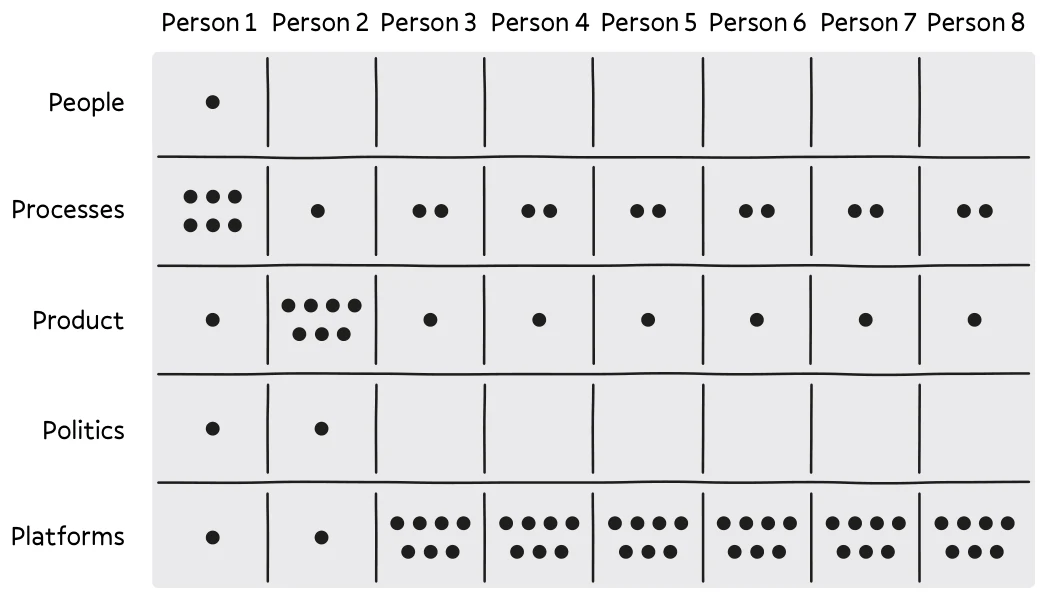
| Function | Person 1 | Person 2 | Persons 3–8 (each) |
|---|---|---|---|
| People | 10% | 0% | 0% |
| Processes | 60% | 10% | 20% |
| Product | 10% | 70% | 10% |
| Politics | 10% | 10% | 0% |
| Platforms | 10% | 10% | 70% |
In the provided illustration, it is evident that the team structure is unbalanced due to a significant deficit in the people and politics functions. As a result, it becomes necessary to have someone from outside the team attend to these particular functions. Interestingly enough, this team example is based on a Scrum team (drawn from my personal experience).
Capturing Miscalibration
Miscalibration arises when there is a discrepancy between a person and the work they perform.12–14 It can manifest in various ways:
- Operational miscalibration: This occurs when there is a gap between the time a person should spend on each function and the time they actually spend.
- Motivational miscalibration: Here, a discrepancy arises between the time a person should spend on each function and the time they want to spend on them.
- Competency miscalibration: This type of miscalibration emerges when there is a disconnect between the time a person should spend on each function based on their role requirements and their competence to effectively fulfill those responsibilities.
Consequently, the Functional Domino can reflect different perspectives, such as the Actual Domino (showing time allocation), the Expected Domino (indicating role expectations), the Desired Domino (reflecting personal preferences), and the Competency Domino (assessing competence scores from 1 to 10 for each function). Take a look at the visualization below:
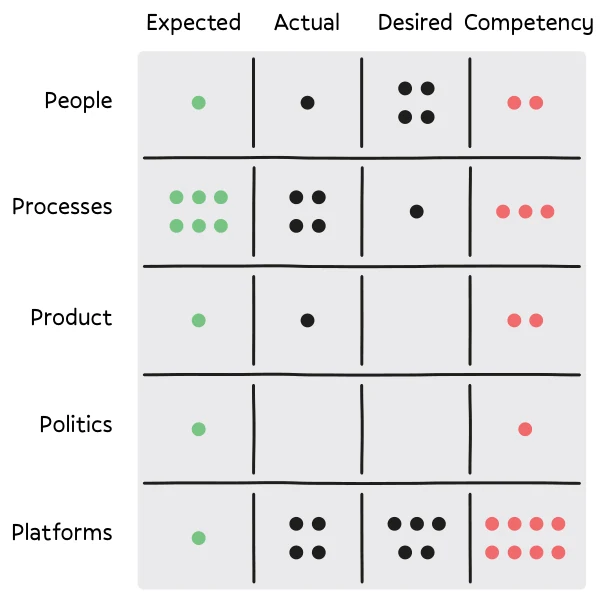
| Function | Expected | Actual | Desired | Competency (1–10) |
|---|---|---|---|---|
| People | 10% | 10% | 40% | 2 |
| Processes | 60% | 40% | 10% | 3 |
| Product | 10% | 10% | 0% | 2 |
| Politics | 10% | 0% | 0% | 1 |
| Platforms | 10% | 40% | 50% | 8 |
From the provided example, it is evident that there is a significant motivational and competency miscalibration within the individual’s work allocation.
References
- K. Dikert, M. Paasivaara, and C. Lassenius, “Challenges and Success Factors for Large-Scale Agile Transformations: A Systematic Literature Review,” Journal of Systems and Software 119 (2016): 87–108.
- K. Conboy and N. Carroll, “Implementing Large-Scale Agile Frameworks: Challenges and Recommendations,” IEEE Software 36, no. 2 (2019): 44–50.
- D. Ulrich and J. H. Dulebohn, “Are We There Yet? What’s Next for HR?” Human Resource Management Review 25, no. 2 (2015): 188–204.
- M. Hammer, “What Is Business Process Management?”, Handbook on Business Process Management, Vol. 1 (Springer, 2015), 3–16.
- R. G. Cooper, “The Drivers of Success in New-Product Development,” Industrial Marketing Management 76 (2019): 36–47.
- J. Pfeffer, “Power Play,” Harvard Business Review 88, no. 7–8 (2010): 84–92.
- J. W. Ross, I. M. Sebastian, and C. M. Beath, “How to Develop a Great Digital Strategy,” MIT Sloan Management Review 58, no. 2 (2017): 7–9.
- N. B. Moe, T. Dingsøyr, and T. Dybå, “A Teamwork Model for Understanding an Agile Team: A Case Study of a Scrum Project,” Information and Software Technology 52, no. 5 (2010): 480–91.
- K. Schwaber and J. Sutherland, The Scrum Guide: The Definitive Guide to Scrum (November 2020), https://scrumguides.org/docs/scrumguide/v2020/2020-Scrum-Guide-US.pdf.
- J. E. Mathieu, J. R. Hollenbeck, D. van Knippenberg, and D. R. Ilgen, “A Century of Work Teams in the Journal of Applied Psychology,” Journal of Applied Psychology 102, no. 3 (2017): 452–67.
- A. L. Kristof-Brown, R. D. Zimmerman, and E. C. Johnson, “Consequences of Individuals’ Fit at Work: A Meta-Analysis of Person–Job, Person–Organization, Person–Group, and Person–Supervisor Fit,” Personnel Psychology 58, no. 2 (2005): 281–342.
- R. M. Ryan and E. L. Deci, Self-Determination Theory: Basic Psychological Needs in Motivation, Development, and Wellness (Guilford Publications, 2017).
- F. D. Le Deist and J. Winterton, “What Is Competence?” Human Resource Development International 8, no. 1 (2005): 27–46.
- M. A. Campion, A. A. Fink, B. J. Ruggeberg, L. Carr, G. M. Phillips, and R. B. Odman, “Doing Competencies Well: Best Practices in Competency Modeling,” Personnel Psychology 64, no. 1 (2011): 225–62.
From Never Stop Experimenting by Stavros Stavru, PhD, illustrated by Iva Grueva. Published here in full on .
How to cite this technique
Stavru, S. (2025). The Functional Domino. In Never Stop Experimenting: 31 Real-World Experiments for Continuous Growth in Work and Life. Morgan James Publishing. https://neverstopexperimenting.com/techniques/functional-domino
Related techniques

08 · Leadership & teams
The Team Strategy Matrix
Uncover the best way to manage your team.
09 · Leadership & teams
The Manager’s Dilemma
When given the choice, do you favor individual superstars or a cohesive super team?
10 · Leadership & teams
The Care Meter
Gauge your adequacy in providing care for others.

11 · Leadership & teams
The Fitness Radar
Assess whether the person you care for is in the right place.
13 · Leadership & teams
The Conflicts Strainer
Identify and prioritize conflicts that truly require attention.
14 · Leadership & teams
The Power Circles
Master the art of effectively blending various forms of power.
One new experiment, now and then
New techniques, real-world results and behind-the-scenes stories from Stavros. No spam; unsubscribe anytime.