Technique 7 of 31
The Self-Esteem Wheel
Gauge your positive self-perception.
- Self-Awareness
- Confidence
- Personal Growth
In short
The Self-Esteem Wheel measures how positively you see yourself across ten dimensions, from Possessions to Motivation. Rate your current achievement and the importance of each dimension from 1 to 10, subtract importance from achievement, and draw the result as a wheel of surpluses and deficits. The ideal is a total surplus and deficit of zero.
For: Individuals, and coaches working with them
The Problem
In high-performing teams, I kept encountering the same issue—low self-esteem and assertiveness limiting engagement in continuous improvement.1 When people hesitate to speak up or doubt their value, collaboration weakens, innovation slows, and potential is lost.
The Experiment
While coaching individuals on personal development, I explored different ways to build confidence and assertiveness. The result was the Self-Esteem Wheel—a structured framework that helps people identify areas for growth and take clear steps toward change. What began as an experiment soon became a reliable tool for fostering confidence, strengthening teamwork, and unlocking potential.
What Aspects Shape Our Self-Esteem?

Within the Self-Esteem Wheel, there are ten fundamental dimensions that I have come to recognize as profoundly influential in shaping our self-perception:2
| Dimension | Key question | What it covers |
|---|---|---|
| Possessions | What do I have? | Reflects what we possess, encompassing our physical attributes, intellectual capabilities, talents, material status, educational achievements, skills, knowledge, experience, and competencies.3 |
| External Evaluation | What do people think about me? | Examines how we are evaluated by others, encompassing praise, recognition, followership, and social media engagement.4 |
| Here and Now | What are the things I am currently working on? | Focuses on our current actions, behaviors, and decisions, evaluating their moral and ethical significance in our own eyes.5 |
| Social Status | What impact do I have on the world? | Explores our role and contribution to the well-being of society, encompassing the importance of our profession, social impact, and contributions to humanity.6 |
| History | What is the story of my life? | Considers our past actions, experiences, and family history, recognizing their impact on our self-perception.7 |
| Need | How essential am I to the needs of others? | Examines the extent to which we are needed by others, encompassing our responsibilities toward family, caring for elderly parents, and contributing to community development.8 |
| Demographics | With whom do I have a sense of belonging? | Acknowledges our personal characteristics and peculiarities, including gender, age, nationality, sexuality, temperament, and other defining attributes.9 |
| Intentions | What should I do next? | Explores our beliefs, values, dreams, and goals, recognizing their influence on our self-perception.10 |
| Health | What is my current level of wellness? | Evaluates our physical, emotional, and mental well-being, encompassing our overall sense of health and vitality.11 |
| Motivation | How strong is my will to live? | Considers our desire for life itself, examining the depth of our intrinsic motivation and zest for living.12 |
How to Assess Your Positive Self-Perception?
To construct your Self-Esteem Wheel and gain insights into how positively you perceive yourself, follow these steps:
Step 1: Evaluate where you are at the moment.
Rate your current achievement in each dimension of the Self-Esteem Wheel on a scale from 1 (lowest) to 10 (highest). Reflect on your own feelings and perceptions when assigning these ratings.
Step 2: Evaluate how important this dimension is to you.
Evaluate the significance of each dimension by assigning a weight rating from 1 (lowest) to 10 (highest). Consider how important each dimension is to you personally.
For example, let’s examine the specific ratings given to the dimensions:
| Dimension | Current Achievement | Importance Rating | |
|---|---|---|---|
| 1. Possession | What do I have? | 4 | 5 |
| 2. External evaluation | What do people think about me? | 2 | 7 |
| 3. Here and now | What are the things I am currently working on? | 6 | 2 |
| 4. Social status | What impact do I have on the world? | 7 | 5 |
| 5. History | What is the story of my life? | 1 | 8 |
| 6. Need | How essential am I to the needs of others? | 5 | 6 |
| 7. Demographics | With whom do I have a sense of belonging? | 8 | 3 |
| 8. Intentions | What should I do next? | 6 | 3 |
| 9. Health | What is my current level of wellness? | 3 | 9 |
| 10. Motivation | How strong is my will to live? | 5 | 8 |
Step 3: Visualize your ratings using the Self-Esteem Wheel.
We transfer these ratings to the Self-Esteem Wheel by filling in each dimension using distinct visual layers:
- The inner yellow area represents the rating you’ve given for your current achievement.
- The outer ring reflects the importance rating, symbolized by either plus signs (+) or minus signs (–).
A plus sign (+) indicates a surplus—your achievement in that dimension exceeds its importance to you. A minus sign (–) indicates a deficit—where importance outweighs your current sense of achievement.
Based on the ratings from the example above, we get the following Self-Esteem Wheel.
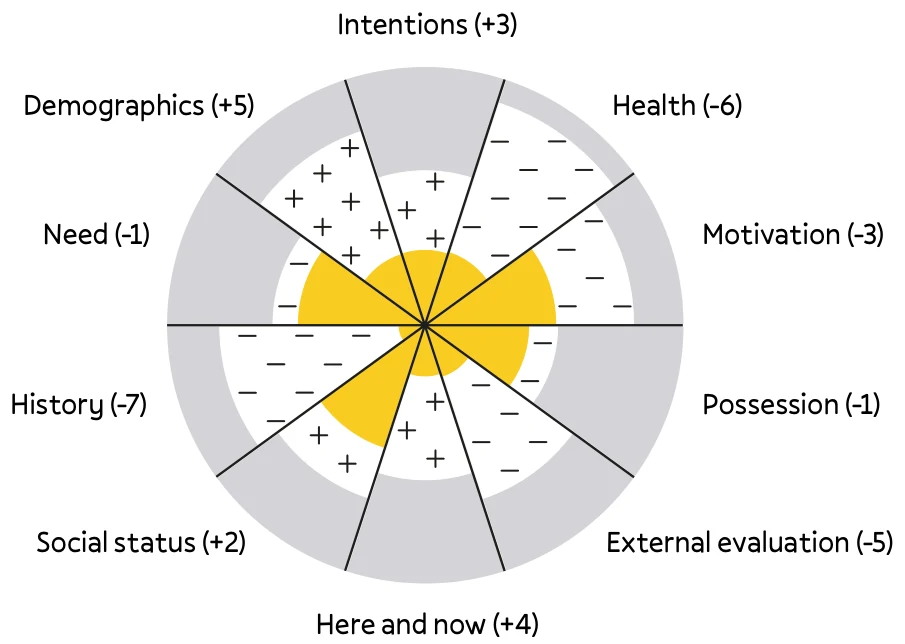
From the example, we can observe that each dimension yields a final rating, which may be a positive or negative number. This is obtained by subtracting the importance rating from the achievement rating. When achievement is greater than importance, we have a surplus (shown with plus signs). When importance is greater than achievement, we have a deficit (shown with minus signs).
In the example Self-Esteem Wheel, we see four dimensions with a surplus: here and now (+4), social status (+2), demographics (+5), and intentions (+3). Meanwhile, there are six dimensions with deficits: possession (-1), external evaluation (-5), history (-7), need (-1), health (-6), and motivation (-3).
Step 4: Calculate your total surplus and deficit.
Compute the total surplus and deficit by summing up the surplus ratings and deficit ratings separately. In the example, the total perceived surplus is +14, while the total perceived deficit is -23.
How to Make Sense of the Self-Esteem Wheel?
The Self-Esteem Wheel offers valuable insights into your self-assessment, highlighting excesses and deficits, dimensions of high importance to you, areas for self-improvement, and more. When analyzing your Self-Esteem Wheel, consider the following visual patterns:
-
Take note of how many dimensions show a high importance rating, represented in the outer ring by a dense cluster of plus or minus symbols.
Typically, this number is small for most individuals—often between one and four dimensions. However, an ideal state would show equal or nearly equal importance across all dimensions, signifying balanced self-esteem.13 In fact, when the importance ratings across all dimensions are perfectly balanced, the wheel symbolically reflects a state of inner peace—an embodiment of harmony and equilibrium.
-
Examine how many dimensions reflect a deficit, indicated by the presence of minus signs in the outer ring.
It’s common to have several dimensions where you feel your achievement doesn’t fully meet the level of importance you assign to them. These discrepancies may negatively impact your self-assessment. One way to respond is to reassess the weight you place on those dimensions.14 Ask yourself why they matter so much and explore the underlying beliefs, convictions, or expectations involved. Alternatively, focus on improving your sense of achievement in those areas to foster a deeper sense of progress and fulfillment.
-
Identify dimensions with substantial deficits, where a large gap exists between how important they are to you and how you currently assess your performance in them.
Often, individuals have one or two dimensions that evoke feelings of insignificance. Surprisingly, the recommendation is to shift focus to other dimensions during such moments.10 This perspective allows a broader view, reminding us that self-assessment is constructed from various dimensions. With a more balanced and positive self-perception, we can take appropriate steps forward.
-
Notice whether there are dimensions with surpluses, represented by plus signs in the outer ring.
These are often overlooked sources of confidence and strength. Although they may not always be at the forefront of our awareness, they can serve as powerful contributors to a more positive self-image. Recognizing and appreciating these surpluses can help you tap into hidden potential and reinforce your overall well-being.
Contrary to expectations, the Self-Esteem Wheel defines an excellent rating as having a total deficit and total excess of zero.
This signifies a state where no dimensions make us feel inadequate, and we value our successes across different dimensions proportionally to their weight. By analyzing your Self-Esteem Wheel based on these patterns, you can gain valuable insights into your self-assessment and make informed decisions about nurturing positive self-esteem.15
References
- M. Rosenberg, Society and the Adolescent Self-Image (Princeton University Press, 1965).
- C. J. Mruk, Self-Esteem and Positive Psychology: Research, Theory, and Practice, 4th ed. (Springer Publishing Company, 2013).
- H. Dittmar, Consumer Culture, Identity, and Well-Being: The Search for the “Good Life” and the “Body Perfect” (Psychology Press, 2008).
- L. Festinger, “A Theory of Social Comparison Processes,” Human Relations 7, no. 2 (1954): 117–40.
- L. Kohlberg, The Philosophy of Moral Development (Harper & Row, 1981).
- N. E. Adler et al., “Relationship of Subjective and Objective Social Status with Psychological Functioning,” Health Psychology 19, no. 6 (2000): 586–92.
- D. P. McAdams, “The Psychology of Life Stories,” Review of General Psychology 5, no. 2 (2001): 100–22.
- E. H. Erikson, Identity: Youth and Crisis (W.W. Norton, 1968).
- H. Tajfel and J. C. Turner, “The Social Identity Theory of Intergroup Behavior,” In Psychology of Intergroup Relations, ed. S. Worchel and W. G. Austin (Hall Publishers, 1986), 24–27.
- E. A. Locke and G. P. Latham, A Theory of Goal Setting & Task Performance (Prentice Hall, 1990).
- K. H. Trzesniewski et al., “Development of Self-Esteem,” In Self-Esteem (Psychology Press, 2013), 60–79.
- R. M. Ryan and E. L. Deci, “Self-Determination Theory and Intrinsic Motivation,” American Psychologist 55, no. 1 (2000): 68–78.
- K. Neff, “The Development and Validation of a Scale to Measure Self-Compassion,” Self and Identity 2, no. 3 (2003): 223–50.
- E. L. Deci and R. M. Ryan, “Human Autonomy: The Basis for True Self-Esteem,” in Efficacy, Agency, and Self-Esteem, ed. M. H. Kernis (Plenum Press, 1995), 31–49.
- J. Crocker and L. E. Park, The Costly Pursuit of Self-Esteem,” Psychological Bulletin 130, no. 3 (2004): 392–414.
From Never Stop Experimenting by Stavros Stavru, PhD, illustrated by Iva Grueva. Published here in full on .
How to cite this technique
Stavru, S. (2025). The Self-Esteem Wheel. In Never Stop Experimenting: 31 Real-World Experiments for Continuous Growth in Work and Life. Morgan James Publishing. https://neverstopexperimenting.com/techniques/self-esteem-wheel
Related techniques

03 · Personal growth
The Fly Technique
Take a moment to decelerate and prioritize what truly matters.
04 · Personal growth
The Cat Matrix
Master your personal efficiency.
05 · Personal growth
The Bonanza Goals
Establish irresistible goals that fuel your motivation.

06 · Personal growth
The Forever Check
Evaluate the long-term viability of your current routines.

26 · Stress & well-being
The Stress Reflector
Unveil the inner workings of stress and uncover a viable, long-term coping strategy.
15 · Leadership & teams
The Leadership Triangle
Assess people’s unwavering willingness to follow you, even to the ends of the earth.
One new experiment, now and then
New techniques, real-world results and behind-the-scenes stories from Stavros. No spam; unsubscribe anytime.