Technique 3 of 31
The Fly Technique
Take a moment to decelerate and prioritize what truly matters.
- Time Management
- Prioritization
- Productivity
In short
The Fly Technique is a task-triage method. Before working on a new task, you pause and answer five questions (important to me, important to others, clear, easy, urgent), then use a matrix to decide whether to delete, transfer, plan and postpone, delegate and follow up, clarify, simplify or execute it.
For: Individuals managing a heavy workload
The Problem
Task management isn’t just about getting things done—it’s about avoiding the trap of endless work.1 Many of us instinctively dive straight into tasks, assuming that action is always the best choice. However, this approach often leads to an overwhelming cycle where tasks pile up faster than we can complete them, resulting in decision fatigue and a decline in productivity.2 Studies show that constantly making decisions without a structured framework can deplete mental energy, leading to poor judgment and procrastination.2
The Experiment
To break this cycle, I collaborated with individual team members to test a more deliberate approach. This led to the development of the Fly Technique—a method that helps determine whether a task should be done now, postponed, redefined, delegated, or discarded. By shifting from reactive to intentional task management, we found a way to regain clarity and control over workload.
How Can I Handle a Task?
At first glance, it may appear peculiar to ask, “What can I do with a task?” However, the significance of this question should not be underestimated. While many would instinctively respond with, “I work on and complete the task,” it is vital to recognize that tasks often seem never-ending, like a continuous cycle, similar to a mouse endlessly spinning its wheel. Having explored a range of productivity frameworks—including Getting Things Done,2 the Eisenhower Matrix,3 Personal Kanban,4 time-blocking methodologies,1 constraint-based prioritization,5 and decision-making under cognitive load6—I’ve realized that execution is not always the best answer:7
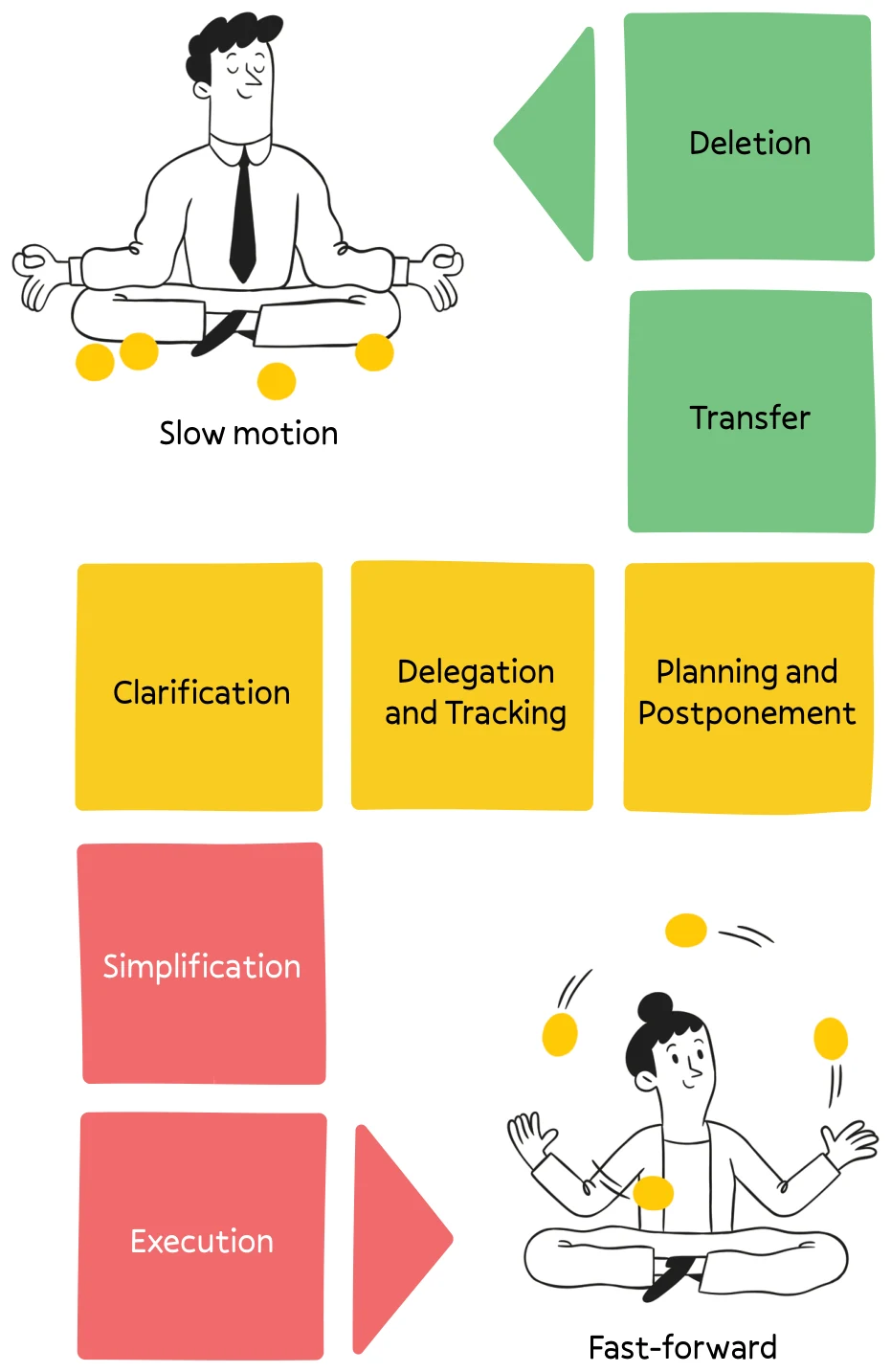
Deletion
Do I Need to Do This at All?
Surprisingly, the best decision is often to not do the task at all. Greg McKeown’s Essentialism8 emphasizes the power of saying no to low-value tasks to free up time for truly important work. The Pareto Principle (80/20 rule) suggests that 80% of results come from just 20% of efforts—so eliminating low-impact tasks can significantly boost productivity.appropriate choice.
Transfer
Can Someone Else Handle This?
Tasks can be reassigned entirely, including both execution and responsibility.3 Transferring is not just about offloading work but ensuring that the right person is handling the task efficiently. Studies on decision fatigue2 show that proper distribution of work prevents burnout and improves outcomes.
Planning and Postponement
Can It Wait?
Structured procrastination9 suggests that delaying a task strategically can improve efficiency by allowing for better preparation and focus. However, postponement should be intentional—not driven by avoidance. If you choose to delay a task, establish a clear review date to prevent it from becoming forgotten.
Delegation and Tracking
Can Someone Else Execute It While I Oversee It?
Unlike transferring a task outright, delegation involves maintaining responsibility while assigning the execution to someone else.10 This requires tracking progress and providing oversight. Successful delegation should reduce cognitive6 load without creating additional work for the delegator.
Clarification
Do I Fully Understand the Task?
Many inefficiencies stem from unclear expectations. Before jumping into a task, invest time in defining it precisely. Cognitive science research11 suggests that our brains resist ambiguity, leading to mental strain when handling vague tasks. By clarifying purpose and expectations, we improve execution speed and quality.
Simplification
Can I Make This Easier?
Complex tasks are more likely to be postponed or abandoned due to their cognitive load. Techniques like breaking tasks into subtasks2 and minimizing unnecessary effort12 help reduce complexity and boost execution speed.
Execution
Am I Ready to Act?
Only after considering all the above options should you begin working on the task. Deep Work1 highlights that focused execution requires eliminating distractions and engaging fully in the task.
How Does the Fly Experience Time?

When faced with a new task, resist the autopilot response of immediately working on it. Instead, pause and evaluate. Research on decision fatigue2 confirms that taking a moment to choose the right action saves more time in the long run than rushing into the wrong task.
The actions you choose shape the rhythm of your work and life.12 Merely rushing through tasks may leave you surprised as time slips away, with everything seeming to unfold in fast-forward. Conversely, consistently opting to delete, transfer, or postpone tasks may evoke feelings of boredom and dissatisfaction. The key lies in striking a harmonious balance. Below, we explore each action’s potential to propel you along the spectrum from slow motion to fast-forward.
How Can I Achieve Balance?
Discovering the ideal equilibrium requires careful consideration of the matrix presented below. As the cornerstone of the Fly Technique, this matrix serves as a practical tool to effortlessly ascertain whether a given task should be completed immediately, postponed, or approached from an entirely different angle.
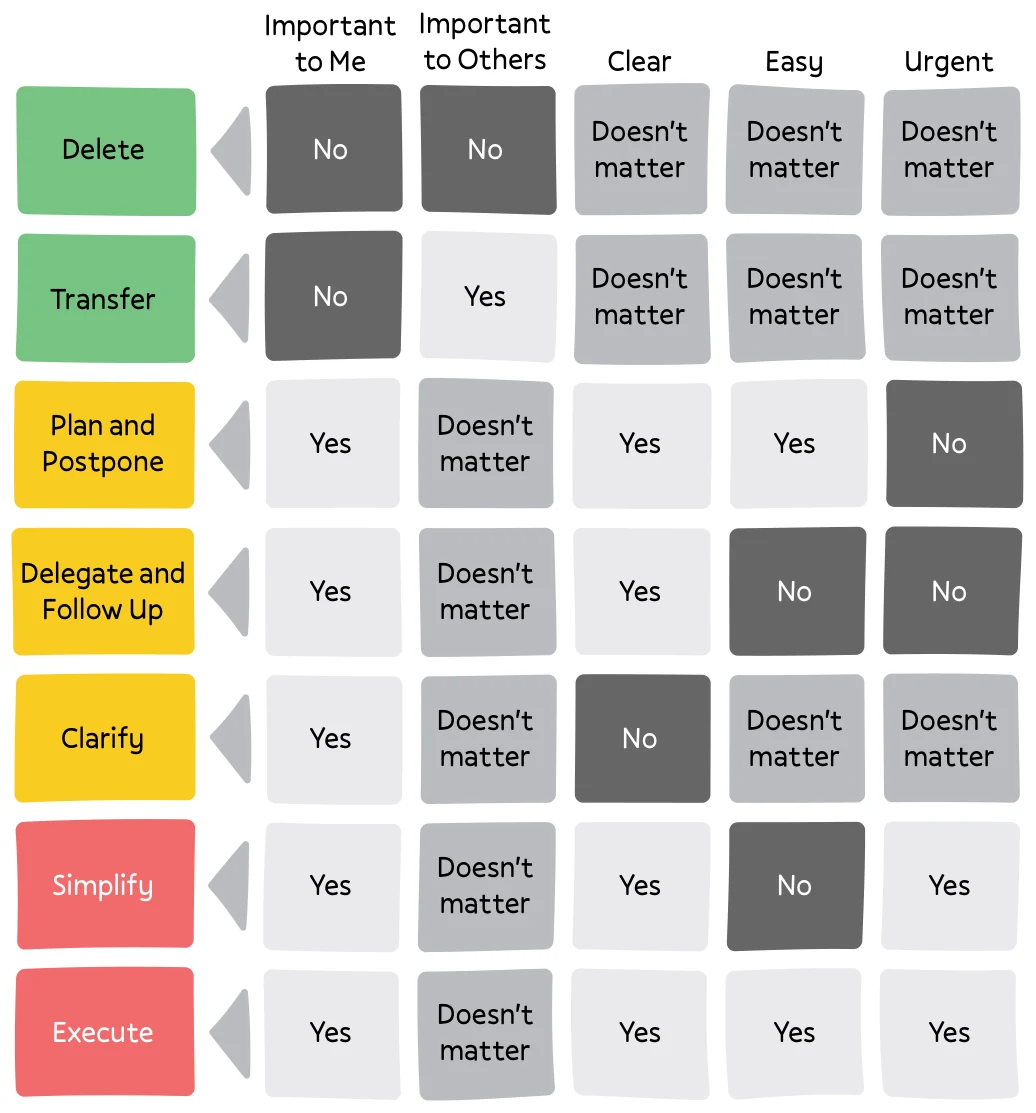
| Action | Important to Me | Important to Others | Clear | Easy | Urgent |
|---|---|---|---|---|---|
| Delete | No | No | Doesn’t matter | Doesn’t matter | Doesn’t matter |
| Transfer | No | Yes | Doesn’t matter | Doesn’t matter | Doesn’t matter |
| Plan and Postpone | Yes | Doesn’t matter | Yes | Yes | No |
| Delegate and Follow Up | Yes | Doesn’t matter | Yes | No | No |
| Clarify | Yes | Doesn’t matter | No | Doesn’t matter | Doesn’t matter |
| Simplify | Yes | Doesn’t matter | Yes | No | Yes |
| Execute | Yes | Doesn’t matter | Yes | Yes | Yes |
Now, how should you organize the tasks themselves? The answer lies in your responses to the following five pivotal questions that characterize each task:
- Is the completion of this task significant to me? Does it align with my personal goals and aspirations?
- Is the completion of this task significant to others? Consider the impact on colleagues, managers, teams, or any relevant stakeholders.
- Is the task urgent? Is there an impending deadline that necessitates its prompt completion?
- Is the task clear? Do you possess a comprehensive understanding of what needs to be done and the desired outcome?
- Is the task easy? Can it be swiftly accomplished with minimal effort?
References
- C. Newport, Deep Work: Rules for Focused Success in a Distracted World (Grand Central Publishing, 2016).
- R. F. Baumeister and J. Tierney, Willpower: Rediscovering the Greatest Human Strength (Penguin Press, 2011).
- S. R. Covey, The 7 Habits of Highly Effective People: Powerful Lessons in Personal Change (Simon & Schuster, 2013).
- J. Benson and T. DeMaria Barry, Personal Kanban: Mapping Work | Navigating Life (CreateSpace, 2011).
- E. M. Goldratt and J. Cox, The Goal: A Process of Ongoing Improvement, 3rd ed. (North River Press, 2004).
- D. J. Levitin, The Organized Mind: Thinking Straight in the Age of Information Overload (Dutton, 2014).
- O. Burkeman, Four Thousand Weeks: Time Management for Mortals (Farrar, Straus and Giroux, 2021).
- G. McKeown, Essentialism: The Disciplined Pursuit of Less (Crown Business, 2014).
- J. Perry, The Art of Procrastination: A Guide to Effective Dawdling, Lollygagging and Postponing (Workman Publishing, 2012).
- B. Tracy, Eat That Frog!: 21 Great Ways to Stop Procrastinating and Get More Done in Less Time, 3rd ed. (Berrett-Koehler Publishers, 2017).
- D. Kahneman, Thinking, Fast and Slow (Farrar, Straus and Giroux, 2011).
- J. P. Womack and D. T. Jones, Lean Thinking: Banish Waste and Create Wealth in Your Corporation (Free Press, 2003).
From Never Stop Experimenting by Stavros Stavru, PhD, illustrated by Iva Grueva. Published here in full on .
How to cite this technique
Stavru, S. (2025). The Fly Technique. In Never Stop Experimenting: 31 Real-World Experiments for Continuous Growth in Work and Life. Morgan James Publishing. https://neverstopexperimenting.com/techniques/fly-technique
Related techniques
04 · Personal growth
The Cat Matrix
Master your personal efficiency.
05 · Personal growth
The Bonanza Goals
Establish irresistible goals that fuel your motivation.

06 · Personal growth
The Forever Check
Evaluate the long-term viability of your current routines.

07 · Personal growth
The Self-Esteem Wheel
Gauge your positive self-perception.

19 · Stakeholders
The DFK Technique
Establish a clear and accurate goal for your communication.
One new experiment, now and then
New techniques, real-world results and behind-the-scenes stories from Stavros. No spam; unsubscribe anytime.