Technique 2 of 31
The Growth Map
Lay the groundwork for a strong culture of experimentation.
- Culture
- Organizational Development
- Learning
In short
The Growth Map is a visual tool for measuring a team’s culture of continuous improvement. Team members label each task by zone (gray for boredom, yellow for comfort, green for growth, red for anxiety), visualize the labels monthly and score the result. It builds on a five-step Growth Ladder of Safety, Empathy, Meaning, Challenge and Creativity.
For: Teams, team leads and organizations building a culture of growth
The Problem
Agile and high-performing teams thrive on continuous improvement, but a common challenge persists: How do we accelerate the adoption of a Kaizen culture1 and Growth Mindset?2 While the intent is there, it remains unclear how to embed these mindsets effectively.
The Experiment
While working with organizations on continuous improvement, I partnered with teams to refine a structured yet flexible approach—the Growth Map. This visual tool helps teams assess their current state, pinpoint gaps, and develop strategies for progress. By integrating it into their practices, teams gained a clear, actionable pathway toward fostering a true culture of growth.
What Are the Steps of the Growth Ladder?

Step 5: Creativity
Nurture an environment that embraces exploration and freedom.8 Encourage individuals to investigate, create, and unleash their curiosity. Curiosity fuels the desire for learning, granting individuals immense power to innovate and grow.
Step 4: Challenge
Learning thrives in the face of difficulty.7 Create a stimulating environment where individuals regularly encounter well-calibrated challenges. Emphasize problem definition over prescribing solutions, empowering individuals to seek innovative answers rather than merely following prescribed paths.
Step 3: Meaning
Provide a compelling context and fill activities with purpose.5 By granting individuals a mission and a sense of significance, their motivation flourishes, fueling their desire to excel in their endeavors.6
Step 2: Empathy
Cultivate a culture of care and respect for others’ unique qualities. This fosters a strong sense of self-esteem, boosts confidence, and encourages assertiveness—a catalyst for self-actualization.4
Step 1: Safety
Imperfection and growth go hand in hand. Foster a safe environment where individuals feel at ease making mistakes.3 Celebrate errors, elevating them as invaluable opportunities from which we derive lessons and strive for improvement. Transform mistakes into powerful stepping stones toward growth.
Similar to ascending a ladder, the journey toward a culture of continuous improvement requires a deliberate progression through each step. Each stage holds vital importance, and neglecting any step can significantly impede the transformation process.
Throughout my years of experience, I have attempted to navigate the steps in various orders, only to encounter unfavorable outcomes. While it is possible to cultivate a growth mindset culture in a team by deviating from the suggested sequence, it often requires greater sacrifices, time, and effort. This outcome is not coincidental. Safety forms the foundation; without it, the most profound curiosity and exploratory spirit, well-balanced challenges, meaningful purpose, and positive self-esteem cannot thrive.9 Fear and the sense of vulnerability hinder experimentation and the willingness to try new things.10 On the other hand, creativity without challenges or with excessive challenges can lead to boredom or overwhelming burdens. Without meaning, challenge and creativity prove unsustainable, leading to quick disappointment in the face of adversity. Conversely, creativity devoid of challenges or with excessive challenges can devolve into boredom or overwhelming burdens.
How Is Growth Measured?
Recall the timeless tale of Goldilocks and the Three Bears, where Goldilocks discovers her preference for porridge that is neither too hot nor too cold, but just right—the perfect temperature. This narrative holds a valuable lesson when applied to the realm of learning and continuous improvement, known as the Goldilocks principle. This principle asserts that learning is most effective when the task at hand falls within the optimal range—not too easy, yet not too difficult.11
Based on the complexity of a given task and our ability to tackle it, we can find ourselves in one of the following four zones (adapted from the works of Lev Vygotsky):12
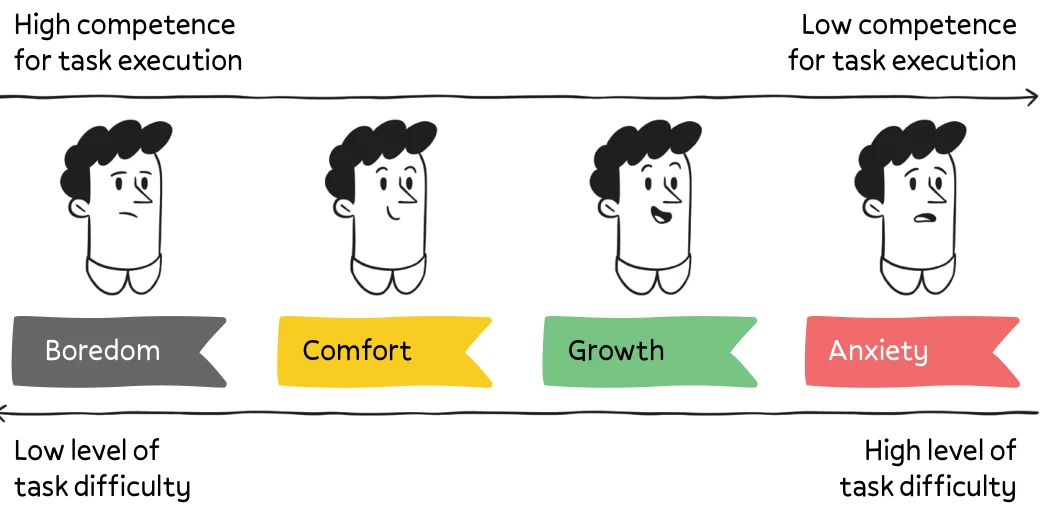
| Zone | What it means |
|---|---|
| Gray Zone (Boredom) | In this zone, we possess high proficiency and mastery, but the tasks we encounter feel trivial and fail to engage our abilities. |
| Yellow Zone (Comfort) | This zone indicates a harmonious match between our abilities and the complexity of the tasks we undertake. We navigate comfortably within this realm. |
| Green Zone (Growth) | As we enter the growth zone, the complexity of tasks surpasses our existing capabilities. However, we hold confidence and determination, foreseeing our potential for success and growth. |
| Red Zone (Anxiety) | The anxiety zone arises when the complexity of tasks surpasses our abilities, leaving us lacking in confidence and filled with worry. |
Thus, the question of measuring the strength of our culture of continuous improvement transforms into an inquiry into how much time we spend in the growth or green zone. The answer to this question provides us with the Growth Map—an invaluable insight into the robustness of our culture of continuous improvement.
How Strong Is Your Culture of Experimentation?
Within my professional practice, I have employed a straightforward method to gauge the strength of a team or organization’s culture of continuous improvement. I refer to this approach as the Growth Map—a visual representation of the tasks undertaken by individuals within a given timeframe, categorized into the four zones mentioned earlier.
Step 1: Assessment
Whenever a team member receives a task, they assign a label to it based on the zone it falls into, aligning with their own competence and perception of difficulty. Ideally, the label corresponds to the color associated with the respective zone: gray for boredom, yellow for comfort, green for growth, and red for anxiety. Alternatively, the team as a whole can collectively determine the labels instead of relying on individual assessments.
Step 2: Visualisation
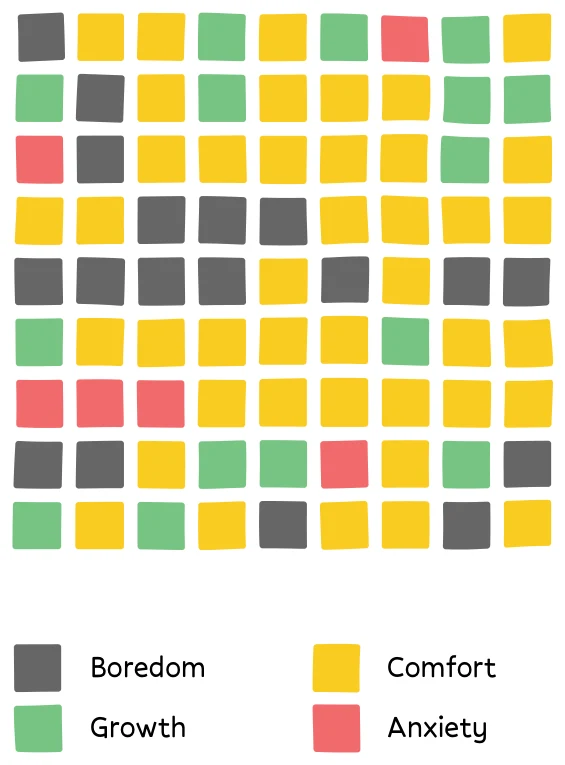
At regular intervals, such as monthly, visualize the task labels at both the individual and team levels.
This visualization provides a comprehensive view of the Growth Map.
Step 3: Analysis and evaluation
With the visualized Growth Map in hand, it becomes effortless to assess the degree to which a growth culture prevails. The presence of mostly gray or red squares indicates room for improvement, while the ideal scenario features a map filled with plenty of green squares.
If a quantitative metric is desired, consider employing the following formula (inspired by Csikszentmihalyi’s seminal work13 on optimal performance):
Growth Culture Score = Number of Green Squares – Number of Gray Squares
Naturally, alternative formulas can be employed, such as the sheer count or percentage of green squares.
Step 4: Intervention
Utilize the insights gleaned from the Growth Map to identify areas of deficiency within the environment. Develop strategies to address these shortcomings and foster a stronger culture of continuous improvement.
References
- M. Imai, Kaizen: The Key to Japan’s Competitive Success (McGraw-Hill, 1986).
- C. Dweck, Mindset: The New Psychology of Success (Ballantine Books, 2016).
- A. C. Edmondson, The Fearless Organization: Creating Psychological Safety in the Workplace for Learning, Innovation, and Growth (Wiley, 2019).
- C. Rogers, Client-Centered Therapy: Its Current Practice, Implications and Theory (Houghton Mifflin, 1951).
- D. H. Pink, Drive: The Surprising Truth About What Motivates Us (Riverhead Books, 2011).
- S. Sinek, Start with Why: How Great Leaders Inspire Everyone to Take Action (Penguin, 2009).
- K. A. Ericsson and R. Pool, Peak: Secrets from the New Science of Expertise (Houghton Mifflin Harcourt, 2016).
- M. Csikszentmihalyi, Creativity: Flow and the Psychology of Discovery and Invention (Harper Perennial, 1996).
- P. Lencioni, The Five Dysfunctions of a Team (Jossey-Bass, 2002).
- B. Brown, Daring Greatly: How the Courage to Be Vulnerable Transforms the Way We Live, Love, Parent, and Lead (Gotham Books, 2012).
- R. Bjork and E. Bjork, Making Things Hard on Yourself, But in a Good Way: Creating Desirable Difficulties to Enhance Learning (Psychology and the Real World, 2011)
- L. S. Vygotsky, Mind in Society: The Development of Higher Psychological Processes (Harvard University Press, 1978).
- M. Csikszentmihalyi, Flow: The Psychology of Optimal Experience (Harper Perennial Modern Classics, 2008).
From Never Stop Experimenting by Stavros Stavru, PhD, illustrated by Iva Grueva. Published here in full on .
How to cite this technique
Stavru, S. (2025). The Growth Map. In Never Stop Experimenting: 31 Real-World Experiments for Continuous Growth in Work and Life. Morgan James Publishing. https://neverstopexperimenting.com/techniques/growth-map
Related techniques

01 · Foundation
The NSE Ratio
Uncover the optimal frequency for engaging in new experiments.
30 · Retrospectives
The Teaming Wheel
Choose a team reflection that meets your current stage of development.

28 · Stress & well-being
The Engagement Pentagram
Foster a deep emotional connection between individuals and their team and organization.
One new experiment, now and then
New techniques, real-world results and behind-the-scenes stories from Stavros. No spam; unsubscribe anytime.