Technique 30 of 31
The Teaming Wheel
Choose a team reflection that meets your current stage of development.
- Team Development
- Intentional Growth
- Adaptive Teaming
In short
The Teaming Wheel matches a team’s retrospective to its stage of development (forming, storming, norming, performing or adjourning). Its fifteen focus areas, from closeness and trust to innovation and gratitude, are grouped in five coloured zones. The Teaming Scan, twelve questions rated 1 to 10, finds the first area scoring 5 or less to reflect on next.
For: Retrospective facilitators, Scrum Masters and Agile teams
The Problem
Agile teams often tweak retrospective designs to combat disengagement, but the real issue runs deeper.1 When discussions don’t align with the team’s growth areas, reflection feels pointless, leading to frustration and low engagement.
The Experiment
Instead of focusing on structure alone, I collaborated with teams to co-create The Teaming Wheel—a developmental tool that helps groups surface and address their most relevant challenges. By matching reflection to a team’s real-time growth needs, conversations became more meaningful, engaging, and actionable.
Why Developmental Alignment Matters?
Just as individuals evolve through stages, so do teams. Drawing on Tuckman’s stages of group development2—forming, storming, norming, performing, and adjourning—we can better support teams by aligning reflective practices with where they are, not where we wish they were.
While discussions about product quality or delivery speed are always tempting, they often address symptoms rather than root causes. Teams that prioritize developmental reflection—the kind that aligns with their current maturity—tend to unlock deeper, more sustainable performance gains. This insight draws directly from Amy Edmondson’s concept of teaming3: the idea that effective collaboration isn’t a static condition but a continuous process of learning, adapting, and evolving together in real time.
Unlike traditional models that treat “team” as a fixed unit, Edmondson frames teaming as a verb—a dynamic activity where people come together, often across boundaries, to solve complex problems in rapidly changing contexts. Teaming requires psychological safety, shared understanding, and constant re-alignment—especially as teams shift, grow, or dissolve.
The Teaming Wheel was inspired by this perspective. It is designed to support teams in doing the work of teaming—by engaging in structured, stage-matched reflections that evolve as the team evolves. Rather than applying a one-size-fits-all format, the Wheel helps teams reflect on the right things at the right time, fostering growth that is both situationally relevant and developmentally grounded.
The Zones of The Teaming Wheel
Each zone of the Teaming Wheel corresponds to a specific stage of development and its key psychological or collaborative focus:
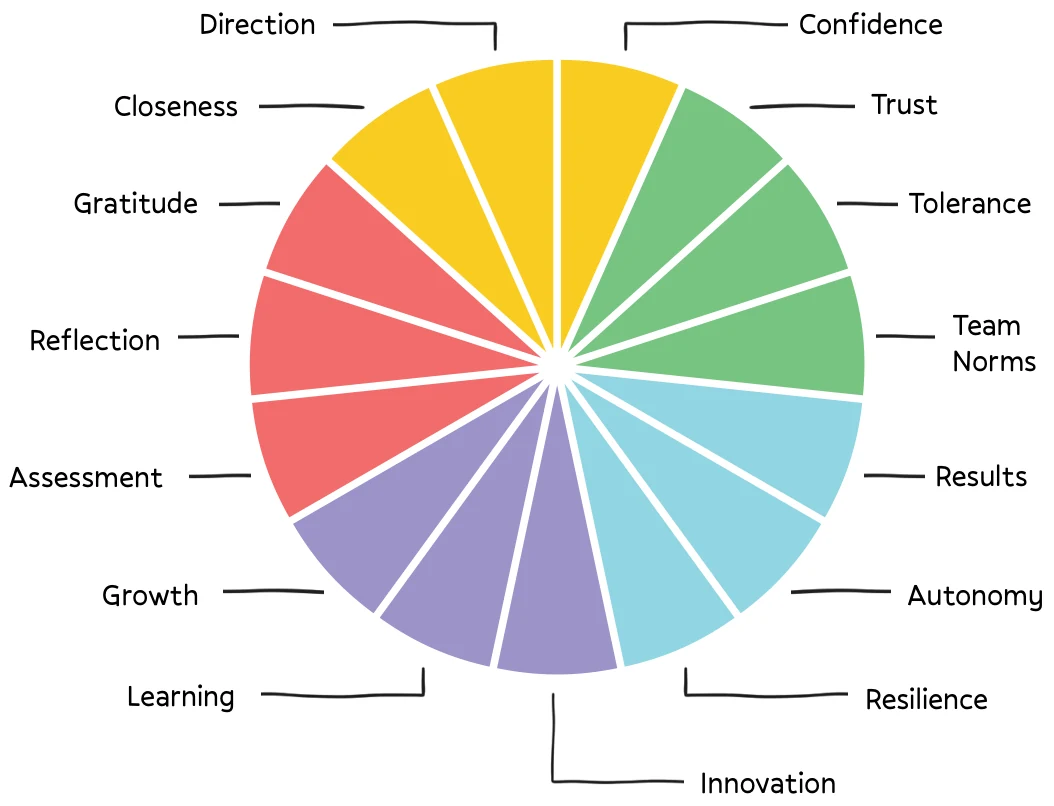
Yellow Zone—Forming
In the forming stage, retrospectives begin with fostering closeness4 through structured personal sharing activities like journey lines and working preference discussions, helping team members develop genuine connections and understanding of each other’s styles. This is followed by direction-setting5 exercises that focus on creating a shared vision and clear goals, using techniques like impact mapping and success criteria definition to align individual contributions with team objectives. The final focus in this zone is building confidence6 through strength-spotting activities and early win celebrations, helping the team recognize its collective capabilities and establish a foundation of self-belief.
Green Zone—Storming
During the storming phase, retrospectives first concentrate on building trust7 through psychological safety exercises and vulnerability circles, creating an environment where team members feel safe to express themselves honestly. This progresses to developing tolerance8 through perspective-sharing activities and cultural mapping exercises, helping the team appreciate and leverage their differences rather than seeing them as obstacles. The final emphasis is on establishing clear team norms9 through collaborative creation of working agreements and communication protocols, providing structure and clarity for team interactions.
Blue Zone—Norming
In the norming phase, retrospectives initially focus on optimizing results10 through value stream mapping and process improvement workshops, helping the team identify and eliminate inefficiencies. This advances to building autonomy11 through decision authority matrices and self-organization exercises, enabling the team to operate independently and make decisions effectively, an approach that aligns with principles of self-managed teams. The final area emphasizes developing resilience12 through sustainable practice planning and stress-testing scenarios, ensuring the team can maintain high performance while avoiding burnout.
Purple Zone—Performing
During the performing phase, retrospectives concentrate first on fostering innovation13 through creative thinking exercises and experiment design workshops, pushing the team beyond conventional solutions. This is followed by an emphasis on continuous learning14 through learning matrices and skill development planning, ensuring the team keeps evolving and improving. The focus on stepping out of comfort zones helps prevent complacency and maintains the team’s high performance through constant challenges and development.15 Ultimately, this high-performing team becomes a platform for individual growth—supporting each member in fully developing their talents, unlocking their personal potential, and finding purpose within the collective success.
Red Zone—Adjourning
In the adjourning phase, retrospectives begin with comprehensive assessment16 activities like success story timelines and impact evaluations, documenting the team’s achievements and learnings. This moves to reflection exercises through journey mapping and lessons-learned documentation, helping team members process their shared experience.17 The final focus is on expressing gratitude18 through appreciation circles and impact story sharing, providing emotional closure and recognition of individual contributions.
What Is the Most Significant Pain Point for My Team at This Moment?
To effectively use the Teaming Wheel, it is crucial to identify the team’s most pressing pain. Failing to pinpoint the right pain can prolong suffering, impede decision-making, and exacerbate the impact of other challenges faced by the team. Recognizing the significance of this, I have developed a simple tool to facilitate the effective use of the Teaming Wheel—The Teaming Scan:
Rate the following factors on a scale of 1 (lowest) to 10 (highest):
| Question | ≤5 | >5 |
|---|---|---|
| 1. How well do team members know each other? | Closeness | Go to question 2 |
| 2. How familiar are team members with the team’s specific goals and tasks? | Direction | Go to question 3 |
| 3. How confident do team members feel, both individually and as a cohesive unit, in their ability to overcome challenges? | Confidence | Go to question 4 |
| 4. To what extent do team members trust one another and feel comfortable displaying vulnerability? | Trust | Go to question 5 |
| 5. How accepting are team members of differences, and how willing are they to collaborate? | Tolerance | Go to question 6 |
| 6. How clearly defined are the team’s rules and norms, including procedures and processes? | Team Norms | Go to question 7 |
| 7. How effectively does the team achieve outstanding results in the most efficient and streamlined manner? | Results | Go to question 8 |
| 8. To what degree is the team self-initiated and capable of working autonomously? | Autonomy | Go to question 9 |
| 9. How sustainable are the team’s practices and processes in the long run? | Resilience | Go to question 10 |
| 10. How successful is the team in generating new value and fostering innovation? | Innovation | Go to question 11 |
| 11. To what extent does the team embrace stepping out of its comfort zone? | Learning | Go to question 12 |
| 12. How much does the team contribute to the growth, both personal and professional, of its members? | Growth |
Where Can I Find a Variety of Retrospectives to Explore and Choose From?
As Derby and Larsen1 emphasize, retrospectives should follow a well-planned sequence of activities that guide the team through reflection, learning, and actionable decision-making. To support this, explore established digital resources like funretrospectives.com, tastycupcakes.org, retrospectivewiki.org, and retromat.org. These platforms offer diverse retrospective toolkits, helping facilitators build retrospectives that go beyond isolated activities to create a meaningful flow tailored to the team’s development stage.
The key to successful retrospective facilitation lies in mastering both the theoretical foundations and practical applications of team improvement techniques, ensuring retrospectives serve as structured reflections rather than mere status updates.19 While online resources offer valuable tactical solutions, effective retrospectives require more than just selecting activities—they need a thoughtfully designed flow that aligns with the team’s development stage and challenges. Deeper understanding comes from exploring literature that examines the psychology and group dynamics of retrospectives. By integrating structured facilitation techniques with theoretical knowledge, facilitators can craft retrospectives that drive meaningful insights and sustained team growth.1
References
- E. Derby and D. Larsen, Agile Retrospectives: Making Good Teams Great (Pragmatic Bookshelf, 2006).
- B. W. Tuckman, “Developmental Sequence in Small Groups,” Psychological Bulletin 63, no. 6 (1965): 384–99.
- A. Edmondson, Teaming: How Organizations Learn, Innovate, and Compete in the Knowledge Economy (Jossey-Bass, 2012).
- J. E. Dutton, Energize Your Workplace: How to Create and Sustain High-Quality Connections at Work (Jossey-Bass, 2003).
- E. A. Locke and G. P. Latham, “Building a Practically Useful Theory of Goal Setting and Task Motivation: A 35-Year Odyssey,” American Psychologist 57, no. 9 (2002): 705–17.
- A. Bandura, Self-Efficacy: The Exercise of Control (Freeman, 1997).
- A. Edmondson, The Fearless Organization: Creating Psychological Safety in the Workplace for Learning, Innovation, and Growth (Wiley, 2019).
- E. Meyer, The Culture Map: Breaking Through the Invisible Boundaries of Global Business (PublicAffairs, 2014).
- J. R. Hackman, Leading Teams: Setting the Stage for Great Performances (Harvard Business Review Press, 2002).
- C. Duhigg, Smarter Faster Better: The Secrets of Being Productive in Life and Business (Random House, 2016).
- F. Laloux, Reinventing Organizations (Nelson Parker, 2014).
- D. L. Coutu, “How Resilience Works,” Harvard Business Review 80, no. 5 (2002), 46–50, 52, 55 passim.
- T. M. Amabile and S. J. Kramer, The Progress Principle: Using Small Wins to Ignite Joy, Engagement, and Creativity at Work (Harvard Business Review Press, 2011).
- P. Senge, The Fifth Discipline: The Art & Practice of the Learning Organization (Doubleday, 1990).
- C. S. Dweck, Mindset: The New Psychology of Success (Random House, 2006).
- M. J. Darling, C. S. Parry, and J. Moore, “Learning in the Thick of It,” Harvard Business Review 83, no. 7 (2005), 84–92, 192.
- D. A. Schön, The Reflective Practitioner: How Professionals Think in Action (Basic Books, 1983).
- A. Grant, Give and Take: A Revolutionary Approach to Success (Viking, 2013).
- N. Kerth, Project Retrospectives: A Handbook for Team Review (Dorset House, 2001).
From Never Stop Experimenting by Stavros Stavru, PhD, illustrated by Iva Grueva. Published here in full on .
How to cite this technique
Stavru, S. (2025). The Teaming Wheel. In Never Stop Experimenting: 31 Real-World Experiments for Continuous Growth in Work and Life. Morgan James Publishing. https://neverstopexperimenting.com/techniques/teaming-wheel
Related techniques

29 · Retrospectives
The Rocket Retrospective
Conduct retrospectives in time-constrained and low-engagement situations.
31 · Retrospectives
The Replay Check
Determine the extent to which others are pleased with the outcomes of your initiative.

02 · Foundation
The Growth Map
Lay the groundwork for a strong culture of experimentation.

28 · Stress & well-being
The Engagement Pentagram
Foster a deep emotional connection between individuals and their team and organization.
One new experiment, now and then
New techniques, real-world results and behind-the-scenes stories from Stavros. No spam; unsubscribe anytime.