Technique 31 of 31
The Replay Check
Determine the extent to which others are pleased with the outcomes of your initiative.
- Satisfaction Measurement
- Event Evaluation
- Feedback
In short
The Replay Check measures how satisfied people are with a meeting, training or initiative by asking whether they would choose to repeat it, not whether they would recommend it as the Net Promoter Score does. People answer on a 0–100% scale, which exposes Promoters who value an event for others but got little from it themselves.
For: Facilitators, trainers and meeting organizers
The Problem
For years, I relied on the Net Promoter Score (NPS) to measure satisfaction in meetings, trainings, and initiatives.1 However, I realized that NPS focuses on recommending an experience rather than personal satisfaction, leading to ambiguous responses. Many studies have questioned NPS’s reliability, pointing out that it fails to accurately predict actual behavior and is often influenced by social desirability bias.2
The Experiment
A casual conversation with my daughter sparked a new idea: Why do we sometimes enjoy experiences but wouldn’t choose to relive them? Testing this concept led to the Replay Check—where instead of asking if someone would recommend an experience, we ask if they would choose to repeat it. This proved to be a more honest measure of engagement and satisfaction, helping teams refine their initiatives based on genuine feedback.
Would You Like to Have It Once More?
The idea for the Replay Check came about very spontaneously.
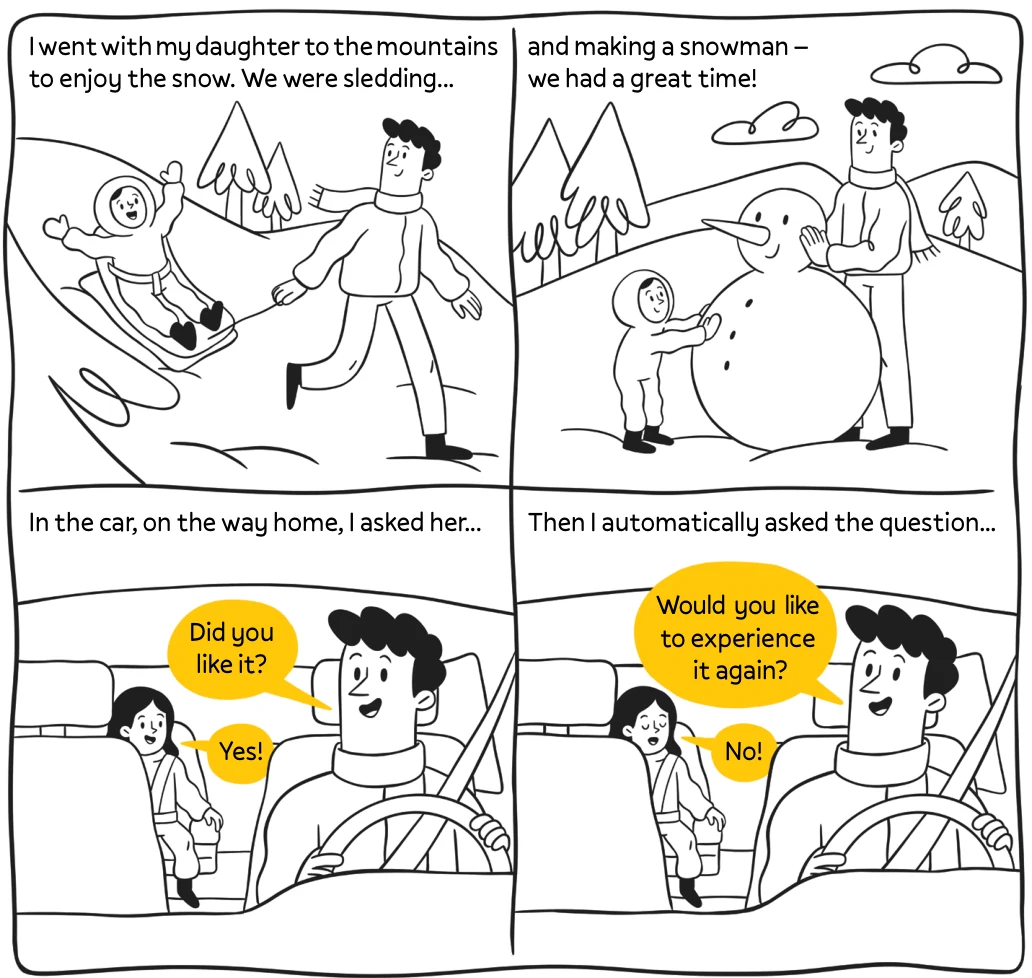
Read the comic as text
I went with my daughter to the mountains to enjoy the snow. We were sledding…
and making a snowman – we had a great time!
In the car, on the way home, I asked her…
Father: Did you like it?
Daughter: Yes!
Then I automatically asked the question…
Father: Would you like to experience it again?
Daughter: No!
Her negative answer made such a strong impression on me that I spent the next few days reflecting on why people enjoy something yet wouldn’t want to repeat it. When we experience something, we tend to justify the investment we made (in terms of time, effort, etc.), even if the decision was obviously wrong.3 This is related to the sunk cost fallacy—our unwillingness to admit that we made a poor choice.
However, the problem runs deeper. Studies on affective forecasting show that people are notoriously bad at predicting their future enjoyment.4 We overestimate the lasting impact of positive experiences and underestimate the effect of negative ones. Similarly, self-perception theory5 suggests that we often determine our attitudes based on past behavior. This means that if we recommend an experience, we assume we must have enjoyed it—regardless of whether we truly want to relive it.
The question “Would you like to experience it again?” bypasses these biases and provides a much more realistic assessment of satisfaction. The Replay Check is based on this idea—instead of asking if someone would recommend an experience, we ask if they would choose to repeat it.
What are the chances (in %) that you’d recommend this experience to your past self, if time travel were possible?

Reflecting on my experience with NPS, I encountered situations where individuals rated as Promoters, yet their Replay Check scores were 0% or 10%. This intriguing phenomenon suggests that they recognize the value of the event for others, understanding that it may better address their needs. However, they themselves did not derive personal benefit, leading to a sense of dissatisfaction.6 Thus, the Replay Check has become an integral component of my measurement toolkit, encompassing corporate meetings (as an effective method for evaluating their effectiveness), as well as training and workshops.
References
- F. F. Reichheld, “The One Number You Need to Grow,” Harvard Business Review 81, no. 12 (2003): 46–54.
- K. Kristensen and J. Eskildsen, “Is the NPS a Trustworthy Performance Measure?” Journal of Service Research 17, no. 2 (2014): 182–93.
- H. R. Arkes and C. Blumer, “The Psychology of Sunk Cost,” Organizational Behavior and Human Decision Processes 35, no. 1 (1985): 124–40.
- D. T. Gilbert and T. D. Wilson, “Prospection: Experiencing the Future,” Science 317, no. 5843 (2007): 1351–54.
- D. J. Bem, “Self-Perception Theory,” Advances in Experimental Social Psychology 6 (1972): 1–62.
- S. M. Dahl, D. R. Little, and J. R. Trinkner, “The Recommendation-Experience Gap: Why People Recommend Experiences They Wouldn't Choose Again,” Journal of Consumer Psychology 31, no. 2 (2021): 302-317.
From Never Stop Experimenting by Stavros Stavru, PhD, illustrated by Iva Grueva. Published here in full on .
How to cite this technique
Stavru, S. (2025). The Replay Check. In Never Stop Experimenting: 31 Real-World Experiments for Continuous Growth in Work and Life. Morgan James Publishing. https://neverstopexperimenting.com/techniques/replay-check
Related techniques
29 · Retrospectives
The Rocket Retrospective
Conduct retrospectives in time-constrained and low-engagement situations.
30 · Retrospectives
The Teaming Wheel
Choose a team reflection that meets your current stage of development.

16 · Leadership & teams
The Decision Compass
Assess and enhance the efficiency of your decision-making.

25 · Stress & well-being
The Lottery Check
Assess the contentment of the individuals you lead.
One new experiment, now and then
New techniques, real-world results and behind-the-scenes stories from Stavros. No spam; unsubscribe anytime.