Technique 16 of 31
The Decision Compass
Assess and enhance the efficiency of your decision-making.
- Decision-Making
- Evaluation
- Consensus
In short
The Decision Compass measures how efficient a decision is. Rate it from 1 to 10 on four dimensions, cost, quality, commitment and anticipated impact, plot the ratings on a compass, and take the lowest rating as the decision’s efficiency score. Teams compare scores, agree on one and plan actions to raise it.
For: Individuals and teams making decisions
The Problem
High-performing teams need efficient decision-making, yet many struggle with slow, unclear, or ineffective processes that limit agility.1 Without a structured approach, decisions can feel reactive rather than strategic, making it harder to navigate complexity with confidence.2 The challenge is not just speed but also ensuring decisions are well-informed and impactful, particularly when navigating unstructured and complex decision environments.3
The Experiment
To address this, I worked with teams to create the Decision Compass—a structured tool that breaks decisions into four key dimensions, offering insights into strengths and improvement areas. By integrating this framework, teams transitioned from uncertainty to clarity, improving both speed and quality in decision-making
What Does It Take to Be Efficient in Decision-Making?

The Decision Compass examines the efficacy of decision-making across four pivotal dimensions:
Cost
Within this dimension, we delve into the practicality of the decision’s cost. We evaluate factors such as time investment, missed opportunities, expenses incurred throughout the decision-making process, and more.4
Quality
Here, we gauge the level of excellence in the decision’s quality. We assess its thoroughness, accuracy in addressing cognitive biases and logical fallacies,5 consistency, and other markers of sound decision-making, considering key judgment errors in managerial decisions.6
Commitment
In this dimension, we explore the extent of alignment and engagement among stakeholders toward the decision. We consider factors like acceptance by others, willingness to contribute, emotional attachment, and overall consensus.7
(Anticipated) Impact
Within this dimension, we analyze the projected positive effects of the decision. We evaluate anticipated outcomes, the decision’s ecological impact, potential side effects or negative consequences, and other aspects tied to the expected results.8
How Does the Decision Compass Safeguard Your Choices?
To effectively assess your decision using the Decision Compass, follow these steps:
Step 1: Evaluate the efficiency of each decision dimension.
Assign a rating from 1 (lowest) to 10 (highest) for each dimension, considering the following aspects:
| Dimension | Rating |
|---|---|
| 1. How optimal is the cost of the decision made? Time spent; missed opportunities; expenses incurred in the decision-making process, etc. | 3 |
| 2. How high is the quality of the decision made? Completeness; accuracy in addressing cognitive biases and logical errors; consistency, etc. | 6 |
| 3. What is the level of commitment, from both yourself and others, to the decision that has been made? Acceptance by others; willingness to contribute; emotional attachment, etc. | 2 |
| 4. What is the expected effect of the decision made? Anticipated outcomes; potential side effects, etc. | 6 |
Step 2: Visualize the ratings using the Decision Compass.
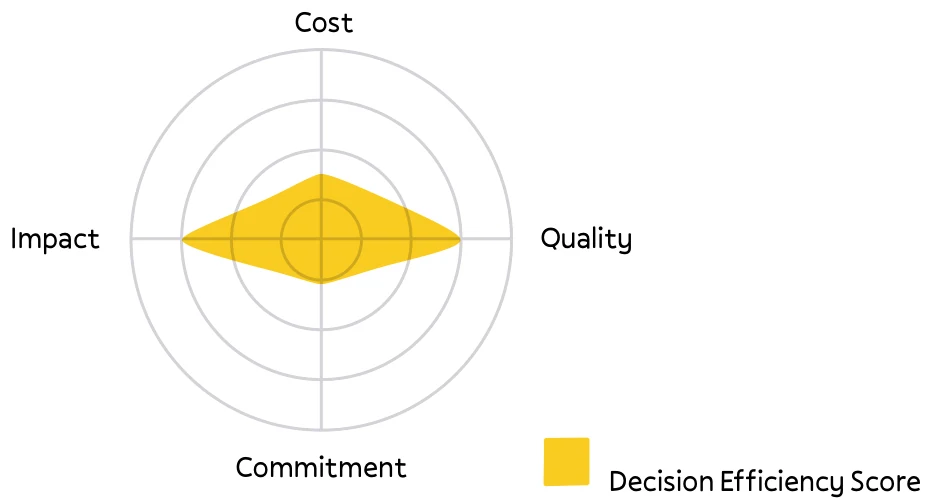
Refer to the example compass below, where the cost of the decision is rated at 3, decision quality at 6, commitment at 2, and expected impact at 6.
Step 3: Calculate the overall efficiency score for your decision.
The final score corresponds to the lowest rating among the four dimensions. This approach acknowledges that a decision is only as robust as its weakest aspect.9 The goal is to incrementally enhance this final score, starting from the dimension presenting the most significant challenges in your decision-making process.
In the example above, the final score is 2, with commitment alignment being the weakest link.
How to Utilize the Decision Compass for Collective Decision-Making?
Throughout my experience, I have explored various formats to streamline the evaluation process when decisions are made collectively.
- Individual Decision Compasses. Each team member individually rates the dimensions for efficient decision-making on a scale of 1 to 10. Based on their evaluations, they create their own Decision Compass and calculate their final score.
- Discussion. In this step, each person shares their final score. The focus then shifts to the lowest and highest scores, encouraging open discussion and justifications for the varying perspectives.
- Consensus. Steps 1 and 2 are repeated until a common final score is agreed upon by the team, reflecting the collective assessment of the decision-making process’s efficiency.
- Follow-Up Actions. Identify potential actions that can enhance the final score, addressing areas for improvement and bolstering the decision-making process.
References
- K. M. Eisenhardt, “Making Fast Strategic Decisions in High-Velocity Environments,” Academy of Management Journal 32, no. 3 (1989): 543–76
- D. Kahneman, D. Lovallo, and O. Sibony, “Before You Make That Big Decision,” Harvard Business Review 89, no. 6 (2011): 50–60.
- H. Mintzberg, D. Raisinghani, and A. Theoret, “The Structure of ‘Unstructured’ Decision Processes,” Administrative Science Quarterly 21, no. 2 (1976): 246–75.
- R. A. Howard, “Decision Analysis: Practice and Promise,” Management Science 34, no. 6 (1988): 679–95.
- A. Tversky and D. Kahneman, “Judgment Under Uncertainty: Heuristics and Biases,” Science 185, no. 4157 (1974): 1124–31.
- M. H. Bazerman and D. A. Moore, Judgment in Managerial Decision Making, 7th ed. John Wiley & Sons, 2008).
- C. A. O’Reilly, and J. Chatman, “Organizational Commitment and Psychological Attachment: The Effects of Compliance, Identification, and Internalization on Prosocial Behavior,” Journal of Applied Psychology 71, no. 3 (1986): 492–99.
- R. L. Keeney and H. Raiffa, Decisions with Multiple Objectives: Preferences and Value Trade-Offs (Cambridge University Press, 1993).
- Aczél, J., & Alsina, C. (1987). “Synthesizing Judgements: A Functional Equations Approach.” Mathematical Modelling, 9(3-5), 311-320.
From Never Stop Experimenting by Stavros Stavru, PhD, illustrated by Iva Grueva. Published here in full on .
How to cite this technique
Stavru, S. (2025). The Decision Compass. In Never Stop Experimenting: 31 Real-World Experiments for Continuous Growth in Work and Life. Morgan James Publishing. https://neverstopexperimenting.com/techniques/decision-compass
Related techniques

08 · Leadership & teams
The Team Strategy Matrix
Uncover the best way to manage your team.

09 · Leadership & teams
The Manager’s Dilemma
When given the choice, do you favor individual superstars or a cohesive super team?
10 · Leadership & teams
The Care Meter
Gauge your adequacy in providing care for others.

11 · Leadership & teams
The Fitness Radar
Assess whether the person you care for is in the right place.

12 · Leadership & teams
The Functional Domino
Determine the best-suited role for each person in your organization.

13 · Leadership & teams
The Conflicts Strainer
Identify and prioritize conflicts that truly require attention.
One new experiment, now and then
New techniques, real-world results and behind-the-scenes stories from Stavros. No spam; unsubscribe anytime.