Technique 17 of 31
The Five Decision Hats
Mitigate the obstacles encountered when translating facts into actionable steps.
- Critical Thinking
- Bias Prevention
- Decision Quality
In short
The Five Decision Hats guard a group decision against five traps that distort how facts become actions, filtering, interpreting, gap-filling, concluding and evaluating. Each participant wears one or more hats, raises theirs when they spot their trap, and the group discusses it, records any accepted risk and weighs those risks in a final evaluation.
For: Teams making decisions together
The Problem
Empowered decision-making is essential for high-performing teams, yet it’s often neglected.1 Hesitation, lack of clarity, or external pressure can shift control back to management or clients, limiting autonomy and agility.2 Decision-making isn’t just about choosing—it’s about turning facts into action, a process complicated by biases, uncertainty, and diverse perspectives.3
The Experiment
Inspired by Chris Argyris’ Ladder of Inference4 and Edward de Bono’s Six Thinking Hats,5 I created the Five Decision Hats to help teams structure decisions effectively. This framework ensures objective fact interpretation, balanced perspectives, and deliberate, well-informed choices. By using it, teams reinforce their decision-making authority and sustain their role as self-sufficient, high-performing units.
What Are the Common Pitfalls in Decision-Making?
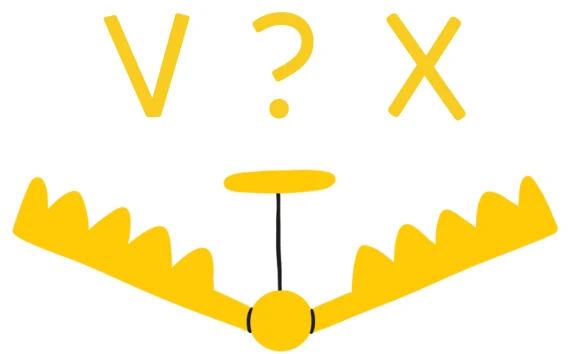
During the process of transforming facts into actions, it’s crucial to be aware of the five traps that can hinder efficient decision-making:
Filtering
This trap occurs when we selectively focus on specific facts while ignoring or disregarding others, leading to a biased view of the situation—a phenomenon known as confirmation bias.6
Interpreting
Beware of falling into this trap, where we assign subjective meanings to facts based on our personal but potentially flawed understandings and perceptions.7
Gap-filling
Be cautious not to fill in missing facts with assumptions or unverified information, as it can lead to incorrect conclusions and misguided actions.8
Concluding
This trap ensnares us when our calculations or logical reasoning are flawed, resulting in erroneous decisions and ineffective outcomes.9
Evaluating
This trap ensnares us when our calculations or logical reasoning are flawed, resulting in erroneous decisions and ineffective outcomes.9
How to Utilize the Five Hats for Efficient Decision-Making?
The concept behind the Five Hats is to ensure continuous monitoring of the five traps throughout the decision-making process. Without such structured approaches, group decisions can suffer from common pitfalls like groupthink, overconfidence, and polarization, which reduce decision quality.11 Here’s how it works:
Step 1: Distribute the hats.

Before starting the decision-making process, allocate the hats (filtering, interpreting, gap-filling, concluding, and evaluating) among the participants. Ensure that all traps are accounted for. If the group is small, individuals may wear multiple hats, while in larger groups, some hats may be shared.
Step 2: Raise your hat when trapped.

As soon as you recognize that you have fallen into a trap associated with your assigned hat, indicate it without disrupting the ongoing conversation. Wait for an appropriate moment to voice your concerns.
Step 3: Identify and discuss the trap.
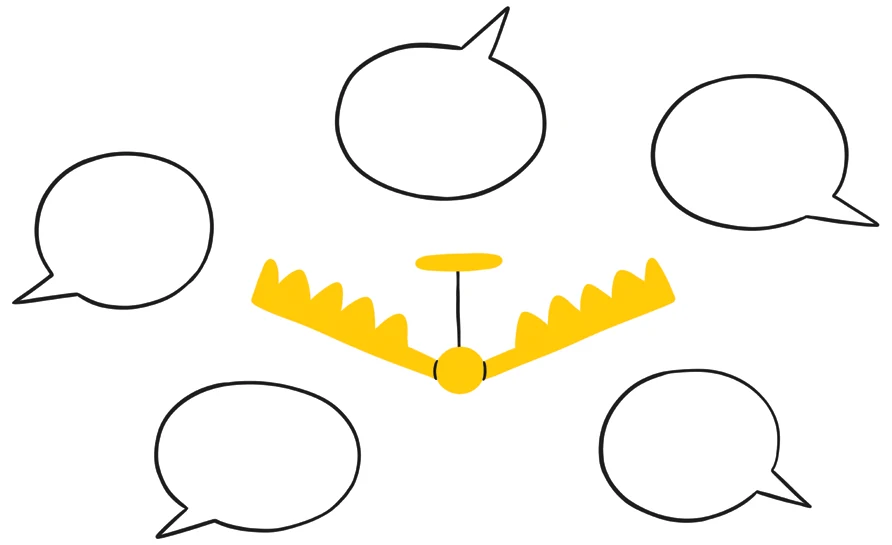
Engage in a discussion to address the identified trap and work towards neutralizing it. If consensus cannot be reached, and the decision proceeds with the acknowledged risk, document its presence.
Steps 2 and 3 are iterated throughout the decision-making process, ensuring continuous awareness and risk assessment. Failure to discuss and neutralize traps can result in poor collective decision-making, where teams prioritize consensus over critical thinking.12
Step 4: Final evaluation of the decision.
Revisit the risks noted during the process. Consider the overall impact on the decision’s integrity and determine the threshold for accepting it as the right choice.
References
- E. L. Deci and R. M. Ryan, Intrinsic Motivation and Self-Determination in Human Behavior (Springer, 1985).
- A. Edmondson, “Psychological Safety and Learning Behavior in Work Teams,” Administrative Science Quarterly 44, no. 2 (1999): 350–83.
- C. Heath and D. Heath, Decisive: How to Make Better Choices in Life and Work (Crown Business, 2013).
- C. Argyris, Overcoming Organizational Defenses: Facilitating Organizational Learning (Allyn and Bacon, 1990).
- E. de Bono, Six Thinking Hats (Little, Brown and Company, 1999).
- R. S. Nickerson, “Confirmation Bias: A Ubiquitous Phenomenon in Many Guises,” Review of General Psychology 2, no. 2 (1998): 175–220.
- D. Kahneman, Thinking, Fast and Slow (Farrar, Straus and Giroux, 2011).
- T. Gilovich, How We Know What Isn’t So: The Fallibility of Human Reason in Everyday Life (Free Press, 1991).
- M. H. Bazerman and D. A. Moore, Judgment in Managerial Decision Making (Wiley, 2013).
- P. E. Tetlock, Expert Political Judgment: How Good Is It? How Can We Know? (Princeton University Press, 2005).
- C. R. Sunstein and R. Hastie, Wiser: Getting Beyond Groupthink to Make Groups Smarter (Harvard Business Review Press, 2015).
- I. L. Janis, Groupthink: Psychological Studies of Policy Decisions and Fiascoes (Houghton Mifflin, 1982).
From Never Stop Experimenting by Stavros Stavru, PhD, illustrated by Iva Grueva. Published here in full on .
How to cite this technique
Stavru, S. (2025). The Five Decision Hats. In Never Stop Experimenting: 31 Real-World Experiments for Continuous Growth in Work and Life. Morgan James Publishing. https://neverstopexperimenting.com/techniques/five-decision-hats
Related techniques
08 · Leadership & teams
The Team Strategy Matrix
Uncover the best way to manage your team.
09 · Leadership & teams
The Manager’s Dilemma
When given the choice, do you favor individual superstars or a cohesive super team?
10 · Leadership & teams
The Care Meter
Gauge your adequacy in providing care for others.

11 · Leadership & teams
The Fitness Radar
Assess whether the person you care for is in the right place.

12 · Leadership & teams
The Functional Domino
Determine the best-suited role for each person in your organization.
13 · Leadership & teams
The Conflicts Strainer
Identify and prioritize conflicts that truly require attention.
One new experiment, now and then
New techniques, real-world results and behind-the-scenes stories from Stavros. No spam; unsubscribe anytime.