Technique 18 of 31
The Resistance Dragons
Recognize pivotal battles for impactful change.
- Change Management
- Transformation
- Resistance
In short
The Resistance Dragons separate two kinds of resistance to change. The Red Dragon is general aversion to any change, with seven heads such as change fatigue and disengagement; the Yellow Dragon opposes one specific change, with seven heads such as anticipated losses. Defeat the Red Dragon first, then cut off at least five heads of each.
For: Leaders and change agents driving a transformation
The Problem
In today’s fast-changing world, embracing change is essential,1 yet resistance often derails transformation.2 I identified two key forces: general aversion to change (the Red Dragon) and pushback against a specific change (the Yellow Dragon). Ignoring either can stall progress.
The Experiment
Through hands-on work with organizations undergoing transformation, I refined a framework to navigate resistance effectively. Instead of fighting it, this approach uncovers the fears and motivations behind each “dragon.”3 By distinguishing between broad and specific resistance, leaders can craft strategies that inspire, engage, and drive real change.4 of resistance from both the forces that resist any change and those that oppose the specific change at hand. Only then can the winds of transformation prevail!
How Mighty Is the Red Dragon?
Embarking on any journey of change requires first confronting the mighty Red Dragon, the guardian of the status quo.
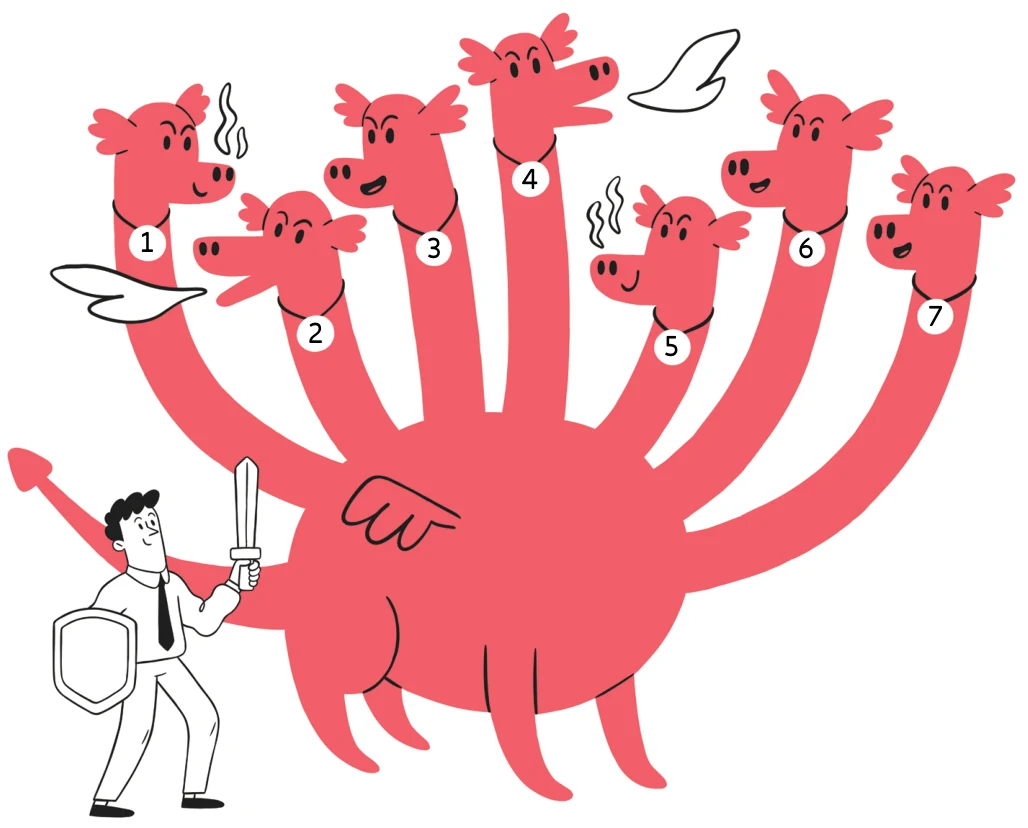
This persistent entity firmly opposes any form of transformation, regardless of its necessity, potential benefits, or problem-solving capabilities.5
The Red Dragon sees change as an evil force that must be destroyed at any cost. When this dragon becomes strong, the chances of change grow very slim, like a seed trying to grow in empty soil in a hostile environment.
To overcome the Red Dragon’s grip, one must face and conquer its seven heads:
1. Strong Contentment with the Present State6
Elevate individuals’ awareness of the drawbacks and limitations of the existing status quo, cultivating a greater sense of dissatisfaction or unveiling new needs and possibilities.
2. Lack of Diversity7
A homogeneous team or organization may hinder receptiveness to change, isolating itself from external stimuli and alternative perspectives. Embracing diversity by welcoming individuals from varied backgrounds and experiences encourages an environment open to change.
3. Endurance of the Status Quo8
The longer individuals remain entrenched in a particular state, the more resistant they become to detachment. Injecting fresh perspectives and rejuvenating the team with new talent can help break the chains of inertia.
4. Low Energy Levels (Change Fatigue)9
Chronic fatigue, burnout, and overall diminished energy impede receptivity to change. Cultivating a healthy work rhythm, fostering resilience, and boosting energy levels are vital in fostering a positive attitude toward change.
5. Negative Past Experiences with Change10
Previous encounters with unsuccessful changes can breed skepticism and resistance. By addressing the underlying reasons for past failures and showcasing the differences in the current approach, a foundation of trust can be rebuilt.
6. Organizational/Team Insecurity11
Lack of trust, strained relationships, absence of support, fear of failure, rejection, and disapproval stand as formidable obstacles. A supportive and nurturing environment that fosters trust and offers a safety net for growth is essential in battling this head of the Red Dragon.
7. Disengagement12
Indifference toward the organization’s goals and affairs sustains the status quo. Engaging individuals by fostering a sense of purpose, providing clear direction, and creating opportunities for contribution is paramount in paving the way for change.
My own experience has shown that severing at least five of the Red Dragon’s heads is imperative for change to take hold. Failing to do so has led to the eventual restoration of the status quo, even if change is initially implemented.
How to Defeat the Yellow Dragon?
One crucial lesson for leaders is to refrain from engaging in battle with the Yellow Dragon until the Red Dragon has been defeated. This is because the Red Dragon has the ability to revive the Yellow Dragon, rendering any victory over it temporary. It is thus advisable to begin the battle against the Yellow Dragon only when individuals exhibit positive or, at the very least, neutral attitudes toward change.
The Yellow Dragon represents resistance specific to a particular change initiative and manifests through seven mighty heads:
1. Lack of Understanding of the Change13
Insufficient information about the change, its purpose, implementation details, and expected outcomes strengthens the Yellow Dragon. Enhance the effectiveness of communication regarding the change to foster comprehension.
2. Significant Investment Required14
The greater the energy, time, effort, and resources demanded by a change, the more undesirable it becomes. Optimize the efforts required for change implementation to alleviate resistance.
3. Insufficient Knowledge, Skills, and Competence15
The fear of inadequacy and an inability to cope with the demands of change breed resistance. Foster the acquisition of necessary knowledge, skills, and competence while instilling a sense of control.
4. Exclusion from Decision-Making16
Resistance arises when individuals are excluded from decision-making processes and face imposed changes. Strive to involve people in the decision-making process, even if it is through consultation.
5. Unattractive Outcomes17
The change’s lack of perceived importance or relevance dampens enthusiasm. Ensure that the change addresses current challenges, alleviates real pain points, or fulfills specific needs of those affected.
6. Anticipated Losses18
Resistance may stem from apprehension regarding the loss of valued assets, such as power, achievements, or connections. Mitigate these losses or provide proportional compensation to alleviate resistance.
7. Perceived Impracticality19
Doubts about the feasibility and anticipated results of a change generate negative inclinations. Demonstrate the change’s practicality and viability to instill confidence and reduce resistance.
Experience has shown that cutting off at least five heads of the Yellow Dragon is imperative for success in implementing a specific change. Failure to do so not only hampers obtaining support but may also result in conscious or unconscious acts of sabotage.
References
- S. K. Piderit, “Rethinking Resistance and Recognizing Ambivalence: A Multidimensional View of Attitudes Toward an Organizational Change,” Academy of Management Review 25, no. 4 (2000): 783–94.
- S. Oreg, M. Vakola, and A. Armenakis, “Change Recipients’ Reactions to Organizational Change: A 60-Year Review of Quantitative Studies,” Journal of Applied Psychology 96, no. 2 (2011): 362–94.
- D. A. Coghlan, “A Person-centered Approach to Dealing with Resistance to Change,” Leadership & Organization Development Journal 14, no. 4 (1993): 10-14.
- J. D. Ford, L. W. Ford, and A. D’Amelio, “Resistance to Change: The Rest of the Story,” Academy of Management Review 33, no. 2 (2008): 362–77.
- W. Samuelson and R. Zeckhauser, “Status Quo Bias in Decision Making,” Journal of Risk and Uncertainty 1, no. 1 (1988): 7–59.
- B. Burnes, “Understanding Resistance to Change—Building on Coch and French,” Journal of Change Management 15, no. 2 (2015): 92–116.
- S. E. Page, The Diversity Bonus: How Great Teams Pay Off in the Knowledge Economy (Princeton University Press, 2017).
- K. Lewin, “Frontiers in Group Dynamics: Concept, Method and Reality in Social Science; Social Equilibria and Social Change,” Human Relations 1, no. 1 (1947): 5–41.
- J. B. Bernerth, “The Role of Change Fatigue in Organizational Change Efforts,” Journal of Organizational Change Management 24, no. 1 (2011): 20–32.
- A. E. Rafferty and S. L. D. Restubog, “Why Do Employees’ Perceptions of Their Organization’s Change History Matter?” Journal of Change Management 17, no. 4 (2017): 303–22.
- A. Edmondson, “Psychological Safety and Learning Behavior in Work Teams,” Administrative Science Quarterly 44, no. 2 (1999): 350–83.
- W. A. Kahn, “Psychological Conditions of Personal Engagement and Disengagement at Work,” Academy of Management Journal 33, no. 4 (1990): 692–724.
- L. K. Lewis, “Employee Perspectives on Implementation Communication as Predictors of Perceptions of Success and Resistance,” Western Journal of Communication 70, no. 1 (2006): 23–46.
- S. Oreg, “Resistance to Change: Developing an Individual Differences Measure,” Journal of Applied Psychology 88, no. 4 (2003): 680–93.
- N. T. Feather, “Values, Valences, and Choice: The Influence of Values on the Perceived Attractiveness and Choice of Alternatives,” Journal of Personality and Social Psychology 68, no. 6 (1995): 1135-51.
- R. Lines, “Influence of Participation in Strategic Change: Resistance, Organizational Commitment and Change Goal Achievement,” Journal of Change Management 4, no. 3 (2004): 193–215.
- A. E. Rafferty, N. L. Jimmieson, and A. A. Armenakis, “Change Readiness: A Multilevel Review,” Journal of Management 39, no. 1 (2013): 110–35.
- E. B. Dent and S. G. Goldberg, “Challenging ‘Resistance to Change’,” The Journal of Applied Behavioral Science 35, no. 1 (1999): 25–41.
- B. J. Weiner, “A Theory of Organizational Readiness for Change,” Implementation Science 4, no. 1 (2009): 67.
From Never Stop Experimenting by Stavros Stavru, PhD, illustrated by Iva Grueva. Published here in full on .
How to cite this technique
Stavru, S. (2025). The Resistance Dragons. In Never Stop Experimenting: 31 Real-World Experiments for Continuous Growth in Work and Life. Morgan James Publishing. https://neverstopexperimenting.com/techniques/resistance-dragons
Related techniques
08 · Leadership & teams
The Team Strategy Matrix
Uncover the best way to manage your team.
09 · Leadership & teams
The Manager’s Dilemma
When given the choice, do you favor individual superstars or a cohesive super team?
10 · Leadership & teams
The Care Meter
Gauge your adequacy in providing care for others.

11 · Leadership & teams
The Fitness Radar
Assess whether the person you care for is in the right place.

12 · Leadership & teams
The Functional Domino
Determine the best-suited role for each person in your organization.
13 · Leadership & teams
The Conflicts Strainer
Identify and prioritize conflicts that truly require attention.
One new experiment, now and then
New techniques, real-world results and behind-the-scenes stories from Stavros. No spam; unsubscribe anytime.