Technique 28 of 31
The Engagement Pentagram
Foster a deep emotional connection between individuals and their team and organization.
- Emotional Connection
- Motivation
- Organizational Attachment
In short
The Engagement Pentagram tracks how emotionally connected people feel to their team and organization. Team members rate the five factors of the 5R Engagement Model (Relevance, Reputation, Results, Role and Recognition) from 1 to 10; the averages are summed into a total and drawn as a five-pointed star whose rays show where to act.
For: Team leads, managers and organizational consultants
The Problem
A question I often hear as an organizational trainer and consultant is: How do we build a real emotional connection within teams? Engagement isn’t just about getting work done—it’s about feeling invested, excited, and purposeful.1
The Experiment
Through research and collaboration with teams, I identified five key factors shaping emotional connection—leading to the 5R Engagement Model. To make this practical, I developed the Engagement Pentagram, a simple tool for assessing and tracking emotional attachment. By applying it, teams strengthened engagement and built cultures where people felt truly connected to their work.
What Influences Engagement?
Drawing from my experience as an organizational trainer and consultant, I have identified five key factors that significantly contribute to individuals’ emotional connection to their workplace, which I named the 5R Engagement Model:
Relevance

The question at the core of this factor is, “To what extent do I perceive meaning in my team’s mission and goals?” The answer reveals the alignment between personal values, beliefs, objectives, interests, and the team’s purpose.2
Reputation

Here, the question is, “How positively are we perceived by others in relation to our identity and accomplishments?” It encompasses the assessment of colleagues, clients, management, friends, family, and society as a whole.3
Results

This factor revolves around the question, “To what extent are we making progress towards our defined mission and goals?” It encompasses current achievements, the pace of advancement, proximity to the desired outcome, and feedback received from stakeholders.4
Role

The question posed is, “To what extent do I believe that my contributions significantly impact the team’s success?” It examines the sense of personal agency and the difference one’s presence and involvement make in achieving collective objectives.5
Recognition

This factor delves into the question, “To what extent do I feel that the recognition I receive corresponds to the value of my contributions?” It encompasses various forms of acknowledgment, such as compensation, benefits, rewards, and appreciation for one’s efforts.6
To enhance engagement among individuals, it is beneficial to address these five areas in a systematic manner. Typically, I begin by helping individuals understand their team’s mission and goals and establish personal connections to them.7 Next, I prioritize fostering a positive team image and building a strong reputation within the individual’s immediate environment, including providing additional support to their family and communities. Subsequently, I focus on transparency regarding progress, feedback, and the overall perception of results.8 I then engage in discussions about the significance of each individual’s role in contributing to the team’s success while continuously fostering growth in this regard. Lastly, I devote significant effort to cultivating a sense of fairness within the workplace, ensuring that recognition and rewards align with individuals’ contributions.9
What Is the Engagement Pentagram?
Engagement is a dynamic aspect that evolves over time, requiring a monitoring tool to track its fluctuations and prompt intervention when necessary. Let me introduce the Engagement Pentagram, designed to serve this purpose effectively. Here’s how it works:
- Individual assessment of the five factors. Invite each team member to evaluate the five engagement factors by responding to the corresponding questions. Ratings can range from 1 (lowest) to 10 (highest) for each factor.
- Calculate the average individual assessments. Compute the average ratings for each factor across the team members to determine an overall score for each engagement factor.
- Sum the averaged ratings for the total engagement rating. Sum up the overall ratings for the five factors to obtain a comprehensive engagement rating, providing an overall indication of the team’s engagement at the present moment.
- Visualize the engagement using the Engagement Pentagram.
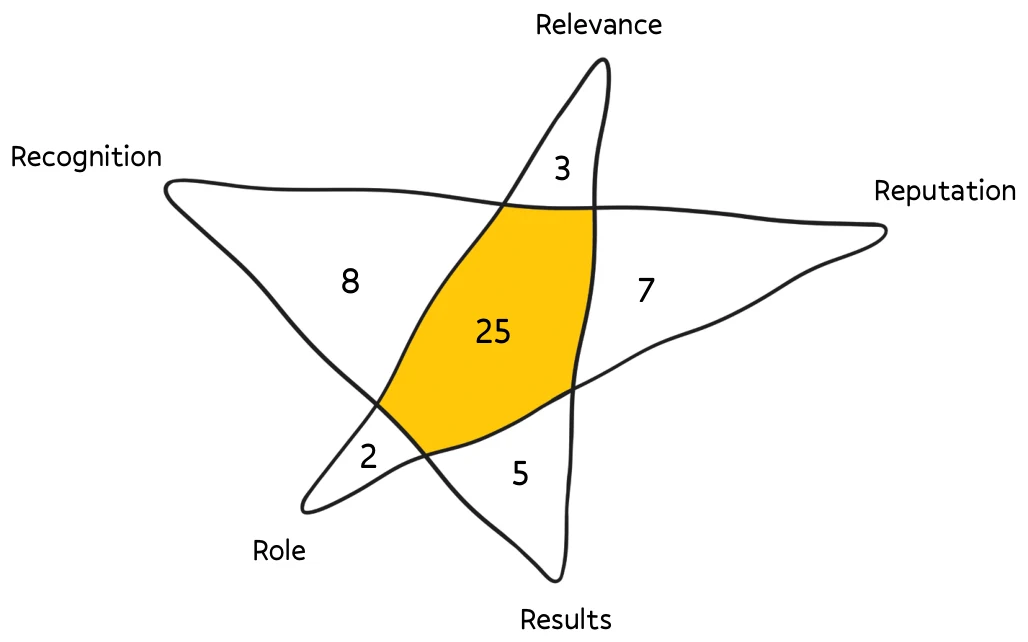
Represent the Engagement Pentagram graphically, with the central point denoting the overall engagement rating (sum of the five factors’ ratings). The rays extending from the center correspond to the individual factors, and their length signifies the level of engagement for each factor. For instance, a short ray indicates a low rating, while a longer one represents a higher rating. Analyzing the example provided, we observe that the “Role” factor receives the lowest rating (2), resulting in the shortest ray, while the “Contribution” factor achieves the highest rating (8). The objective is to lengthen all the rays of the pentagram, signifying overall improvement in engagement over time.
The Engagement Pentagram can be utilized not only at the team or organizational level but also to visualize and manage individual engagement for specific team members.
References
- W. A. Kahn, “Psychological Conditions of Personal Engagement and Disengagement at Work,” Academy of Management Journal 33, no. 4 (1990), 692–724.
- A. Wrzesniewski, and J. E. Dutton, “Crafting a Job: Revisioning Employees as Active Crafters of Their Work,” Academy of Management Review 26, no. 2 (2001), 179–201.
- J. E. Dutton, J. M. Dukerich, and C. V. Harquail, “Organizational Images and Member Identification,” Administrative Science Quarterly 39, no. 2 (1994), 239–63.
- E. A. Locke and G. P. Latham, A Theory of Goal Setting & Task Performance (Prentice Hall, 1990).
- A. M. Grant, “The Significance of Task Significance: Job Performance Effects, Relational Mechanisms, and Boundary Conditions,” Journal of Applied Psychology 93, no. 1 (2008), 108–24.
- J. S. Adams, “Inequity in Social Exchange,” Advances in Experimental Social Psychology 2 (1965), 267–99.
- M. G. Pratt and B. E. Ashforth, “Fostering Meaningfulness in Working and at Work,” in Positive Organizational Scholarship: Foundations of a New Discipline, ed. K. S. Cameron, J. E. Dutton, and R. E. Quinn (San Francisco: Berrett-Koehler, 2003), 309-327.
- T. Amabile and S. Kramer, The Progress Principle: Using Small Wins to Ignite Joy, Engagement, and Creativity at Work (Harvard Business Review Press, 2011).
- J. A. Colquitt, D. E. Conlon, M. J. Wesson, C. O. Porter, and K. Y. Ng, “Justice at the Millennium: A Meta-Analytic Review of 25 Years of Organizational Justice Research,” Journal of Applied Psychology 86, no. 3 (2001), 425–45.
From Never Stop Experimenting by Stavros Stavru, PhD, illustrated by Iva Grueva. Published here in full on .
How to cite this technique
Stavru, S. (2025). The Engagement Pentagram. In Never Stop Experimenting: 31 Real-World Experiments for Continuous Growth in Work and Life. Morgan James Publishing. https://neverstopexperimenting.com/techniques/engagement-pentagram
Related techniques

25 · Stress & well-being
The Lottery Check
Assess the contentment of the individuals you lead.

26 · Stress & well-being
The Stress Reflector
Unveil the inner workings of stress and uncover a viable, long-term coping strategy.
27 · Stress & well-being
The Ventilation Box
Help people cope with their negative emotions during change.
10 · Leadership & teams
The Care Meter
Gauge your adequacy in providing care for others.

02 · Foundation
The Growth Map
Lay the groundwork for a strong culture of experimentation.
One new experiment, now and then
New techniques, real-world results and behind-the-scenes stories from Stavros. No spam; unsubscribe anytime.