Technique 27 of 31
The Ventilation Box
Help people cope with their negative emotions during change.
- Emotional Processing
- Change Management
- Catharsis
In short
The Ventilation Box helps teams vent negative emotions about change and rework. People write on ten Ventilation Cards, rate each feeling’s intensity from 1 to 10 and drop the cards in a box; the organization donates the total to a social cause, then the box is ritually destroyed. Blitzventing compresses this into one meeting.
For: Teams going through change or rework, and their leads
The Problem
“You’ve done an excellent job, but we’ll need to redo this functionality!”—a phrase Agile teams hear often. While change is part of Agile, it can still feel discouraging.1 The real challenge isn’t the rework itself but the emotional toll—the sense that effort was wasted.2
The Experiment
To help teams process these emotions constructively, I introduced the Ventilation Box—an approach that provides space to acknowledge frustrations before they escalate. By encouraging open discussion and emotional release, teams developed a healthier mindset toward rework, improving resilience and psychological safety.3
What Do the Ventilation Cards Entail?
The Ventilation Cards serve as tools for individuals to navigate their emotions during times of change. These prompts guide people to make sense of their experiences by asking thought-provoking questions and encourage them to find solace through expressive writing. Drawing inspiration from the therapeutic benefits of expressive writing, as highlighted by James Pennebaker4 and further supported by research on emotional and physical health,5 the Ventilation Cards offer a pathway to emotional relief.
Typically, the Ventilation Cards are sized like index cards, distinguished by vibrant colors, and conveniently placed alongside the Ventilation Box—a topic we will delve into shortly. While the provided ten cards offer valuable guidance, feel free to explore and create your own personalized prompts.

The ten Ventilation Cards:
- I am angry because…
- I am furious at…
- I am disgusted by…
- I feel hostility towards…
- The thought of… scares me.
- I fear that…
- I am sad because…
- I am disappointed with…
- I am ashamed to…
- I feel uncomfortable about…
What Is Included as Part of the Ventilation Box?
Behind the Ventilation Box lies a purposeful endeavor to alleviate the feeling of loss by transforming it into a positive force. To counterbalance the notion that time and effort have been wasted, the Ventilation Box incorporates a charitable component, aligning with our commitment to corporate social responsibility.6 Upon collecting the Ventilation Cards, the organization makes a monetary donation to a nonprofit organization, an institution with noble aspirations, or a public cause. Consequently, the time perceived as lost becomes an instrument for generating a positive social impact—an empowering outcome.
-
Introduce access to Ventilation Cards and the Ventilation Box.
Each team is equipped with their own deck of Ventilation Cards and a designated Ventilation Box, conveniently positioned nearby.
-
Encourage venting through the Ventilation Cards and the Ventilation Box.
Motivate individuals to engage with the Ventilation Cards and channel their emotions into the Ventilation Box. Two crucial guidelines should be followed:
- Rule 1. The contents of the Ventilation Cards will remain private and confidential, never to be read by others. As we will explore later, the ideal practice is to ceremoniously dispose of the box and its contents, allowing for the release of negative thoughts and emotions.7
- Rule 2. Assign a numerical value from 1 to 10 to each Ventilation Card placed in the box, reflecting the intensity of the emotion experienced. The cumulative sum of these numbers will determine the organization’s donation amount toward the chosen social cause, as determined by the team.
-
Calculate the cumulative value of the Ventilation Box.
After a designated period, such as a month, retrieve the Ventilation Box and calculate the cumulative value derived from the assigned numbers. This sum guides the organization in determining the donation amount allocated to the specific social cause.8 Typically, I adopt the principle that each unit corresponds to one euro. For instance, if a person’s intensity of emotion related to a particular change experience is rated as 6, the organization’s donation will increase by €6.
-
Destroy the Ventilation Box.
Transform Steps 3 and 4 into a poignant ritual that symbolizes the liberation of accumulated negative emotions.9
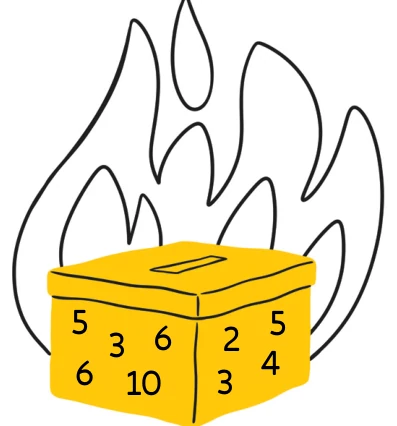
Due to practical considerations, I typically utilize a shredder to dispose of the Ventilation Cards and the Ventilation Box.
However, the more immersive the ritual, such as burning the entire box and its contents, the more liberating the experience becomes.10
-
Restart the cycle with new Ventilation Cards and a new Ventilation Box.
Begin anew by replenishing the Ventilation Cards and introducing a fresh Ventilation Box, fostering an ongoing cycle of emotional release and social impact.
What Is Blitzventing?
In times of substantial change, when emotions escalate to hurricane-like intensity, it becomes imperative to dedicate special time and space for cathartic venting.11 This is where blitzventing comes into play—a structured approach designed to provide an outlet for intense emotions. Here’s how it unfolds:
-
Arrange a meeting.
Allocate at least an hour for a dedicated gathering, solely focused on exploring and processing the emotions evoked by the change.12
-
Complete the Ventilation Cards.
Through a series of rounds, complete the Ventilation Cards. Here’s the breakdown of each round:
- Distribute copies of a specific Ventilation Card to each participant.
- Encourage swift completion of the card, emphasizing instinctive responses over extensive contemplation.13
- Once finished, participants should flip the card and indicate the intensity of the emotion they are experiencing on the back.
- Ask them to place their completed card in the center of the table, creating a stack of cards.
Repeat Steps 2(a) to 2(d) for each Ventilation Card in the set.
-
Determine the donation sum.
Aggregate the numerical values indicated on the back of each card to calculate the sum that the organization will donate towards the chosen cause.
-
Ritualistic disposal.
Employ the customary ritual employed with the Ventilation Box to dispose of all the cards, ensuring their transformation into a symbol of release.14
References
- J. Highsmith, Agile Project Management: Creating Innovative Products (Addison-Wesley Professional, 2009).
- W. Bridges, Managing Transitions: Making the Most of Change (Da Capo Lifelong Books, 2017).
- A. Edmondson, The Fearless Organization: Creating Psychological Safety in the Workplace for Learning, Innovation, and Growth (Wiley, 2018).
- J. W. Pennebaker, Opening Up: The Healing Power of Expressing Emotions (Guilford Press, 2012).
- K. A. Baikie and K. Wilhelm, “Emotional and Physical Health Benefits of Expressive Writing,” Advances in Psychiatric Treatment 11, no. 5 (2005): 338–46.
- C. W. Bauman and L. J. Skitka, “Corporate Social Responsibility as a Source of Employee Satisfaction,” Journal of Business Ethics 110, no. 1 (2012): 1–10.
- D. R. Holtom, T. C. Mitchell, T. W. Lee, and M. B. Eberly, "Turnover and Retention Research: A Glance at the Past, a Closer Review of the Present, and a Venture into the Future," Academy of Management Annals 2, no. 1 (2008): 231–74.
- N. M. Hobson, J. Schroeder, J. L. Risen, D. Xygalatas, and M. Inzlicht, “The Psychology of Rituals: An Integrative Review and Process-Based Framework,” Personality and Social Psychology Review 22, no. 4 (2018): 260–84.
- V. Turner, The Ritual Process: Structure and Anti-Structure (Aldine Transaction, 1969).
- R. F. Baumeister, K. D. Vohs, and D. C. Funder, "Psychology as the Science of Self-Reports and Finger Movements: Whatever Happened to Actual Behavior?" Perspectives on Psychological Science 2, no. 4 (2007): 396–403.
- E. Kübler-Ross, On Grief and Grieving: Finding the Meaning of Grief Through the Five Stages of Loss (Simon & Schuster, 2005).
- J. M. Smyth and J. W. Pennebaker, “Exploring the Boundary Conditions of Expressive Writing,” Journal of Clinical Psychology 64, no. 2 (2008): 263–84.
- J. J. Gross and R. A. Thompson, “Emotion Regulation: Conceptual Foundations,” in Handbook of Emotion Regulation, 2nd ed., ed. J. J. Gross (Guilford Press, 2014), 3–20.
- K. A. Roberts and J. Yamashita, “The Power of Ritual in Organizational Change,” Journal of Change Management 12, no. 4 (2012): 495–510.
From Never Stop Experimenting by Stavros Stavru, PhD, illustrated by Iva Grueva. Published here in full on .
How to cite this technique
Stavru, S. (2025). The Ventilation Box. In Never Stop Experimenting: 31 Real-World Experiments for Continuous Growth in Work and Life. Morgan James Publishing. https://neverstopexperimenting.com/techniques/ventilation-box
Related techniques

25 · Stress & well-being
The Lottery Check
Assess the contentment of the individuals you lead.

26 · Stress & well-being
The Stress Reflector
Unveil the inner workings of stress and uncover a viable, long-term coping strategy.

28 · Stress & well-being
The Engagement Pentagram
Foster a deep emotional connection between individuals and their team and organization.
18 · Leadership & teams
The Resistance Dragons
Recognize pivotal battles for impactful change.
13 · Leadership & teams
The Conflicts Strainer
Identify and prioritize conflicts that truly require attention.
One new experiment, now and then
New techniques, real-world results and behind-the-scenes stories from Stavros. No spam; unsubscribe anytime.