Technique 4 of 31
The Cat Matrix
Master your personal efficiency.
- Focus
- Goal Achievement
- Productivity
In short
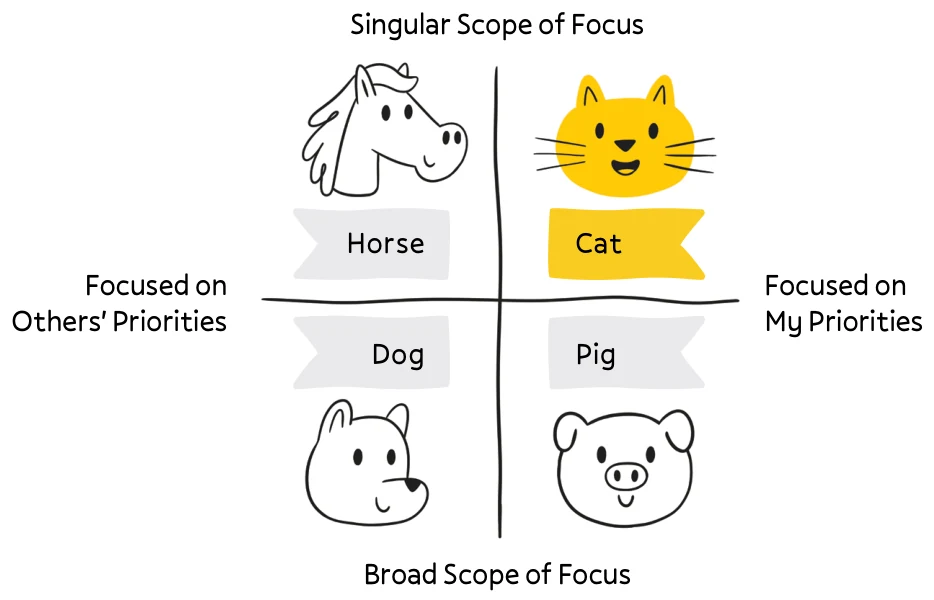
The Cat Matrix maps your focus on two axes, your own priorities versus others’ and a single goal versus a broad scope, giving four animals (Dog, Horse, Pig and Cat). Track how much of your day you spend as each; the share spent as a Cat, focused on one goal of your own, is your Cat Index.
For: Individuals who want to protect time for their own goals
The Problem
Long-term goals often get sidelined by urgent demands—problems to fix, conflicts to resolve, and tasks that seem to rely solely on us.1 With no perfect moment in sight, our ambitions stall, leaving us feeling stuck.
The Experiment
By working with individuals on productivity and prioritization, I developed the Cat Matrix, a simple yet powerful tool that reveals focus patterns.2 It helps people recognize where they are investing their energy and make more intentional choices. Alongside it, we introduced the Cat Index—a way to track time spent in the focused, goal-driven state of a “cat.” Together, these tools provide a structured method to identify distractions, improve decision-making, and sustain productivity.3
Which Animal Represents Your Personal Efficiency?
The Cat Matrix revolves around two fundamental dimensions:
- The horizontal axis captures the dichotomy between dedicating your efforts to your personal goals and tending to the objectives of others, be it your manager, colleagues, or team.4
- The vertical axis signifies the breadth of your focus, spanning from a singular specific goal to a more expansive scope involving two or three concurrent objectives.5
By assessing your position on the matrix using these two dimensions, you can uncover the animal that best represents your current disposition:
Now I’m a Horse. Yesterday I Was a Pig. What’s Happening?
Don’t worry; it is entirely natural to transition between different animals multiple times throughout the day.6 Keep track of which animal from the matrix you most frequently embody and for extended periods. This practice will grant you valuable insights into your personal efficiency concerning your individual goals.
Outlined below is an example of my own day, illustrating my prevailing distribution (rest assured, I, too, have work to accomplish). The key lies in constantly questioning oneself:
| Dog | Horse | Pig | Cat |
|---|---|---|---|
| 12% | 33% | 10% | 45% |
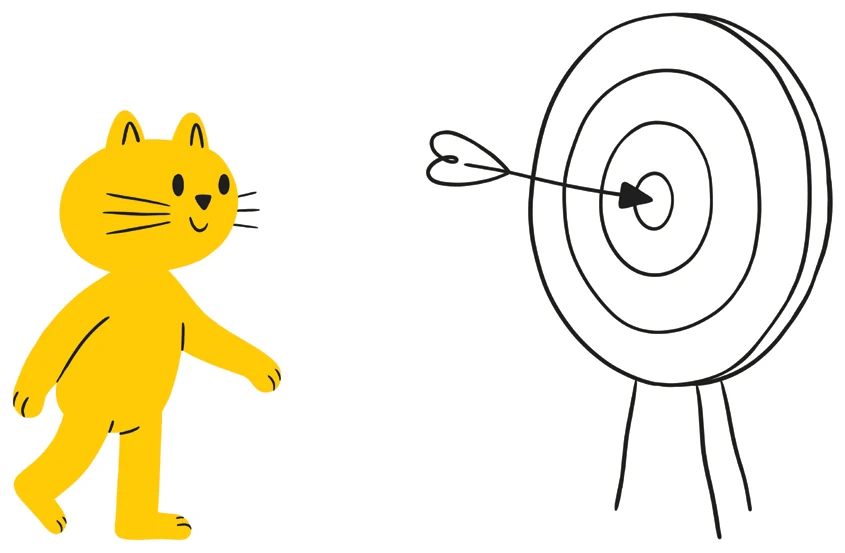
Our ultimate aspiration is to embody the essence of a cat for the majority of our journey.7 This signifies wholeheartedly dedicating our focus and actions toward a singular, specific goal that resonates with our personal aspirations.8
What Is Your Cat Index?
I employ the Cat Index as a tangible measure of my personal efficiency, reflecting the duration I embody the focused and goal-oriented qualities of a cat.9 In the aforementioned example, the index reaches a value of 45. By adopting this accessible metric, I can effortlessly monitor progress, discern emerging trends, and implement necessary adjustments to optimize my personal efficiency.
Allow me to share an illustrative depiction showcasing the dynamics of my index from a few years ago:
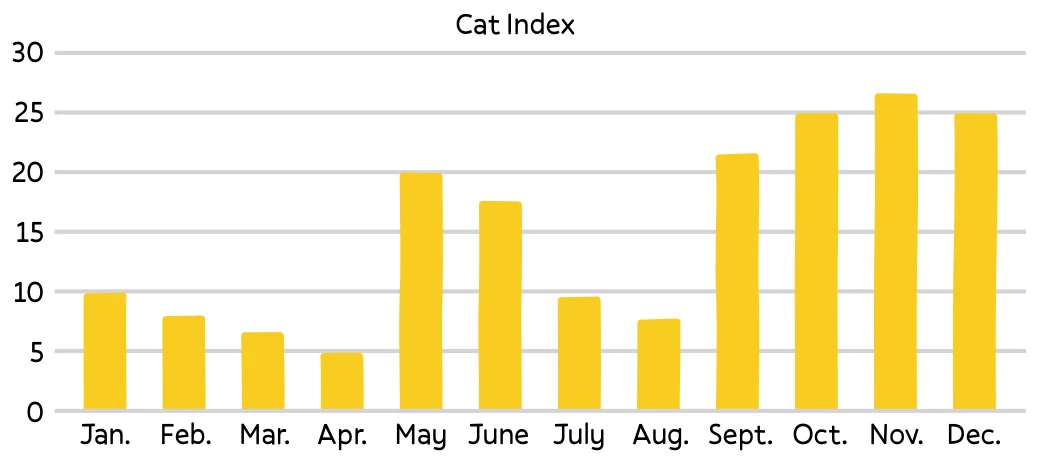
The graph above encapsulates a pivotal year when I embarked on a resolute personal challenge, wholeheartedly embracing the matrix and dedicating myself to amplifying my personal efficiency.10 As you can observe, the journey was punctuated by numerous peaks and troughs, underscoring the undeniable truth that it was far from a straightforward endeavor.
Yet, challenges were anticipated, as they often accompany transformative growth. Determination and perseverance were indispensable companions on this path, reminding me that the pursuit of personal efficiency requires sincere commitment and tenacity.
References
- S. R. Covey, A. R. Merrill, and R. R. Merrill, First Things First: To Live, to Love, to Learn, to Leave a Legacy (Simon & Schuster, 1994).
- J. Clear, Atomic Habits: An Easy & Proven Way to Build Good Habits & Break Bad Ones (Avery, 2018).
- D. Ariely, Predictably Irrational (HarperCollins, 2010).
- P. M. Gollwitzer, “Implementation Intentions: Strong Effects of Simple Plans,” American Psychologist 54, no. 7 (1999): 493–503.
- J. S. Rubinstein, D. E. Meyer, and J. E. Evans, “Executive Control of Cognitive Processes in Task Switching,” Journal of Experimental Psychology: Human Perception and Performance 27, no. 4 (2001): 763–97.
- A. Gazzaley, and L. D. Rosen, The Distracted Mind: Ancient Brains in a High-Tech World (MIT Press, 2016).
- C. Newport, Deep Work: Rules for Focused Success in a Distracted World (Grand Central Publishing, 2016).
- M. Csikszentmihalyi, Flow: The Psychology of Optimal Experience (Harper Perennial Modern Classics, 2008).
- C. Duhigg, The Power of Habit: Why We Do What We Do in Life and Business (Random House, 2012).
- K. A. Ericsson and R. Pool, Peak: Secrets from the New Science of Expertise (Eamon Dolan/Houghton Mifflin Harcourt, 2016).
From Never Stop Experimenting by Stavros Stavru, PhD, illustrated by Iva Grueva. Published here in full on .
How to cite this technique
Stavru, S. (2025). The Cat Matrix. In Never Stop Experimenting: 31 Real-World Experiments for Continuous Growth in Work and Life. Morgan James Publishing. https://neverstopexperimenting.com/techniques/cat-matrix
Related techniques

03 · Personal growth
The Fly Technique
Take a moment to decelerate and prioritize what truly matters.
05 · Personal growth
The Bonanza Goals
Establish irresistible goals that fuel your motivation.

06 · Personal growth
The Forever Check
Evaluate the long-term viability of your current routines.

07 · Personal growth
The Self-Esteem Wheel
Gauge your positive self-perception.

12 · Leadership & teams
The Functional Domino
Determine the best-suited role for each person in your organization.
One new experiment, now and then
New techniques, real-world results and behind-the-scenes stories from Stavros. No spam; unsubscribe anytime.