Technique 6 of 31
The Forever Check
Evaluate the long-term viability of your current routines.
- Sustainability
- Well-Being
- Work Methods
In short
The Forever Check is an end-of-day question for testing whether your way of working is sustainable. What percentage of my current workday would I want to replicate in all my future workdays? Daily answers build a Forever Map, with days below 50% red, below 90% yellow and above 90% green, that shows trends over a month.
For: Individuals and agile teams watching for burnout
The Problem
Agile thrives on sustainability, yet even top teams struggle with heavy workloads, mental strain, and burnout. Without regular self-checks, they risk pushing too far, reducing long-term effectiveness.1
The Experiment
To address this, I worked with teams to introduce the Forever Check—initially a simple experiment that gradually became a daily habit. Rather than waiting for signs of burnout, this approach enables teams to proactively assess their ways of working and make adjustments before issues escalate.2 Over time, it evolved into a reliable practice for maintaining steady, healthy progress.3
Today = Tomorrow = Forever?
Inspired by the thought-provoking query posed by renowned philosopher Friedrich Nietzsche in The Gay Science,4 the concept of the Forever Check came to fruition. Paraphrasing Nietzsche’s question, I pondered: Would you embrace the opportunity to relive your life repeatedly, spanning across the existence of the world?. This question sparked something within me, compelling me to make immediate changes in my personal and professional realms. Over time, it evolved into a guiding principle for leading a fulfilling and gratifying life. Extending this criterion to my workday, the idea behind the Forever Check was born.
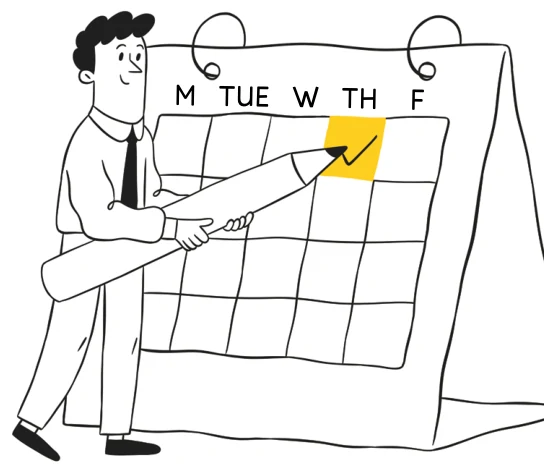
Aligned harmoniously with the notion of sustainability,5 the Forever Check encapsulates the ability to seamlessly carry forward what we do today into our future endeavors, indefinitely spanning across time. The core question of the Forever Check is:
What percentage of my current workday would I want to replicate in all my future workdays?
| Red | Yellow | Green |
|---|---|---|
| 0%, 10%, 25% | 50%, 75% | 90%, 100% |
To employ the Forever Check effectively, consider this question at the end of your workday.6,7 The percentage of your workday that you wish to repeat indefinitely serves as an indicator of its sustainability. A lower percentage signifies a need for change and improvement, while a higher percentage suggests a positive outcome. However, it is crucial to consider the essential elements required to consistently replicate those favorable aspects in your upcoming days.
Is It Acceptable to Have 75% Red Days?
Once you have accumulated data from the consistent application of the Forever Check (such as daily assessments), you can leverage this valuable information to create your very own Forever Map, reflecting a longer-term perspective (e.g., the past month).8 This comprehensive view allows for a convenient evaluation of the overall health and sustainability of your activities, extending beyond the scope of individual days and enabling the identification of notable trends.
To illustrate, let me provide you with an example of such a map. Here, days falling below 50% on the Forever Check are denoted in red, those below 90% in yellow, and those exceeding 90% in green.
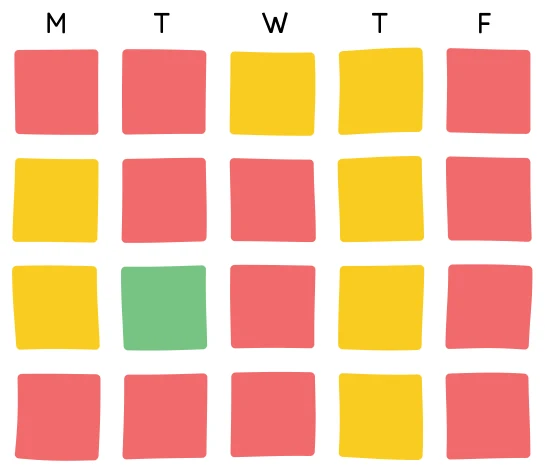
When you examine the Forever Map, consider the following: Are 75% red days acceptable? Where would you personally establish the threshold for a healthy boundary?
References
- C. Maslach and M. P. Leiter, The Burnout Challenge: Managing People’s Relationships with Their Jobs (Harvard University Press, 2022).
- J. Pfeffer, Dying for a Paycheck: How Modern Management Harms Employee Health and Company Performance—and What We Can Do About It (HarperBusiness, 2018).
- J. Porter, “Why You Should Make Time for Self-Reflection (Even If You Hate Doing It),” Harvard Business Review, March 21, 2017.
- F. Nietzsche, Die fröhliche Wissenschaft (Verlag von E. W. Fritzsch, 1887).
- P. F. Drucker, Managing Oneself (Harvard Business Review Press, 1999).
- G. Gavett, “The Power of Reflection at Work,” Harvard Business Review, May 2014.
- J. Clear, Atomic Habits: An Easy & Proven Way to Build Good Habits & Break Bad Ones (Avery, 2018).
- G. Di Stefano, F. Gino, G. P. Pisano, and B. R. Staats, “Learning by Thinking: How Reflection Can Spur Progress Along the Learning Curve,” Harvard Business School Working Paper No. 14-093 (2023).
From Never Stop Experimenting by Stavros Stavru, PhD, illustrated by Iva Grueva. Published here in full on .
How to cite this technique
Stavru, S. (2025). The Forever Check. In Never Stop Experimenting: 31 Real-World Experiments for Continuous Growth in Work and Life. Morgan James Publishing. https://neverstopexperimenting.com/techniques/forever-check
Related techniques

03 · Personal growth
The Fly Technique
Take a moment to decelerate and prioritize what truly matters.

04 · Personal growth
The Cat Matrix
Master your personal efficiency.
05 · Personal growth
The Bonanza Goals
Establish irresistible goals that fuel your motivation.

07 · Personal growth
The Self-Esteem Wheel
Gauge your positive self-perception.

26 · Stress & well-being
The Stress Reflector
Unveil the inner workings of stress and uncover a viable, long-term coping strategy.

25 · Stress & well-being
The Lottery Check
Assess the contentment of the individuals you lead.
One new experiment, now and then
New techniques, real-world results and behind-the-scenes stories from Stavros. No spam; unsubscribe anytime.