Technique 5 of 31
The Bonanza Goals
Establish irresistible goals that fuel your motivation.
- Motivation
- Goal Setting
- Personal Drive
In short
Bonanza Goals is a goal-setting framework for choosing goals you truly want. A goal qualifies if it meets seven criteria (relevance, importance, ecology, control, urgency, balance and emotion). You rate the goal 1–5, probe it vertically with chains of seven questions, repeat that probing as many times as the rating, and summarize the result.
For: Individuals and teams setting goals
The Problem
Seneca’s wisdom, “When a man does not know what harbour he is making for, no wind is the right wind,” reminds us that without a clear goal, we risk drifting aimlessly.1 The present moment is the wind that can either propel us forward with purpose or leave us stranded. The real challenge isn’t just moving but ensuring we’re heading somewhere meaningful.
The Experiment
Through iterations and feedback from teams and individuals alike, I refined Bonanza Goals—a structured goal-setting framework. By using vertical probing to uncover the deeper “why” behind goals and horizontal probing to broaden perspectives,2 we transformed goal-setting into a purposeful journey rather than a simple checklist.
What Are Bonanza Goals?
While numerous techniques3 emphasize the process of defining goals with specificity, measurability, and time-bound criteria, I believe the more critical question lies in selecting the right goal—one that ignites an unwavering desire within us and propels us forward, even in the face of adversity.
This is where Bonanza Goals come into play, embodying the very essence of the term “bonanza” as defined by the Oxford Dictionary:4 “A large amount of something that is highly desired”!
For a goal to embody the spirit of a bonanza, my experience has taught me that it must fulfill the following criteria:
Relevance
The goal should resonate with who I truly am—aligning with my values, beliefs, convictions, and worldview.5
Importance
The goal’s impact should hold profound meaning and significance in my life.6
Ecology
The pursuit of the goal should be free from negative repercussions, ensuring harmony with myself, others, nature, and the world at large so that the goal retains its intrinsic value.7
Control
I should possess sufficient agency to influence the journey toward achieving the goal, enabling me to navigate the path according to my own vision. This aligns with Bandura’s concept of self-efficacy, which emphasizes the belief in one’s ability to take control over personal outcomes and persist despite obstacles.8
Urgency
A sense of urgency should propel me to take immediate action, filling me with a sense of purpose and timeliness.9
Balance
The challenge inherent in the goal should be finely balanced, engaging me without causing boredom or overwhelming anxiety along the way.10
Emotion
The goal should evoke positive emotions, such as enthusiasm, joy, and curiosity, nurturing an unwavering motivation, rather than triggering fear, anger, or disgust. Research on positive emotions suggests that they not only enhance motivation but also broaden cognitive resources and resilience, as outlined in Fredrickson’s Broaden-and-Build Theory.11
How to Define Bonanza Goals?
Let me share with you the way I define my Bonanza goals:
Step 1
Rate the goal on a scale from 1 (lowest) to 5 (highest), considering factors such as time commitment and effort required. This rating determines the level of resources needed to achieve the goal and ensures its alignment with your aspirations.
For instance, let’s consider the goal of going on a camping trip with my son and rate it as 2.
Step 2
Engage in an in-depth exploration of the goal by answering the following questions repeatedly based on the rating from Step 1:
Why? Uncover values, beliefs, convictions, and relevance.2
For example, “Why do I want to go on a camping trip with my son?”—“Because I want to spend more time with him.” Continue the chain of questioning, delving deeper into the underlying values until reaching a terminal value, such as the close relationship between you and your son.
And what? Reflect on the potential end result or outcome of the goal and the significance it holds for you.2
For instance, “And what if we go on a camping trip?”—“We will share various experiences.” Continue the chain by asking “And what if we share various experiences?” to unveil the ultimate result, such as building trust between you and your son.
Who will be affected? Consider the potential impact and side effects of the goal, ensuring ecological harmony.7
For example, “Who will be affected by our camping trip?”—“My other two children.” Continue the chain by probing further into the affected parties, such as “If the other two children are affected, who else will be impacted?”—“My spouse.”
What is needed? Identify factors beyond your control that are necessary for the goal’s realization.8
For instance, “What is needed to go on a camping trip with my son?”—“His consent.” Continue the chain by asking “What is needed to have his consent?” to unravel influential factors within your control.
And what will happen if I do nothing? Uncover the urgency factors and potential consequences of inaction.9
For example, “What will happen if I do nothing about the camping trip?”—“I will miss the predictable autumn season.” Continue the chain to reveal further outcomes, such as how the trip may turn into an unpleasant experience.
Is there something excessive? Evaluate the goal for potential imbalances.10
For example, “Is there something excessive in the camping trip?”—“The hours of hiking.” Continue the chain by questioning, “Is there something excessive in the hours of hiking?” to identify any areas of imbalance.
And how does this make me feel? This question is a bit more specific, but very important. With it, emotions are probed11 in the context of answers to previous questions. Simply put, we go through all our answers and ask ourselves the question: “And how does this make me feel?”
In the example above: “And how does this make me feel?”: (1) “. . . to spend more time with him”—Happiness; (2) “. . . for him to feel close to me”—Satisfaction; (3) “. . . we will share various things”—Curiosity, etc.
I call Step 2 “in-depth probing” or “vertical probing” precisely because of the chain of the same questions we ask each time we give an answer.
Step 3
Repeat Step 2 as many times as the rating given in Step 1, seeking different answers to the questions asked.
I call this step “broad probing” or “horizontal probing” because of the variety it introduces.
Step 4
Summarize the insights gained from Steps 2 and 3 to define your Bonanza Goal. Periodically review these reflections to maintain motivation.12
As an illustration, I employ a technique where I form a “cloud of emotions” centered around my identified goal, which acts as a resilient anchor during challenging moments. This approach is supported by Fredrickson’s research on positive emotions, which highlights their role in strengthening psychological resilience and sustaining motivation over time.11
Allow me to exemplify this approach using my goal of going on a camping trip with my son:
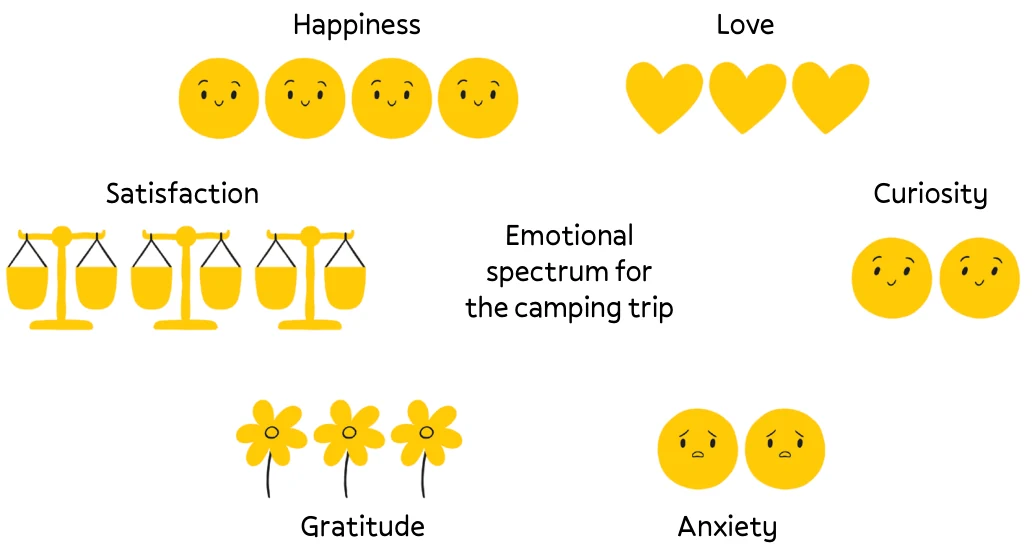
The number of emoji assigned to each emotion, ranging from one (least) to five (most), reflects the intensity of the corresponding emotion within the context of my Bonanza Goal.
References
- L. A. Seneca, Letter 71, in Ad Lucilium Epistulae Morales, Vol. 2, trans. R. M. Gummere (Harvard University Press, 1920), 75.
- T. J. Reynolds and J. Gutman, “Laddering Theory, Method, Analysis, and Interpretation,” Journal of Advertising Research 28, no. 1 (1988): 11–31.
- E. A. Locke and G. P. Latham, “Building a Practically Useful Theory of Goal Setting and Task Motivation: A 35-Year Odyssey,” American Psychologist 57, no. 9 (2002): 705–17.
- Oxford Dictionary, s.v. “bonanza,” 2023, Oxford University Press.
- K. M. Sheldon and A. J. Elliot, “Goal Striving, Need Satisfaction, and Longitudinal Well-Being: The Self-Concordance Model,” Journal of Personality and Social Psychology 76, no. 3 (1999): 482–97.
- V. E. Frankl, Man’s Search for Meaning (Beacon Press, 2006; original work published 1959).
- K. M. Sheldon and T. Kasser, “Pursuing Personal Goals: Skills Enable Progress, but Not All Goals Are Created Equal,” Personality and Social Psychology Bulletin 21, no. 5 (1995): 475–86.
- A. Bandura, Self-Efficacy: The Exercise of Control (Freeman, 1997).
- P. Steel, “The Nature of Procrastination: A Meta-Analytic and Theoretical Review,” Psychological Bulletin 133, no. 1 (2007): 65–94.
- M. Csikszentmihalyi, Flow: The Psychology of Optimal Experience (Harper & Row, 1990).
- B. L. Fredrickson, “The Role of Positive Emotions in Positive Psychology: The Broaden-and-Build Theory of Positive Emotions,” American Psychologist 56, no. 3 (2001): 218–26.
- R. M. Ryan and E. L. Deci, “Self-Determination Theory and the Facilitation of Intrinsic Motivation, Social Development, and Well-Being,” American Psychologist 55, no. 1 (2000): 68–78.
From Never Stop Experimenting by Stavros Stavru, PhD, illustrated by Iva Grueva. Published here in full on .
How to cite this technique
Stavru, S. (2025). The Bonanza Goals. In Never Stop Experimenting: 31 Real-World Experiments for Continuous Growth in Work and Life. Morgan James Publishing. https://neverstopexperimenting.com/techniques/bonanza-goals
Related techniques

03 · Personal growth
The Fly Technique
Take a moment to decelerate and prioritize what truly matters.

04 · Personal growth
The Cat Matrix
Master your personal efficiency.

06 · Personal growth
The Forever Check
Evaluate the long-term viability of your current routines.

07 · Personal growth
The Self-Esteem Wheel
Gauge your positive self-perception.

28 · Stress & well-being
The Engagement Pentagram
Foster a deep emotional connection between individuals and their team and organization.

19 · Stakeholders
The DFK Technique
Establish a clear and accurate goal for your communication.
One new experiment, now and then
New techniques, real-world results and behind-the-scenes stories from Stavros. No spam; unsubscribe anytime.