Technique 22 of 31
The Negotimeter Technique
Shed light on the vector field of your negotiations.
- Negotiation Dynamics
- Relationship Assessment
- Strategy
In short
The Negotimeter maps the three forces of attraction in a negotiation: alpha (economic interest), beta (emotions and relationships) and gamma (rational considerations). Rate twelve factors from -5 to +5, chart them as repulsion, neutral or attraction, and compare your chart with the other party’s to see whose pull is stronger and who holds the leverage.
For: Negotiators and Agile teams dealing with colleagues, clients and stakeholders
The Problem
Negotiation is integral to Agile teams, shaping interactions with colleagues, clients, and stakeholders.1 Yet, success isn’t just about logic or persuasion—it hinges on an often-overlooked factor: attraction.2 When engagement and trust are weak, even strong arguments fall flat, leading to stalled talks and poor outcomes.3
The Experiment
Together with teams navigating difficult negotiations, I introduced the Negotimeter—a tool designed to make these invisible forces visible. By mapping engagement, alignment, and friction points, it helps negotiators refine their approach and build stronger connections. Rather than relying solely on persuasion, teams learned to shape the negotiation environment itself, leading to better outcomes.
What Are Alpha, Beta, and Gamma Attraction?
During negotiations, three distinct forces of attraction come into play, each shaping our decision-making and outcomes in a unique way.
Alpha Attraction

The first force solely revolves around economic interest, which I refer to as alpha attraction.4
Beta Attraction

The second arises from emotions and feelings, which frequently influence and shape our decisions and actions.5 I refer to this as beta attraction.
Gamma Attraction

The third type of force, which I call gamma attraction, represents rational considerations that lie between the extremes of alpha and beta attractions.6 These forces take into account additional factors that influence our inclination to establish relationships with others.
Based on my experience, I have observed that we tend to concentrate on and prioritize one type of attraction (such as economic interest). As a result, we may struggle to understand why negotiations fail. Only when we consider all attraction forces and effectively navigate the entire vector field of negotiations do we gain the essential elements for success.
Alpha Attraction
This force represents our economic and practical interests, driven by four key factors:
- Benefit. What value can I gain from a successful agreement with this party?7 This includes both immediate and potential future gains.
- Costs. What resources (time, money, effort) must I invest to engage in and implement this negotiation?8 This helps determine if the potential returns justify the investment.
- Alternative Benefit. What other options are available if I don’t pursue this negotiation, and what value could they provide?9 This helps assess our negotiating position and opportunity costs.
- Alternative Costs. What would I lose by not engaging with this party?10 This includes both direct losses and missed opportunities for future value.
Beta Attraction
This force captures the emotional and relational dynamics that influence our decisions, driven by four key factors:
- Proximity and Familiarity. How comfortable and connected do I feel with this party based on our history and interactions?11 This includes both physical and psychological closeness.
- Similarity. To what extent do I perceive shared values, beliefs, and approaches with this party?12 This creates natural trust and understanding.
- Reciprocity. How much mutual positive regard exists between us?13 This includes both past experiences and expectations of future interactions.
- Presence. How appealing do I find the overall presentation and demeanor of the other party (incl. physical attraction)?14
Gamma Attraction
This force represents rational considerations beyond pure economics or emotions, encompassing four key factors:
- Alignment. How well does the proposed solution match my specific needs and objectives?15 This includes both current and anticipated future requirements.
- Uniqueness. What distinctive value does this party offer that I cannot easily find elsewhere?16 This helps assess their competitive advantage.
- Dependency. How critical is this relationship for achieving my objectives?17 This includes both immediate and long-term strategic considerations.
- Integrity. How consistently does this party demonstrate reliability and ethical behavior?18 This helps predict future relationship quality.
How Can We Visually Represent These Subtle Negotiation Dynamics?
Each attraction force is assigned a rating on a scale ranging from -5 (indicating the lowest rating) to +5 (representing the highest rating). A negative rating suggests that the specific attraction force not only fails to attract but even repels us.
For instance, if the costs involved in the negotiation are excessively high, we may feel strongly inclined to walk away, warranting a rating of -5. Conversely, a rating of +5 is assigned when the costs and efforts required are minimal.
The Negotimeter assessment is presented in the following format:
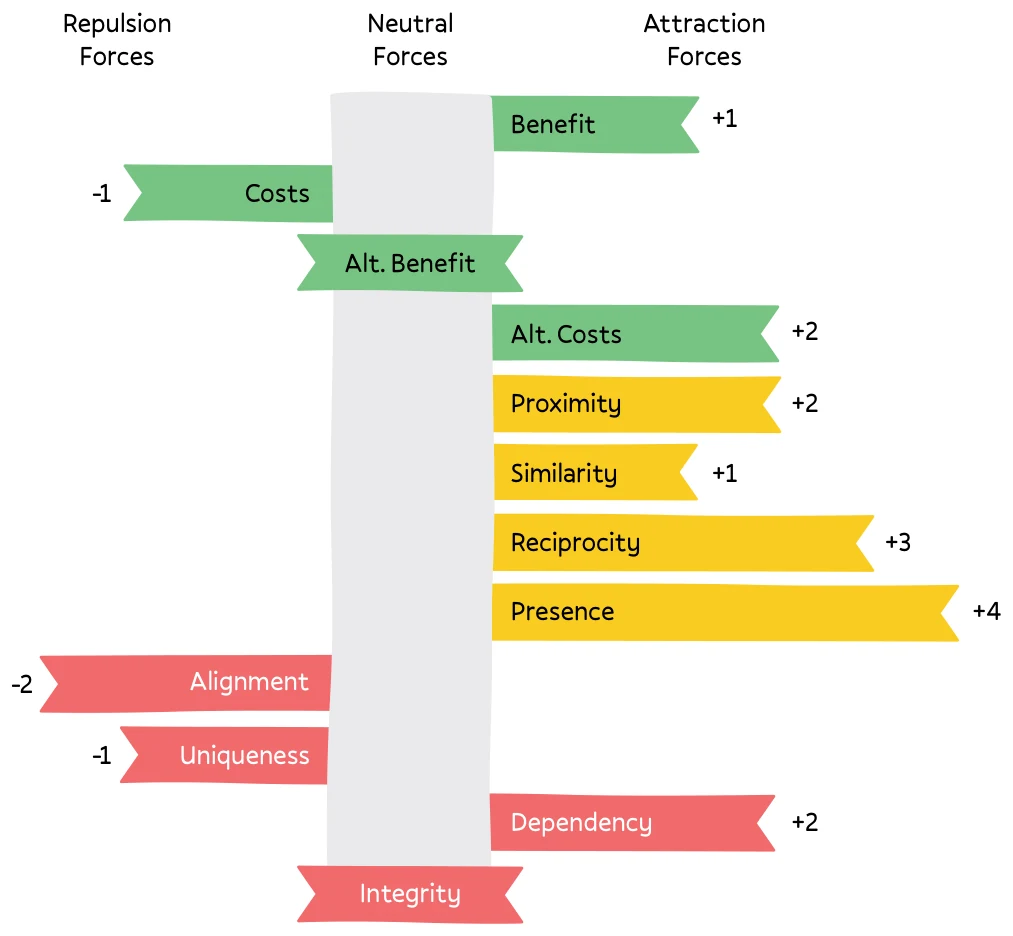
| Force | Attraction type | Rating |
|---|---|---|
| Benefit | Alpha | +1 |
| Costs | Alpha | -1 |
| Alt. Benefit | Alpha | Neutral |
| Alt. Costs | Alpha | +2 |
| Proximity | Beta | +2 |
| Similarity | Beta | +1 |
| Reciprocity | Beta | +3 |
| Presence | Beta | +4 |
| Alignment | Gamma | -2 |
| Uniqueness | Gamma | -1 |
| Dependency | Gamma | +2 |
| Integrity | Gamma | Neutral |
Analyzing an example Negotimeter reveals compelling insights. The most noteworthy observation is the prevailing influence of beta attraction, indicating a strong emotional interest primarily driven by factors such as reciprocity, presence, and proximity.
While emotional interest is not inherently detrimental, it should be recognized that it is susceptible to external influences due to its foundation in emotions.19
Additionally, from a rational standpoint, the assessment indicates suboptimal alignment with our actual needs, as the proposal does not effectively address our requirements. A similar observation can be made for alpha attraction, suggesting that the negotiation lacks economic justification.
By highlighting these attraction forces, the Negotimeter protects us from engaging in ill-suited negotiations, offering valuable guidance beyond the sway of emotions and reinforcing the importance of aligning with our genuine needs and interests
What Does the Negotimeter Reveal About Negotiation Dynamics?
Gaining insights into the attraction strength the other party feels towards us provides invaluable information to navigate negotiations more effectively. By assessing the other party’s Negotimeter, we can uncover significant clues.
For instance, if we discover that the other party exhibits a stronger attraction towards us than we do towards them, it positions us in a more advantageous and commanding position, enabling us to assert our demands with greater confidence.20
Let's consider the following example:
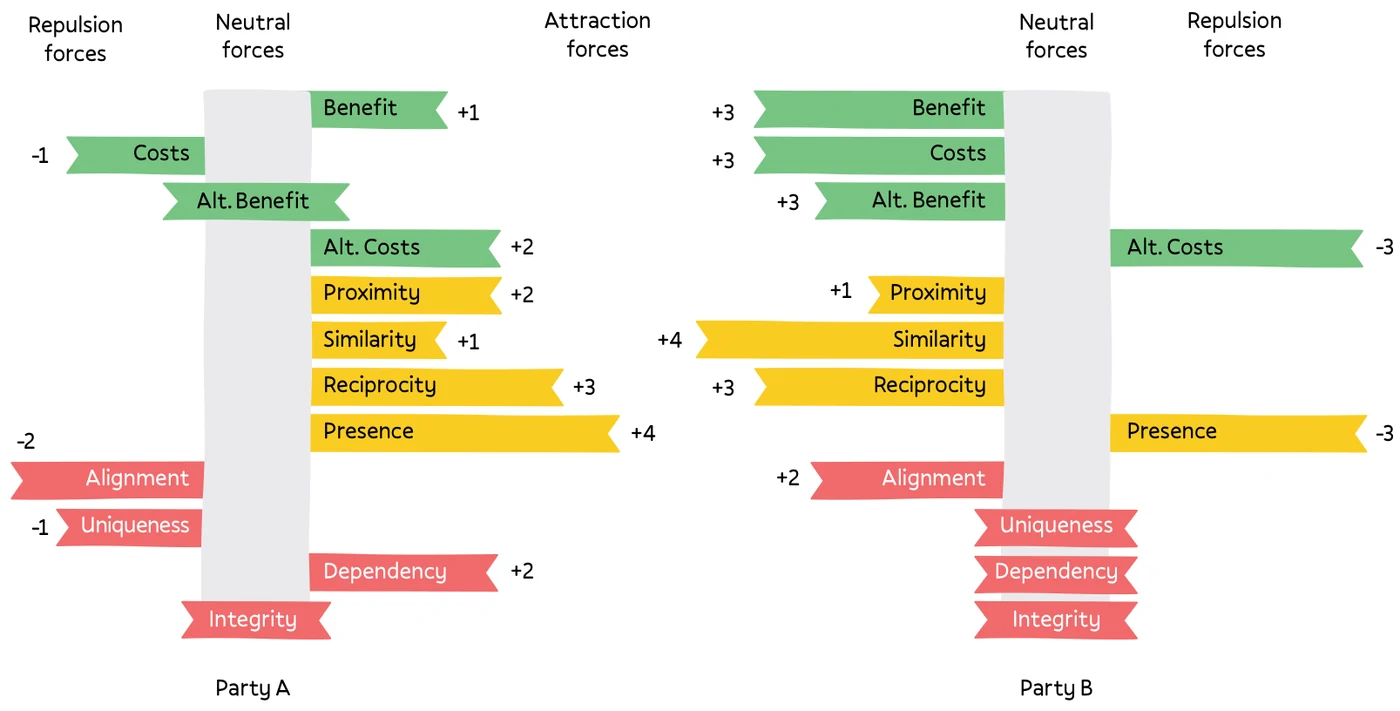
| Force | Party A | Party B |
|---|---|---|
| Benefit | +1 | +3 |
| Costs | -1 | +3 |
| Alt. Benefit | Neutral | +3 |
| Alt. Costs | +2 | -3 |
| Proximity | +2 | +1 |
| Similarity | +1 | +4 |
| Reciprocity | +3 | +3 |
| Presence | +4 | -3 |
| Alignment | -2 | +2 |
| Uniqueness | -1 | Neutral |
| Dependency | +2 | Neutral |
| Integrity | Neutral | Neutral |
- Party A has an attraction rating of 0.15 (sum of attraction forces minus repulsion forces, divided by 60), showing a slightly positive but relatively weak overall attraction. This low positive rating reflects mixed forces at play—strong positive emotional factors like presence (+4) and reciprocity (+3) balanced against negative rational factors like alignment (-2) and uniqueness (-1).
- Party B shows a higher attraction rating of 0.20, primarily driven by strong economic benefits (+5) and positive rational factors, despite some significant repulsion forces like presence (-3).
This asymmetry, where Party B has a stronger attraction than Party A, suggests Party A may have more leverage in the negotiation, despite both ratings indicating an overall viable negotiation scenario.
References
- R. J. Lewicki, B. Barry, and D. M. Saunders, Negotiation, 7th ed. (McGraw-Hill Education, 2015).
- L. L. Thompson, The Mind and Heart of the Negotiator, 6th ed. (Pearson, 2014).
- D. T. Kong, K. T. Dirks, and D. L. Ferrin, “Interpersonal Trust Within Negotiations: Meta-Analytic Evidence, Critical Contingencies, and Directions for Future Research,” Academy of Management Journal 57, no. 5 (2014): 1235–55.
- D. A. Lax and J. K. Sebenius, The Manager as Negotiator (Free Press, 1986).
- G. A. Van Kleef, C. K. De Dreu, and A. S. Manstead, “Supplication and Appeasement in Negotiation: The Interpersonal Effects of Disappointment, Worry, Guilt, and Regret,” Journal of Personality and Social Psychology 91, no. 1 (2006): 129–44.
- M. H. Bazerman and M. A. Neale, Negotiating Rationally (Simon & Schuster, 1992).
- Lax and Sebenius, The Manager as Negotiator.
- R. H. Mnookin, S. R. Peppet, and A. S. Tulumello, Beyond Winning: Negotiating to Create Value in Deals and Disputes (Harvard University Press, 2000).
- R. Fisher and W. Ury, Getting to Yes: Negotiating Agreement Without Giving In, 3rd ed. (Penguin, 2011).
- D. Malhotra and M. H. Bazerman, Negotiation Genius: How to Overcome Obstacles and Achieve Brilliant Results at the Bargaining Table and Beyond (Bantam, 2007).
- R. B. Cialdini, Influence: Science and Practice, 5th ed. (Pearson, 2009).
- D. Byrne, The Attraction Paradigm (Academic Press, 1971).
- A. W. Gouldner, “The Norm of Reciprocity: A Preliminary Statement,” American Sociological Review 25, no. 2 (1960): 161–78.
- E. Goffman, The Presentation of Self in Everyday Life (Anchor Books, 1959).
- M. A. Neale and M. H. Bazerman, “Negotiating Rationally: The Power and Impact of the Negotiator’s Frame,” Academy of Management Executive 6, no. 3 (1992): 42–51.
- R. B. Fisher and W. L. Ury, Getting to Yes: Negotiating Agreement Without Giving In, 3rd ed. (Penguin, 2011).
- R. M. Emerson, “Power-Dependence Relations,” American Sociological Review 27, no. 1 (1962): 31–41
- R. C. Mayer, J. H. Davis, and F. D. Schoorman, “An Integrative Model of Organizational Trust,” Academy of Management Review 20, no. 3 (1995): 709–34.
- G. Loewenstein and J. S. Lerner, “The Role of Affect in Decision Making,” in Handbook of Affective Sciences, ed. R. J. Davidson, K. R. Scherer, and H. H. Goldsmith (Oxford University Press, 2003), 619–42.
- H. H. Kelley and J. W. Thibaut, Interpersonal Relations: A Theory of Interdependence (Wiley, 1978).
From Never Stop Experimenting by Stavros Stavru, PhD, illustrated by Iva Grueva. Published here in full on .
How to cite this technique
Stavru, S. (2025). The Negotimeter Technique. In Never Stop Experimenting: 31 Real-World Experiments for Continuous Growth in Work and Life. Morgan James Publishing. https://neverstopexperimenting.com/techniques/negotimeter
Related techniques

19 · Stakeholders
The DFK Technique
Establish a clear and accurate goal for your communication.

20 · Stakeholders
The Stakeholder Formula
Select the optimal strategy for managing stakeholders effectively.

21 · Stakeholders
The Propositions Generator
Discover strategies for crafting irresistible proposals.
14 · Leadership & teams
The Power Circles
Master the art of effectively blending various forms of power.

13 · Leadership & teams
The Conflicts Strainer
Identify and prioritize conflicts that truly require attention.
One new experiment, now and then
New techniques, real-world results and behind-the-scenes stories from Stavros. No spam; unsubscribe anytime.